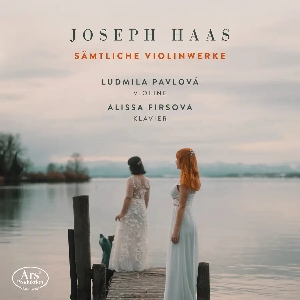
Joseph Haas (1879-1960)
Violin Sonatine in G minor, Op.4 No.1 (1905)
Violin Sonatine in D major, Op.4 No.2 (1905)
Violin Sonata in B minor, Op.21 (c.1909)
Grillen Suite 1, and II, Op.40 (1912)
Ludmila Pavlová (violin)
Alissa Firsova (piano)
rec. 2025, Kulturzentrum Immanuel, Wuppertal, Germany
Ars Produktion ARS38699 [74]
Joseph Haas was born in Maihingen in 1879 and was a student of Max Reger. In time he became a composition teacher, first in Stuttgart and then, after the First World War, in Munich. He founded an organisation for the promotion of new music alongside Paul Hindemith and Heinrich Burkard and his master class attracted some of the most exciting talents in Germany, among them Karl Amadeus Hartmann, Karl Höller, Eugen Jochum and Wolfgang Sawallich. Haas wrote in a large variety of forms but this disc focuses on the period when he composed a sequence of works for violin and piano, between 1905 and 1912.
The Sonatines were written during his years of study with Reger, who recommended them for publication. The First is crisp and notable for its geniality but also clarity – there’s nothing of what is taken to be Reger’s clotted writing. The central movement is warmly textured, with a play of stern and elfin to push necessary contrast whilst the finale is a charming catch-as-you-can affair, jocular and expert. No.2 reprises these qualities. Its opening is pert and bright with a gauzy Romantic B section, whilst the Andantino is a series of variations, a song-without-words followed by wit, sonorous warmth, brusquer variations but above all, couched in a language of approachable charm. The Rondino finale is again laced with wit and charm, two qualities that Haas seems to have possessed in abundance.
The large-scale Violin Sonata followed a few years later. Its opening is muscular and romantic-dramatic though its second theme is yielding and elegantly laced. The development and contrast are splendidly maintained throughout ten minutes. The pert capricious Scherzo is followed by an ardently romantic slow movement, made the more so by Ludmila Pavlová’s attention to Haas’ dynamics. The shade of Brahms can be glimpsed in the Sonata’s finale, one of the few places where he is an overt presence in these chamber works.
Grillen (Grasshoppers) is a perky suite is six movements dating from 1912. Haas enjoys some off-kilter rhythmic hijinks here, deploys some dapper pizzicatos in the second movement, as well as reflective lyricism in the third, which is full of rather Schumannesque internal contrast. His piano writing in Grillen confers much more independence which draws from Alissa Firsova a full quotient of characterful playing. Whether droll or quietly melancholic this suite offers traditional values clothed in warm-hearted music.
The booklet notes are fine, the recording balance has been astutely judged, and the Pavlová-Firsova duo deliver agile, characterful and rewarding readings of music that is all, apparently, appearing on disc for the first time.
Jonathan Woolf
Buying this recording via the link below generates revenue for MWI, which helps the site remain free