
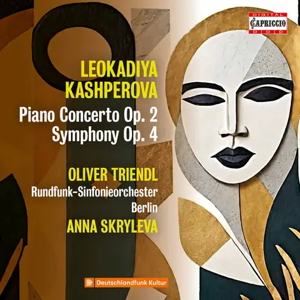
Leokadiya Kashperova (1872-1940)
Concerto for piano and orchestra in A minor Op 2*
Symphony in B minor Op 4
Rundfunk-Sinfonieorchester Berlin/Anna Skryleva
Oliver Triendl (piano)
rec. 2023* & 2024, Saal, Haus des Rundfunks, Berlin
Capriccio C5549 [72]
So many female composers of the early twentieth century have appeared in the last few years that it has become ‘mind-boggling’ to realise what talent lay hidden and overlooked for such a time. Leokadiya Kasparova’s music has not been much heard or available since her death and even in her lifetime, especially after her not very successful marriage in 1916, after which she composed little. She has, however, made it into the biography of Igor Stravinsky as he was her piano pupil – although he seems not to have recognised that she wrote music.
If you are a lover of big, fat, Romantic piano concertos, the sort which Hyperion have been promoting for many years, then this will appeal to you. Kashperova’s Concerto Op 2 dates from 1900 at the time when she was teaching Starivinsky. It is in a classical, three-movement format. The Allegro maestoso begins pompously with trombones but the virtuoso piano part, played by the composer at its first performance in Moscow in February 1901, soon breaks forth. The second theme has, what the writer of the booklet notes, Kerstin Schüssler-Bach, describes, having a ‘Russian colour’. There is an extended cadenza, but the work ends thoughtfully. This enables the Adagio middle movement to emerge gently and delicately. A broader theme emerges later in warmly luxuriant harmonies and orchestration. The finale, marked Allegro con anima, is, for me, the most memorable movement and again, the description of its character as having ‘dance-like dignity of a polonaise’ seems succinctly accurate. There are attractive syncopated melodies and a great deal of opportunity for show in the solo part. Just before the end, a lyrical, earlier idea broadens out into ‘hymn-like intensification’ before the exciting ending which, would be bound to elicit a massive round of applause in any concert hall. But sadly, I expect you may not ever have the opportunity of hearing such a work as this live, despite the fact that any lovers of Rachmaninov would recognise the work’s emotional impact.
The B minor Symphony of 1905 is a very impressive achievement and proves the composer to be at the peak of her powers. It is dedicated to Glazunov; she must have known his ballet ‘The Seasons’ (1900) and a work like the 2nd Symphony (1886) with its lush second movement. I did feel that composer’s influence especially in the melancholy oboe melody heard in the third movement Andante, which is apparently marked ‘thème russe’ As for a Russian influence otherwise, perhaps, the second movement marked Allegretto scherzando has Russian, dance-like quality and the finale has another ‘thème russe’ heard on the cor anglais. The work opens with a pastoral introduction, but the ensuing Allegro has a Tchaikovskian quality with its powerful dotted rhythms. The orchestration is typical of those composers trained in St. Petersburg at the end of the nineteenth century under the auspices of Rimsky-Korsikov. There is much doubling and a consequent richness of tone and also the use of a wide variety of instrumental tone colour. Kashperova, like many women composers had to largely write chamber works but this does seem to have given her deep understanding of idiomatic instrumental writing, especially when in solo passages.
The Berlin Orchestra take to this music with alacrity and Oliver Triendl’s credentials in this kind of late Romantic repertoire is second to none. He has 150 CDs to his name with, we read, 100 concertos under his fingers. Anna Skryleva clearly has this music in her soul and it’s difficult to imagine a more compelling combination. So, as they say in all good restaurants, (and even bad ones) enjoy!
Gary Higginson
Other review: Jim Westhead
Buying this recording via the link below generates revenue for MWI, which helps the site remain free













