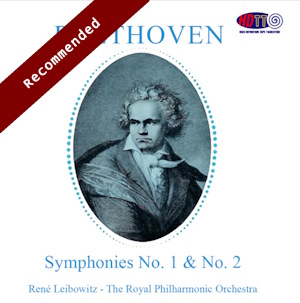
Ludwig van Beethoven (1770-1827)
Symphony No. 1 In C Major, Op. 21
Symphony No. 2 In D Major, Op. 36
Royal Philharmonic Orchestra/René Leibowitz
rec. 7 & 8 April 1961, Walthamstow Assembly Hall, London
Reviewed as download
High Definition Tape Transfers HDTT24183 [46]
I don’t know if this is heresy, but I had as soon listen to Beethoven’s first two symphonies as any of his subsequent masterpieces and performances such as this simply confirm my perverse attachment. I am simply quoting here wholesale from the HDTT website about these recordings, as I could scarcely provide a more succinct summary of their virtues and attractions, and paraphrasing would be otiose:
“René Leibowitz and the Royal Philharmonic Orchestra deliver an electrifying interpretation of Beethoven’s first two symphonies in this landmark 1961 recording. Captured at the Walthamstow Assembly Hall by engineer Kenneth Wilkinson and producer Charles Gerhardt, these performances are renowned for their remarkable transparency, expansive dynamic range, and relentless rhythmic drive. Leibowitz approaches these early masterpieces with a lean, revelatory intensity, treating them as revolutionary statements of their own rather than mere precursors to Beethoven’s later symphonies. The recording perfectly captures the brilliance of the Royal Philharmonic in a venue celebrated for its ideal acoustics. The result is a vibrant, high-fidelity experience that stands as a definitive testament to both the conductor’s vision and the exceptional craft of the original production team.“
Remastered from 4-track tape, these recordings follow standard earlier practice by omitting the exposition repeats in the first movements. Hiss is minimal and both the warmth and brilliance of the sound are remarkable for recordings 65 years old as I write.
Leibowitz’ style reminds me of that of another – also adoptive French – contemporary André Cluytens: energised, driven, supremely “alive” – just so invigorating – yet both burned out relatively young, Cluytens at 62 and Leibowitz at only 59. I agree that the “revolutionary” elements of these symphonies should be emphasised over any kinship to the Classical style. Obviously the grace and elegance of the Andante cantabile of the First Symphony is hugely indebted to Mozart but the spirit of the symphony as a whole is Romantic and the pounding, off-beat rhythms of the Menuetto could never have been written by anyone other than Beethoven. The finale is exhilarating.
The invention of the Second Symphony always used to strike me as a little retrograde compared with the daring of the First but my acquaintance years ago with Toscanini’s recording of it converted me and Leibowitz’s account here is as convincing as any. I love the sonority of the lower strings in the first movement here and when the speed picks up at 2:30 – paced daringly fast by Leibowitz – it is absolutely thrilling. The Larghetto perhaps misses a little tenderness but there is a bucolic bonhomie about the whole which is most winning – whooping horns and all… The rollicking Scherzo slips by in a flash and the finale is likewise a riot of concentrated passion – the precision of the orchestra is a marvel.
The RPO is still Beecham’s orchestra – he had died only a month before these recordings – and they are wonderfully vibrant. The only down side to these vintage accounts is the omission of repeats – but otherwise they are a joy.
Ralph Moore
Availability: High Definition Tape Transfers