
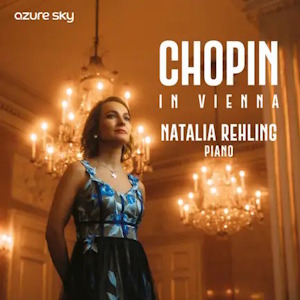
Frédéric Chopin (1810-1849)
Chopin in Vienna
Variations on “La ci darem la mano” Op.2 inc. original version of variation 4 (1827)
Scherzo No.1 in B Minor Op.20 (1831-35)
Étude in E Flat Minor Op.10 No.6 (1830)
Nocturne in F Sharp Major Op.15 No.2 (1830-33)
Four Mazurkas Op.7 (1830-32)
Ballade No.1 in G Minor Op.23 (1835-36)
Natalia Rehling (piano)
rec. 2025, Yamaha Concert Hall, Vienna
Azure Sky AZ1009 [57]
The focus of Natalia Rehling’s recital is the musical connections between Chopin and the time he spent in Vienna, early on in his career. Just after he finished at the Warsaw Conservatory he first visited Vienna, giving two concerts there in his three week stay. In one of the concerts he was the soloist in the orchestral version of the La ci darem la mano variations, a work he had written in 1827. Robert Schumann’s famous review of the work with the famous quote Hats off Gentlemen a Genius! appeared two years later but reviews of the time were similarly positive and it appears that the only obstacle to the work’s wider dissemination was its extreme difficulty; it was in Clara Schumann’s repertoire but even she said it is the hardest piece I have ever seen or played till now. This original, brilliant composition is still so little known that almost every pianist and teacher considers it incomprehensible and impossible to play. The piano world has changed since then and it is is hardly unusual nowadays to hear it, especially in its orchestral garb. The solo version is heard less often and Rehling offers a gripping and technically brilliant reading of this early showpiece. What makes this recording unusual is that the fourth variation is played in an earlier version, found in an autograph copy held by the Austrian National Library in Vienna. For those with good eye-sight (or a magnifying glass – ideally both) this variation is reproduced in the booklet with Chopin’s large X across the page. The swift and treacherous leaps of the version we are familiar with are still present but are augmented with arpeggios rushing to chords that are of necessity slower to play and not as effective. Nonetheless Rehling plays it with great panache. I have only heard this variation played once before on a old live recording by Michael Ponti though I can’t remember it well enough to compare. For those who still want to hear the usual variation Rehling has recorded it after the finale but it does not include the transition into the adagio so not perfect for those who wish to program it into the performance.
Chopin’s second and longer visit to Vienna was between November 1830 and July 1931. He had left Warsaw and was on his way to Paris but was delayed trying to get a visa. The first scherzo was one of the pieces he began to work on in his time there as were the op.10 études, both of which may have been on the backbone of hearing Niccolò Paganini play in Warsaw the previous year. Certainly the demands of both suggest such an influnce even if not in quite the dramatic way that Paganini revolutionised Liszt’s writing. Other events affected his time there; he learned of the November Uprising, feeling isolated away from his friends and family and as he travelled onward to Paris he learned that it had been put down. The revolutionary étude, not Chopin’s title and not recorded here, is perhaps the most patriotic sounding and was composed around the time of the Uprising’s failure but more lyrical outpourings give a hint of the depth of his loss, especially the central section of the scherzo that sets the Polish Christmas song Lulajże jezunui, a comforting taste of home. More mournful is the E flat minor étude that for all its melancholy ends in the major key, one of Chopin’s most magical moments.
Mazurkas are by far the most numerous of the genres that Chopin composed which probably says as much about his homesickness as anything though he began composing them before he left Warsaw. In the four op.7 mazurkas Chopin brings the rustic dance, or at least the urban version of it that he probably knew, into the concert world with sophisticated harmony and sense of rhythm and timbre – quite the achievement for a twenty year old. The booklet notes the similarity of the most familiar of all Chopin’s mazurkas, the stirring B flat, to the Polish National Anthem Mazurek Dąbrowskiego, Dabrowski’s mazurka, an important sound of the November Uprising but it is the unusual chromatic harmony of nos. 2 and 3 that have created a lasting impression. The brief but engaging final mazurka is a revision of a dance Chopin wrote five years earlier.
Chopin’s sojourn in Vienna was fruitful it seems and produced the op.9 and op.15 nocturnes from which Rehling plays the wonderful F sharp major and though the G minor Ballade wasn’t completed until 1833 there are suggestions he sketched it in Vienna. The four ballades are all influenced by the writing of Adam Mickiewicz, another emigré and one who became Chopin’s friend after he moved to Paris in 1932, the year after Chopin’s arrival. Despite this and the turbulent contrasts of mood within the relatively short span of the first ballade there is no known program to the Ballade and no particular connection to Chopin’s thoughts about the Uprising; it remains a masterpiece on its own merits without the necessity of external influences.
The booklet’s writer Beatrix Darmstädter tells us how Rehling plays each piece to make her performance special, thus by using the pedal to varying sophisticated degrees across the piece she breathes life and color into the magically floating melody resembling a mournful human voice for the étude in E flat minor. There are similar comments for the other pieces here and while they may be true I am not sure how helpful they are. Surely Rehling’s performances should speak for themselves? Well they do that just fine; this is a very attractive recital from her exciting, dramatic and virtuosic La ci darem variations to some tastefully judged rubato in the mazurkas. The last of these may be brief but Rehling judges its impish phrases and fractional pauses to perfection. The ballade too is very decent and in the context of the recital works well. Am I missing that edge of desparation in the coda, that sense of being on the edge of a precipice or that hushed magic in the return of the opening theme before this tumult? I must say yes but that is not to say that Rehling misses the mark with what is generally a fine performance bringing an interesting and enjoyable recital to a close.
Rob Challinor
Buying this recording via the link below generates revenue for MWI, which helps the site remain free












