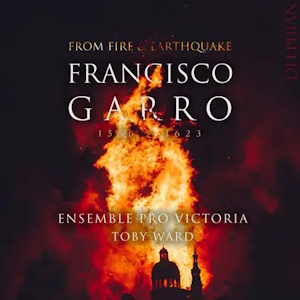
From Fire & Earthquake
Francisco Garro (c.1556-1623)
Asperges me
Missa Saeculorum (primi toni)
In principio erat verbum
Parce mihi Domine a 6
Vidi aquam
Francisco Guerrero (c. 1528-1599)
Maria Magdalena
Francisco Garro
Missa Maria Magdalena
Ensemble Pro Victoria/Toby Ward
rec. 1-3 March 2023, All Hallows, Gospel Oak, London UK
Delphian DCD34305 [71]
Would you believe it? Nothing from Francisco Garro for 400 years and then two titles turn up at once, with this recording now ready to nestle on your shelf up against a release from the Hyperion label all the way from Portugal with Cupertinos directed by Luís Toscano (review). The title From Fire & Earthquake for this release refers to the partbooks for these works, “that survived political upheavals and the disaster of the 1755 Lisbon earthquake.” Francisco Garro is an outstanding figure in the history of Portuguese music, who was born in Spain and became chapel master at the prestigious Sigüenza Cathedral before being appointed Master of the Royal Chapel in Lisbon, a position he held for three decades.
Gareth Thomas’s fine booklet notes give plenty of historical context and detail on each piece, but the figure of Spanish priest and composer Francisco Guerrero remains somewhat shadowy despite having a whole track to his name and his music being used as a source of parody material for Francisco Garro in a number of the works recorded here. This whole disc is an immersive delight, and you can let the whole thing roll over you in a slowly turning mill of gorgeous counterpoint. Every day is a school day however, and it is fascinating to learn that the entire Missa Saeculorum (primi toni) is based on just a few notes in emulation of Guerrero’s Missa Saeculorum Amen. Garro’s contrapuntal skill is demonstrated here in all kinds of inversions, embellishments, retrogrades and augmentations, all while maintaining an expressive directness that wears its complexities lightly.
Another highlight is Vidi aquam written for Eastertide, and notable for its six-voice richness. The careful and effective curation of this programme sets this in advance of Francisco Guerrero’s motet Maria Magdalena, which is in the same mode and keeps the impression of an ongoing flow. The following Missa Maria Magdalena is another parody Mass that develops Guerrero’s music, largely in a comparable six-voice setting but with additions up to an antiphonal eight-voice final Agnus Dei that ends the programme with suitable grandeur.
Cupertinos and Luís Toscano on Hyperion have an almost entirely different programme to Ensemble Pro Victoria with Toby Ward, and those interested in this fine Renaissance music can see these releases as complimentary to each other. The Hyperion sound floats in the big acoustic of the Basílica do Bom Jesus in Braga, Portugal while the Delphian sound is a little closer in perspective, the sound a touch less resonant but with voices unafraid of some expressive vibrato and enriched with the timbres of a fine instrumental ensemble. If I was to have any criticism of this recording in comparison with Ensemble Pro Victoria then it would be a general dynamic consistency that has the ear wanting just a bit more light and shade by the time we reach the end. Renaissance music doesn’t lead one to expect vast contrasts in this regard, but the Hyperion recording manages to tease our minds with its moments of quiet and spatial magic, where Pro Victoria seems to sustain a nice mezzo throughout. Those juicy string bass entries though, they will always bring you back for more.
Dominy Clements
Other review: John Quinn
Buying this recording via the link below generates revenue for MWI, which helps the site remain free