Giacomo Puccini (1858-1924)
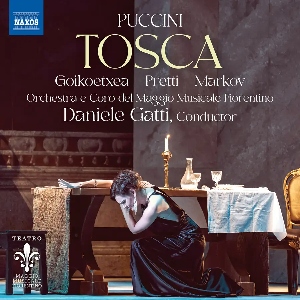
Tosca, opera in 3 Acts.
Floria Tosca: Vanessa Goikoetxea (soprano)
Mario Cavaradossi: Piero Pretti (tenor)
Baron Scarpia: Alexey Markov (baritone)
Coro e Orchestra del Maggio Musicale Fiorentino/Daniele Gatti
rec. live, June 2024, Florence
Italian only libretto available online
Reviewed as a download
Naxos 8.660607-08 [120]
This CD album is the audio track of the video version released on DVD and Blu-ray in February 2025, which was recorded live in Florence in June 2024. It comes fairly fresh on the heels of the 2025 Harding version, favourably reviewed by my colleagues (review ~ review), so one is tempted to wonder if there is really any need for another recording of this perennial favourite, particularly in view of the host of more or less recent recordings already available.
Initial impressions are very favourable, thanks to the rich, precise orchestral sound of the Florence orchestra under Daniele Gatti. The two short, contrasting scenes which open the opera with Angelotti and the Sacristan are given very different moods, and both roles are sung competently, Matteo Torcaso interpreting the role of the Sacristan with a welcome lack of exaggeration.
The role of Cavaradossi is sung by Piero Pretti, whose slightly grainy timbre lends itself to a passionate interpretation of “Recondita armonia,” his opening aria. The problem is that this part obviously needs a combination of lyric and spinto singing from the tenor. Throughout, Pretti sings nicely when not under too much pressure, phrasing the lines delicately, and introducing an appropriately lachrymose tone when needed, like in “O dolce mani…” in Act 3. But there can be signs of strain in the forte passages, where the voice sometimes becomes drier and the beat more intrusive; his “Vittoria” is quite impressive, but “E lucevan le stelle,” starts better than it finishes. One wonders whether he is not punching a little over his weight.
When Tosca makes her entrance, we have the impression that Vanessa Goikoetxea has, basically, the sort of voice needed for the role. The lower and middle registers have a certain richness to them, enabling her to sing expressively, and the top range has power. But I also hear an instability in the voice, a beat that is nearly always present, to a greater or lesser extent, and is already there in her first notes on “Mario, Mario, Mario”, and even more on “Lo neghi”, where the vibrato becomes too wide for my taste. This trend is confirmed as the opera continues, with her sounding somewhat strident even in the tender passages. The way she throws herself into the antagonistic passages serves her well in the more dramatic second act, and she can also float notes nicely on occasion. Her big number “Vissi d’arte” is quite successful; although there are times when the vibrato widens and the intonation becomes questionable, in general, she keeps the beat under control, including on the climactic B-flat, which she doesn’t hold for too long, before concluding very touchingly. The stabbing of Scarpia is done with appropriate dramatic intensity. The final act contains the same frustrating mixture of good and considerably less good singing. Take, for example, the phrase “e noi siam salvi”, which she sings, according to Puccini’s instructions, first loudly then softly; the first statement is marred by the excessive flap, but the second is a delicate piano.
A moment that the audience looks forward to is, of course, Scarpia’s Act 1 entrance, silencing the innocent rejoicing of the Sacristan and the choir-boys with his hypocritical order to them to behave more respectfully in church. Those of us who were lucky enough to see Titto Gobbi on stage will never forget his commanding scenic and vocal presence here. The comparison may be unfair, but I must say I find Alexey Markov rather underwhelming at this demanding moment; the voice could be said to lack bite compared with some, and he too has something of a beat when he is under pressure. My impression improved, however, with further listening; he has been singing this role for about twenty years now, and he is clearly at ease as Scarpia, colouring his voice to be seductive and menacing in turn, and making good use of the text, to create a convincing character. His voice does have qualities: the timbre and solidity are often attractive in the middle register, the vibrato rarely becomes excessive, and the intonation is precise.
For me though, the evening belongs to Gatti and his orchestra. The orchestral sound is full and flexible, and, appropriately, big on pathos. The warmth of the cellos, the sweetness of the piano strings and the roundness of the French horns are all striking at various moments, and I was often aware of instrumental details that I hadn’t noticed before. The “Te Deum” really brings out the clash between personal depravation and religious fervour, and in the accompaniment to “E lucevan le stelle” the first violin and clarinet play beautifully. In general, the orchestra and singers are co-ordinated with impressive precision for a live performance. Gatti has a tendency to stretch out the big moments, like the first act love duet, the “Te Deum”, or Scarpia’s entrance, in a way that I find very effective.
For me, however, comparison with the other recent recording, conducted by Harding, comes down, in general, in favour of the earlier version. It is also conducted with verve, and the tenor, Jonathan Tetelman is clearly superior to Pretti, his more robust, steadier voice making him more suited to the role. Eleonora Buratto as Tosca has a similar type of voice to Vanessa Goikoetxea’s, with a tendency for the vibrato to spread under pressure, but with a better low range, and a fuller, richer tone overall. The two baritones are less easy to separate. Ludovic Tézier can colour his voice quite effectively, and sounds more robust, but I really don’t find his singing attractive. He has a more animalistic interpretation of the role, with exaggerated phrasing, often barking the words and straying completely off the note. Some listeners, like myself, might prefer Markov’s musically tidier singing. For a really competent Scarpia one must look to earlier recordings.
My contribution to the debate between my colleagues about whether the Harding is the best recording of the last fifty years would be to say that it is unfair to dismiss the 2000 Pappano version with Gheorghiu, Alagna and Raimondi. At nearly sixty, Raimondi is not as fresh as he had been, but the voice and dramatic skills are surely still better than either Tézier’s or Markov’s. As for the romantic couple, Gheorghiu is vocally far superior to Burrato, and Alagna can be considered the equal of Tetelman: what he lacks in robustness is made up for in lyrical expressiveness.
The recording that I would most like to see in a list of the best in the last fifty years would be the 1991 Muti version, with the excellent Vaness, who is vocally precise and expressive, Giacomini who impresses with his stentorian baritonal tones but who is also capable of beautiful, tender singing, and the incisive Zancanaro, who never sacrifices vocal quality in the search for effect. It is all the more impressive for being a live recording.
I am thus obliged to conclude that, despite the interesting conducting and the singers’ lively, committed interpretations, except maybe for those who want a less histrionic Scarpia than Tézier in the person of Markov, this recording has not really got much to offer that one cannot find in Harding’s version, not to mention many earlier ones in the catalogue.
David James
Other cast
Cesare Angelotti: Gabriele Sagona (bass)
A Sacristan: Matteo Torcaso (baritone)
Spoletta: Oronzo D’Urso (tenor)
Sciarrone: Dario Giorgelè Baritone
A Jailer: Cesare Filiberto Tenuta (bass)
A Shepherd Boy: Spartaco Scaffei (treble)
Coro di voci bianche dell’Accademia del Maggio Musicale Fiorentino
Buying this recording via the link below generates revenue for MWI, which helps the site remain free