Xiaogang Ye (b. 1955)
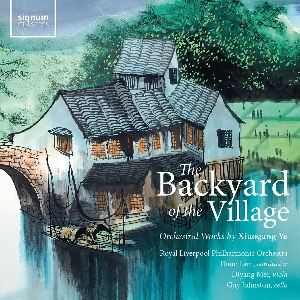
The Backyard of the Village, Op. 89 (2019)
The Memories of Mount Jing Gang, Op. 87 (2019)
My Faraway Nánjīng, Op. 49 (2005)
The Loquat in Five Colours, Overture for Orchestra, Op. 108 (2024)
Diyang Mei (viola), Guy Johnston (cello)
Royal Liverpool Philharmonic Orchestra/Dane Lam
rec. 2024, Philharmonic Hall, Liverpool, UK
Reviewed as lossless download
Signum Classics SIGCD972 [52]
Xiaogang Ye (I’m using the Westernised ordering of his name as per the booklet) is one of China’s most prominent composers. His musical development as a child was hindered by the Cultural Revolution, but in 1978, he was one of a very few to study at the re-opened Central Conservatory of Music in Beijing; fellow students included Tan Dun and Zhou Long. Ye remains China-based, unlike his classmates who moved to the USA.
The Backyard of the Village was a commission which asked for a depiction of the landscapes and villages of the region around the eastern city of Hangzhou, and unsurprisingly Ye used folk music from the area. The flute is a dominant instrument throughout, beginning with a solo that sounds like Chinese music to my uneducated ears, but soon moves into a Western-sounding tonal contemporary style. When the flute returns over the orchestra, the melodic line sounds quite Debussyian at times, though there remains a definite Chinese element. It is a rather episodic work, and I found some of the “joins” between sections rather clunky.
The two “concertos” are contrasting in their moods, The Memories of Mount Jing Gang being mostly rhapsodic, whereas My Faraway Nanjing includes a considerable amount of dissonance, appropriate given that it is depicting the Sino-Japan war of the late 1930s. The Jinggang Mountains are significant in the history of the Communist Revolution, as they are where Mao first led the Red Army in the Civil War. Despite this, the greater part of the work is more in the mood of The Lark Ascending than The 1812 Overture. Only near the very end of the almost thirteen minute piece is there is a hint of something military, and then only briefly. The writing for the viola is generally very attractive, though there is one small section at around 5:20 where a sequence of rising notes sounds very disjointed and totally unappealing.
After a quietly mysterious start to My Faraway Nanjing, the longest work on the album at over sixteen minutes, elements of disquiet begin to creep in, growing increasingly anguished and violent. The cello plays a sad refrain over the last few minutes and the work seems to be closing quietly with a hint of optimism from a solo trumpet until the last few bars of shrieking cello and crashing bass drum. While this is a harder listen than the other three works, it is well-constructed and impressive.
The most recent work, The Loquat in Five Colors, is grandly cinematic, and very enjoyable; an ideal way to close the programme. Like The Backyard of the Village, it has elements that even I could recognise as having an origin in Chinese folk music, but also others that sounded like the soundtrack for an American western. It is less episodic, better blended, and probably my pick of the four works.
Performances from all concerned are very good, as is the sound quality. I did think that it was a slightly unusual release from a British label and major British orchestra, but then again, MWI has recently published reviews of a series of Bruckner recordings from a Chinese orchestra.
I was pleased that none of the four works began with a huge crash of percussion, something that has become very cliched in contemporary classical music. While none of these pieces will join my frequently played list, I did enjoy them, particularly Mount Jing Gang and Loquat. If you like tonal contemporary music, then you should find a good deal of pleasure in these fifty-one minutes.
David Barker
Previous review: Paul RW Jackson
Buying this recording via the link below generates revenue for MWI, which helps the site remain free