
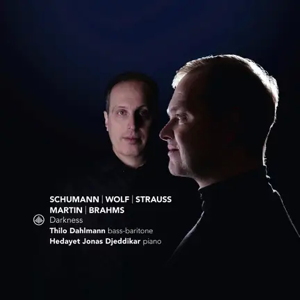
Darkness
Thilo Dahlmann (bass-baritone), Hedayet Jonas Djeddikar (piano)
rec. 2025, Pfaffendorf, Austria
German texts included
Reviewed as a download
Challenge Classics CC720029 [61]
Darkness is the second CD of Lieder that Thilo Dahlmann and Hedayet Jonas Djeddikar have recorded for Challenge Classics, chosen according to a certain thematic logic, the first being The Last Epiphany, reviewed favourably on this site in 2023 (review). The songs in the present collection share, at least for the most part, the theme of an awareness of transience and death, and, often, a subsequent acceptance or religious consolation. Chronologically, they span nearly a hundred years, between the Schumann and the Martin, with the majority of the songs coming from a mere six years between 1896 and 1902.
The first song is Schumann’s Requiem for Nikolaus Lenau, which, while not being strictly a requiem, but rather a lament for the departed and a confident assertion that he is in the presence of the Saviour, establishes the pattern of movement from sadness to consolation. This is an appropriate starting-point, being chronologically the earliest composition on the CD.
The next songs we hear are the three Michelangelo Lieder, composed as a group by Wolf practically at the end of his life, nearly fifty years after Schumann’s song. Here, only the second song, with its unrelenting pessimism in the face of the human condition, reminiscent of the Brahms Vier Ernste Gesänge, really fits the theme of darkness; the others are more ambiguous, and maybe owe their strange mood to Wolf’s state of mind at this late stage of his short life.
The two songs by Richard Strauss, Op. 51, are not very well known. In accordance with the theme, their mood is melancholy, with literal darkness being dominant in the second song. The recitative-like approach, reminiscent of Wolf, might surprise the listener more accustomed to Strauss’ more famous, more melodious Lieder written for the soprano voice.
The Frank Martin cycle Sechs Monologe aus “Jedermann” makes up the biggest single section of the CD, at about twenty minutes. These settings to poems taken from the 1911 play by Hoffmannsthal trace the evolution of the Everyman character, who, in the style of a medieval mystery play, is summoned by Death, who has come to accompany him to his creator. He moves through different states of mind, from materialistic arrogance, through compassion for his mother, to humility before God as a precondition for salvation. Many listeners, like myself, might not find Martin’s musical style, much influenced by Schoenberg’s twelve-tone technique, very easy to listen to, but its appeal grows with closer acquaintance. However, I personally find these songs more approachable in their orchestrated version (maybe because the orchestral richness adds a layer of interest), in, for example, the version sung by José Van Dam, and conducted by Kent Nagano.
The recital ends with Brahms’ Vier ernste Gesänge, probably the most famous item on this CD. The first three songs, setting words from the Old Testament, revolve around the idea that life here below is hardly bearable, a place of suffering and injustice, and offer no consolation except simply death itself. The final song is set to the famous words from the New Testament asserting the importance of love, greater even than faith and hope. While the first three share, mostly, an extremely sombre mood requiring a steady legato on the part of the singer, the fourth one opens energetically, before becoming more serene.
The piano is played consummately by Hedayet Jonas Djeddikar. To take just the first and the last songs in terms of date of composition: Schumann’s rich, romantic accompaniment flows nicely, and Martin’s Jedermann songs are played with interesting varieties of colour, creating a remarkable atmosphere of desolation.
These songs represent quite a challenge for the singer, which is partly alluded to in the publicity material, in the sentence, “Darkness explores the symbolic depth of the bass and baritone voice as a vessel for humanity’s most profound questions.” Thilo Dahlmann does not have, as bass-baritones go, a really dark voice. Some contemporary basses, like Franz-Josef Selig, have voices which to me to have a more natural darkness and weight, and it is certainly true of some from previous generations, like Kurt Moll. José van Dam, a fellow bass-baritone, could produce a particularly attractive, sombre tone. All these singers have recorded at least some of the songs in this recital.
Dahlmann does apply a fair range of dynamics and colouring to his interpretation of the songs. The Schumann, for example, goes from an almost whispered start on “Ruh’…” to the exultant “Jubelsang erklingt”, and the piano in the second verse of the Brahms O Tod is effective. There is some nice legato on occasions, and a rather individual, grainy core to the voice, and the text is dealt with delicately, producing a sensitive interpretation, with some very touching moments.
The reservations I do have – and I am particularly, but not solely, aware of this in the Brahms cycle – concern what I perceive as an excessive vibrato and a lack of steadiness. In the first Brahms song one, for example, I hear this in the phrases “so stirbt er auch”, and also in “wie dies stirbt”, where the forte on “dies” produces a sound that it not to my liking. I have the same misgivings in the second song, where I don’t hear the solid legato on “Da waren Tränen” that I expect. I would also like the vibrato on “O Tod” to be somewhat tighter.
Elsewhere, this impression of instability can even make the result sound slightly clumsy, compared with renditions by certain contemporary singers like Gerhaher, with his maybe excessive lightness, or, even more strikingly, like the young Dietrich Fischer-Dieskau. There are occasions when the widening of the vibrato renders the intonation imprecise, as in the Sechs Monologe, which is a pity, because this is just where the more atonal idiom requires unambiguous pitch. In general, I find Dahlmann’s voice can lack warmth and richness.
Whether one takes to Dahlmann’s particular timbre is of course a rather subjective matter. Other listeners may like it more than I do, or prefer someone like Christian Gerhaher, light as he is. Dietrich Fischer-Dieskau’s interpretations with Gerald Moore are also very impressive. Personally, I feel that these songs (especially the Brahms, but also the others) need a steadier, solid voice, capable of a perfect legato on some of the long phrases. Among basses or baritones who have recorded various of these songs, as well as José van Dam, Thomas Quasthoff comes to mind, as does David Wilson-Johnson, who has made a good recording of the Martin songs. But Alexander Kipnis’ 1936 recordings of the Brahms songs, also accompanied by Moore, must surely still be a reference, in terms of vocal mastery and interpretation, despite the unauthentic accent.
This remains an interesting and demanding recital, sung and played with considerable commitment. The absence of translations of the German texts from booklet is a pity, but these can easily be found on the internet.
David James
Buying this recording via the link below generates revenue for MWI, which helps the site remain free
Contents
Robert Schumann (1810-1856)
Sechs Lieder von Lenau und Requiem, Op. 90 (1850) VII. Requiem
Hugo Wolf (1860-1903)
Drei Gedichte von Michelangelo (1897)
Richard Strauss (1864-1949)
Zwei Gesänge, Op. 51
Frank Martin (1890-1974)
Sechs Monologe aus Jedermann (1943)
Johannes Brahms (1833-1897)
Vier ernste Gesänge, Op. 121 (1896)













