
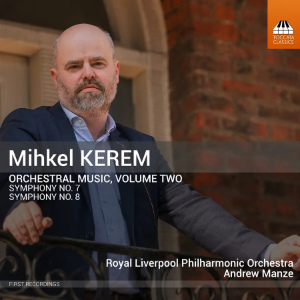
Mihkel Kerem (b. 1981)
Orchestral Music Volume 2
Symphony no.7 (2021)
Symphony no.8 (2022)
Royal Liverpool Philharmonic Orchestra/Andrew Manze
rec. 2025, The Friary, West Everton, Liverpool, UK
Toccata Classics TOCC0776 [52]
Toccata and Martin Anderson have always been partial to a walk on the wild side. In fact it is pretty much obligatory. This time it is the contemporary Estonian composer, Mihkel Kerem. Kerem is a force of nature when it comes to productivity: eight symphonies to his name in just over forty years. At this rate this man will have chalked up as many symphonies as Hovhaness, Fordell (when will we hear even one of this Finn’s symphonies?) or even the phenomenal Segerstam.
The present disc straddles two quite recent 26-minute symphonies and does so with the same forces (RLPO/Andrew Manze) that served up the Vaughan Williams symphonies for Onyx. The single-movement Seventh broods, swells, murmurs and twitters at times, occupying a musical territory comparable at one remove to that of Rautavaara or Pettersson, Rubbra or Nystroem.
A groaning seriousness of purpose carries over into the three-movement Eighth. This prompts thoughts about Sibelius’s Lemminkainen in Tuonela and The Bard. The finale buzzes with a Whistler-like matte-toned tension. This is melded with the hoof-beat of Nightride and Sunrise and trombone calls that glance enviously towards those of the Sibelius Seventh Symphony. We are conscious of a uniformity of parcelled utterance yet also a differentiation that imparts both cohesion and a measure of contrast.
These two laconic symphonies fit well with the images of Northern climes, of taiga and tundra, rather than with Mediterranean dazzle and drama. The “Kerem sound” rejects overt flamboyance or celebration. The shoals and shallows of brightened superficiality are not in this composer’s creative vocabulary.
The extensive English-only, liner notes are by the always reliably diligent and consummately informative Paul Conway. Mr Conway fills in all the details and does so most impressively. This is, after all, music that few will have heard and for which there is practically no performing/listening tradition. To take another example, his work, from a standing start, on behalf of the Toccata cycle of Tabakov symphonies functions finely as both reference and advocacy.
This is not Toccata’s first stroll in the direction of Kerem. See the reviews by Lee Denham and the much-missed Byzantion of a disc that included Kerem’s Third Symphony.
The recording is warmly atmospheric yet does nothing either to take the edge off the woodwind or to stifle clarity.
Rob Barnett
Buying this recording via the link below generates revenue for MWI, which helps the site remain free














I look forward to discovering the music, but I’m slightly intrigued by the comment about him being a ‘force of nature’ when it comes to productivity. 8 symphonies by around the age of 40 isn’t unusual. Shostakovich had managed, Beethoven was up to 7… Was there a typo in the review, or am I missing something? 🙂