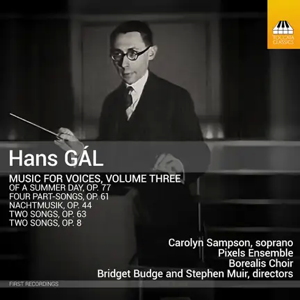
Hans Gál (1890-1987)
Music for Voices Volume Three
Carolyn Sampson (soprano)
Pixels Ensemble
Borealis Choir / Bridget Budge, Stephen Muir
rec. 2024, Clothworkers Centenary Concert Hall, University of Leeds, UK
Toccata Classics TOCC0751 [63]
By pure coincidence, my latest reviews for MWI concern long-lived composers, Hugo Alfvén (1872-1960) and Frederic Mompou (1893-1987). Now we have the third volume of the Music for Voices by Hans Gál, whose long life was about equally split between the German-speaking countries and Scotland. As demonstrated by this disc and its predecessors (Vol. 1: review ~ Vol. 2: review ~ review), at least one element runs through the entire range of his compositional output: music for small unaccompanied choruses.
Margaret Moncrief Kelly’s monograph (to which I have referred in another review) discusses Hans Gál’s life and music very well. Suffice it to say here that he was a major musical figure in Germany and Austria until 1938. Because of Jewish ancestry, in 1933 he was relieved of his post as Director of the Mainz Conservatory. He returned to Vienna but by 1938 he was no longer safe there. He left Austria for America by way of Britain, but ended up settling in Edinburgh where he and his wife lived for the rest of their lives.
The two male-voice choruses of Op.8 demonstrate how early Gál’s ability with a capella works developed, and show his facility at tone-painting; Sterne in Wasser (Starlight on the Water) adds interesting harmonic elements. The two works come from the fateful year 1914. The Nachtmusik (Night Music), opening the program, is from 1933, another fateful year, especially for Gál. It was his response to being forced out of his position and out of Germany. The scoring for soprano, male chorus, flute, cello and piano is used with great distinction. At first, the flute lends a calming note, but the instrumental music gradually becomes darker in tone. The sense of unease increases almost to the end, when the combined efforts of the soprano and flute bring back a sense of rest.
Once Gál was safely settled in Edinburgh, he did the same he had done in Vienna and Mainz: founded a small a capella choir. This time there was an additional incentive: he was now living in the land of the Elizabethan madrigalists, whose music he had long admired. Naturally, some of the works he wrote for such ensemble were in English. Notable among these are Four Part-Songs Op.61 for SATB choir a capella set to texts by English writers of the 16th to 18th centuries. As Steven Muir points out in his notes, this is a skillful blend of Elizabethan practices and modern harmonies.
While all four songs are lovely, Muir implies that setting the third song, Keats’s famous To Sleep, must have had great appeal for Gál. The poem suggests that only in sleep can we escape life’s slings and arrows. Gál did not neglect his native language. Two Songs Op.63 for male voices, Bey dem Weine and Runda, are amiable drinking songs such as Gál might have heard in his youth.
Gál’s largest work in English is the choral suite Of a Summer Day for three-part women’s chorus, soprano solo and strings. It sets nine English poems from the early 17th century to the early 20th. Stephen Muir points out in his notes: “Many of the movements are a call to seize the day”. Yet other moods and emotions are present in the suite. The Prelude introduces the thematic material that will reappear in various individual songs, and is followed by a rather Wagnerian setting of Carlyle’s To-day. We then have three songs which form a sort of sub-group. Morning features the soprano soloist in music that amplifies the 17th century aspects of the poem, as it does for Herrick’s Make Much of Time. Arthur Symonds’s Song of June is much more languorous but still maintains the general mood through the string writing. It should be pointed out that the Borealis Choir excel in this movement.
The next two poems provide a sort of interlude: Arnold’s Elegy is still languorous but Gál brings home that this sense in a far sadder way than what he does with Symonds’s poem. F. W. Harvey’s Scherzo (Ducks) might appear to be the humorous movement, but Gál sees it a little more seriously than one might expect. The last three movements, played without a break, set two texts by Robert Bridges and one by Walter de la Mare. Gál evokes Bridges’s Hurricane with his usual skill at word-painting, ably supported by Carolyn Sampson’s excellent singing. In Bridges’s Sunset,Sampson sings alone. She is very affecting in what impressed me as the most ingenious movement of the whole cycle. Silver, by de la Mare, has some of the most beautiful choral writing as Gál energetically sums up the entire work.
Carolyn Sampson is called upon to embody a variety of moods. In the Nachtmusik, she beautifully portrays the hope against hope that Gál must have felt when he wrote the piece. By contrast, in Of a Summer Day,final peace is not hard-won but achieved gently, and Sampson manages this contrast effortlessly.
Borealis is a choir of professional singers located in the North of England. As on the preceding discs, they not only sing beautifully but are perfectly attentive to the development of Gál’s personal style over the years. The instrumentalists of the Pixels Ensemble have a fine blend. I was especially impressed by the work of Fiona Fulton, Elinor Gow and Ian Buckle in their accompaniment to Nachtmusik. Conductors Bridget Budge and Stephen Muir handle their duties equally well.
William Kreindler
Buying this recording via the link below generates revenue for MWI, which helps the site remain free
Contents
1. Nachtmusik, Op.44, for soprano solo, male voices, flute, cello and piano (1933)
Four Part-Songs, Op.61, for mixed choir (SATB) a cappella (1954)
2. Love Will Find out the Way
3. An Epitaph
4. To Sleep
5. Phillida and Corydon
Of a Summer Day, Op.77 (1951)
6. Prelude
7. I To-day
8. II Morning
9. III Make much of Time
10. IV Song of June –
11. V Elegy
12. VI Scherzo
13. VII Hurricane –
14. VIII Sunset
15. IX Silver
Two Songs, Op.8, for four-part male-voice choir a cappella (1914)
16. Idylle
17. Sterne im Wasser
Two Songs, Op.63, for four-part male-voice choir a cappella (1954)
18. Bey dem Weine
19. Runda