
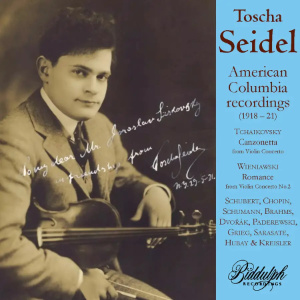
Toscha Seidel (violin)
American Columbia Recordings
rec. 1918-21
Biddulph 85067-2 [78]
Toscha Seidel’s recordings are returning to the catalogue, and not before time. The Auer student has been something of a forgotten figure, though his recordings have appeared on a few violin anthologies over the last decades. Parnassus issued a selection from across the years but Biddulph’s focus is more precise. The disc under review concentrates on his American Columbias, acoustically-recorded discs of 1918-20, presented in chronological order.
Carl Flesch famously once wrote that it was an injustice Seidel hadn’t been included, in preference to Efrem Zimbalist, among the Trinity of Auer pupils alongside Heifetz and Elman. Be that as it may, Seidel enjoyed a healthy career in America from the time of his emigration after the Russian Revolution until at least the 1940s, most famously on the radio and on the West Coast in film music. These early discs represent American Columbia’s attempt to rival Heifetz’s Victor recordings and they show the teenage Seidel’s lavish gifts – molten tone, expressive musicality, teasing rubati, perfect calibration between left and right hand, and technical nonchalance.
His Wieniawski Romance is typically warmly vibrated, even a touch fervid perhaps, but he plays Chopin’s nocturne, in his teacher Leopold Auer’s arrangement, with Olympian elegance. Caprice Viennnois shows, as I wrote when it too appeared on Parnassus, his ‘individual approach to rhythmic elasticity, though it’s full of elan and tonal breadth.’ This is one area of his musicianship that can be criticised; a lack of discipline. The Schubert Serenade, in Mischa Elman’s arrangement, is a richly textured and warmly upholstered recording but his Traumerei shows a chaste refinement that was also a quality he possessed, though it’s one I associate much more with Zimbalist, which is one of the reasons (a lack of tonal allure) that Flesch wanted to downgrade Zimbalist. It’s notable too that he is expressively reserved in the emotive Jacob Sandler’s Eili, Eili and his vibrato is beautifully controlled.
These small pieces can only hint at the variety of his sonata and concerto repertoire but are instructive examples of his art – gems into which he poured his rich tone and sensitive musicianship. Only three are accompanied by a small orchestra, pieces by Cui and the two Tchaikovsky works, a lovely arrangement of the slow movement from the String Quartet No.1 which draws on the full width of his tonal resources and the Canzonetta from the Violin Concerto, which illustrates his quick slides and idiomatic identification and, less happily, the poor tuning of the accompanying band, which is largely brass and winds.
Elsewhere his accompanists were Louis Gruenberg and Harry Kaufman and they’re helpful, assiduous artists. Kaufman was to accompany Seidel many years later in the mid-50s in Seidel’s last, sad, sonata recordings for the Impresario label, recordings that have also just been reissued by Biddulph, which I’ve reviewed separately. Though it’s cut in half – its slow introduction is cut to just 2:30 – Zigeunerweisen reveals Seidel’s propulsive brilliance in this kind of music as Simonetti’s once-popular Madrigale shows his vibrant lyricism. Seidel must have been the only violinist to have recorded Charles Morrison’s Meditation, an attractive slice of salon fluff, richly played and heard in a rather sub-par copy.
Seidel possessed virtuosity, lyricism, sentimental charm, boldness of expression (but one capable of inflexion) and all the qualities necessary for a major career. That it never quite happened is regrettable but at least his early recordings show us, in a way never before revealed in such depth and in fine transfers – his American Columbias of 1921-27 will soon be released by this label – exactly what Carl Flesch meant.
Jonathan Woolf
Buying this recording via the link below generates revenue for MWI, which helps the site remain free
Contents
Henryk Wieniawski (1835-1890)
Violin Concerto No.2: Romance
Fryderyk Chopin (1810-1849)
Nocturne in E minor, Op.72 No.1 arr Leopold Auer
Fritz Kreisler (1875-1962)
Caprice Viennois, Op.2
Liebesfreud
Franz Schubert (1797-1828)
Schwangesang: Serenade arr Mischa Elman
Robert Schumann (1810-1856)
Kinderszenen: Traumerei arr Hüllweck
Jacob Koppel Sandler (1860-1931)
Eili, Eili
César Cui (1835-1918)
Orientale, Op.50 No.9
Antonín Dvořák (1841-1904)
Humoresque, Op.101 No.7 arr. Rehfeld
Pablo de Sarasate (1844-1908)
Zigeunerweisen, Op.20
Pyotr Ilyich Tchaikovsky (1840-1893)
String Quartet No.1: Andante cantabile arr violin
Violin Concerto: Canzonetta
Jenő Hubay (1858-1937)
Scène de la csárda No. 4 ‘Hejre Kati’, Op. 32
Achille Simonetti (1857-1928)
Madrigale
Charles Sumner Morrison (1860-1933)
Meditation
Alfred Margis (1874-1913)
Valse bleue
John Kellette (1873-1922)
I’m Forever Blowing Bubbles
Alfredo d’Ambrosio (1871-1914)
Canzonetta, Op. 6, No.1
Johannes Brahms (1833-1897)
Hungarian Dance No.1 arr Joseph Joachim
Xaver Scharwenka (1850-1924)
Polish Dance
Cécile Chaminade (1857-1944)
Serenade espagnole, Op.150
Louis Gruenberg (piano), Harry Kaufman (piano) and orchestra in Cui and both Tchaikovsky pieces












