
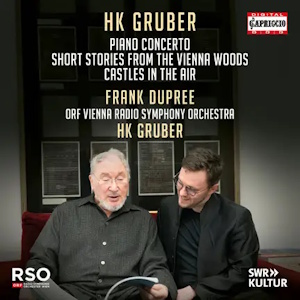
HK Gruber: Short Stories from the Vienna Woods
HK Gruber (b.1943)
Piano Concerto (2016)
Short Stories from the Vienna Woods (2019)
Luftschlösser (Castle in the Air) (1981)
Frank Dupree (piano), Orf Vienna Radio Symphony Orchestra/HK Gruber
rec. 2024 Vienna & Stuttgart
Capriccio C5536 [73]
Austrian composer HK Gruber has an ear responsive to all styles of music and a fine inner ear which enables him to translate these diverse styles into his own, personal sound world. He took the classical music world by storm with his 1978 workFrankenstein!!, a ‘pan-demonium’ for chansonnier and orchestra or chamber group, a setting of bizarre poems by his friend H.C. Artmann. Written for his extraordinary gifts as a performer, its eclectic juxtaposition of the serious with the popular proved very popular with audiences. It has tended to overshadow his many other works, which as this disc shows is unfortunate, as he is a very gifted composer who, unlike many of his post war contemporaries, is interested in engaging with his audience.
His career, like his music, has been eclectic. It began in the 50s as a member of the Vienna Boys’ Choir, then a career as a double bass player in jazz and classical groups. As a member of Die Reihe he played many works of the Second Viennese School and then as a co-founder of the ‘MOB-art & tone-ART’ ensemble, and was instrumental in questioning the hegemony of that very style on Austrian music.
As such, his music can be serial at one moment, lush Romantic the next, then take us to a jazz club or a Viennese ball. Listening to these works on the disc left me in awe at his technical ability to take wildly disparate musical styles and make them his own. They all make sense in the context of his work.
This awe-inspiring technical accomplishment led to something I found quite challenging: his counterpoint. As a student of Gottfried Von Einem, who was himself a student of Hindemith, Gruber is brilliant at it and there are often three or more lines of musical material, all of which are interesting and all of which are jostling for our attention. What he writes is often a lot more appealing than Hindemith’s writing but there is often a lot to take in.
This is never more obvious than in the Piano Concerto, where for almost the first five minutes there are at least four separate musical strands going on at the same time. Simple chords in the piano and jazzy riff on the brass and a sexy solo on the alto saxophone. This contrapuntal brilliance barely lets up for the twenty-five minutes of its duration. It is all engaging but does require concentration. The work was written in 2016 for the brilliant Emanuel Ax, who, for all his programming of the great Austro-German tradition has performed much contemporary music. Ned Rorem told me that early on in writing his Etudes for Ax, he realised the pianist could play anything, and so Rorem put technical limitations aside and wrote whatever he wanted. So too, here, Gruber has written an extremely difficult piano part, where often the left hand and right are playing totally different music, and then he divides each hand into different lines. It is not as complex as Nancarrow’s player piano studies, but close. It took me a few listens until I could get a hold on the work.
The concerto is a continuous evolving development of a fragment of material from Gruber’s 2014 opera Tales from the Vienna Woods and it is brilliantly done. There is apparently a 12-note row running through the work, though happily it is hidden amongst the outpouring if melody. Frank Dupree who has made a name for himself performing the ultra-complex, though enormously enjoyable, works by Nikolai Kapustin, is the perfect soloist here. He is able to adapt to any style of music thrown at him. Gruber proves an excellent conductor in keeping the complex musical lines and the very large orchestra perfectly under control.
I would urge you to search out Capriccio’s short promotional video for the concerto. It has really interesting interviews with Gruber and Dupree, who are both tremendously articulate in discussing the work.
The next work, Short Stories from the Vienna Woods, is a thirty-minute, seven-movement suite developed from the aforementioned opera. Adapted from Ödön von Horváth’s 1931 satire, it examines the moral decay of the bourgeoisie in interwar Vienna. It is a diverting work, with something for everyone. There are expressionist outbursts, Viennese waltzes of both the Johan Strauss and Richard Strauss variety. Elsewhere, there is cabaret music and scraps of dance hall music including a honkytonk piano. This may sound as though the work is a hotchpotch of fragmentary offcuts, but such is the skill and invention of the composer it all works. Once again, the composer proves himself and excellent conductor and keeps everything in check while giving the players the freedom to enter into the madness and give their all.
The disc ends with a surprisingly American sounding piano suite from 1981 Luftschlösser (Castles in the Air). There are shades of Persichetti, Barber and Previn and Dupree brings out the idiosyncrasies of each movement with ease.
Paul RW Jackson
Other review: Rob Barnett
Buying this recording via the link below generates revenue for MWI, which helps the site remain free













