
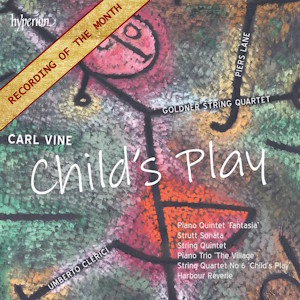
Carl Vine (b. 1954)
Child’s Play
Piano Quintet “Fantasia” (2013)
Strutt Sonata for cello and piano (2017)
String Quintet (2009, rev. 2015)
Piano Trio “The Village” (2013)
String Quartet No. 6 “Child’s Play”(2017)
Harbour Reverie (version for string quartet) (2014)
Goldner String Quartet, Piers Lane (piano), Umberto Clerici (cello II)
rec. 2025, Verbrugghen Hall, Sydney Conservatorium of Music, Australia
Hyperion CDA68521/2 [2 CDs: 90]
Carl Vine, 72 in October this year, is one of Australia’s leading composers, who over fifty years has built up an extensive portfolio of works. The lyrical and dynamic sound of his music has found a welcome audience around the world. I have loved his music since hearing the early chamber works Café Concertino (1983) and Miniature 3 (1984). The flamboyance of his instrumental writing, coupled with dynamic rhythms and an advanced, though never alienating, approach to harmony, make his work appealing to me. This double-CD album therefore provides a welcome late 70th birthday tribute to the composer and a brilliant introduction to his chamber music.
All the works here are for combinations of between two and five players and are linked by having been performed at some stage by the Goldner String Quartet or its members. It is also the quartet’s final album, as in 2023 they announced their decision to disband after three decades of performing together. This is a great pity as they are a wonderful ensemble, who have maintained the same membership over thirty years, they are two married couples. They have, not surprisingly, a tremendously intuitive way of playing, which works well in this music with its sudden changes of direction and dynamics.
Vine is a brilliant pianist and his piano writing, like that of Prokofiev, is very much geared to his personal gifts. Like Prokofiev this includes the ability to play wide leaps with ease, and his piano writing is characterised by leaps in both hands that are not for the fainthearted. As the pianist here is the distinguished Piers Lane who has a long association with Vine, these are approached fearlessly.
The Piano Quintet ‘Fantasia” – in one movement but with three clear sections which are given separate tracks on the disc – is quintessential Vine. Each section uses different techniques on the piano, ranging from lush rolling arpeggios and the aforementioned leaps to rich sustained chords and bell-like tones. This makes the ear hear afresh the relationship between the piano and the strings, who themselves use a wide range of sounds from soaring melodies to puckish pizzicato to draw the ear in. The opening movement covers a range of textures in which all the players have a chance to shine. The central section is part nocturne and part barcarolle, the hushed sound world of which is beautifully captured by the engineers. The finale is a dynamic dance-like piece; Vine has written much music for dance, and such rhythms feature often in his music. The work builds to a brilliant climax ending on a very emphatic perfect cadence.
The Strutt Sonata for cello and piano was commissioned by Josephine Strutt in honour of her then very ill husband, John. It is abstract in nature, but in the notes the composer says he tried to write something John Strutt may have liked to hear. It is, like the quintet, in a single movement with three clear sections. The second is based around a wonderful melody on the cello in which I could not help but hear echoes of Joni Mitchell’s song “Both Sides Now”. It is a very affecting movement. The finale begins in a joyous and playful mood with some jazzy, syncopated rhythms which the Smiles and Lane seem to enjoy playing. This is all pushed away in a heartfelt recapitulation of the slow sections and the work ends in a mood of quiet contemplation. Julian Smiles gave the first performance of the work, and one cannot imagine a better soloist.
Vine’s String Quintet was written in 2009 as a companion to Schubert’s lauded work, and so, like the Schubert, adds an extra cello to a standard string quartet. It was apparently revised in 2015, but we are given no clue as to what the revision entailed, or why. Apart from the instrumentation there is no similarity between the works except that they share a C major tonality; Schubert’s lasts over 50 minutes while Vine’s is under twenty. It is shaped in four sections, the first of which is emotionally charged and explores different instrumental pairings. Much in evidence is a favourite device of Vine’s, the use of multiple, and quick changing, polyrhythms. This is where within the regular bars there are irregular groupings of say three notes against two or five against four, etc. This creates the effect of disorienting the listener’s perception of time, often to dramatic effect. That is hard to bring off, but the players here are meticulous in their attention to the rhythmic details. The second section is a classic slow movement framed around lyrical, though bleak, rising phrases passed round the ensemble. I was then puzzled, as the notes tell us it is followed by a section that the composer says is a minuet, but as it is in 3/4 and 7/8, it is hardly that ancient dance form. It is however very effective with slithering bowed lines and precise plucked chords. The last section is a presto finale, marked by quixotic changes in speed. A slower section of grindingly dissonant chords at about 2’ 30” (track 10) prepares the way for the for a madcap rush to the final emphatic C major chord.
The Piano Trio “The Village” was inspired by the notion that humans seem to function best in smaller social groups. This led the composer to think about his ‘friend groups’ and how they interact and ultimately to create the work as a ‘village’ of ideas, in twelve independent episodes but with related motifs which evolve naturally over the course of the work. Vine creates some ear-catching textures with the three instruments and at about one minute into track two the violin and cello play eerily in artificial harmonics while the piano’s slow chords and gentle grace notes nudges them along. It is a diverting, rather mysterious work with some challenging harmonies that Vine makes seem natural. The fast finale driven by pounding motor rhythms in the piano which underscore lyrical lines in the strings comes as something of a surprise.
The album takes its name from the next work on the album, the String Quartet No 6 “Child’s Play”. It was commissioned by Mike and Frédérique Katz, who wanted “music that uplifted, edified and elated”. The composer realised that this may not be satisfying musically and went for music that, while optimistic, is not without its moments of introspection.
The work’s five continuous sections have names inspired by childhood: Play, Concentration, Friendship, Sleep and Running. While they explore Vine’s thoughts on aspects of ‘child-like’ behaviour the music is in no way childlike or simplistic. The second movement is a brilliant musical evocation of a child concentrating. A simple motif is explored and examined in multiple ways with each instrument contributing its own opinion. The finale is a moto perpetuo mainly in semi-quavers exploring the idea of running. In its uninhibited elation it has something of a hoe-down feel to it. But unlike some hoe-downs I have been to, everyone here knows what they are doing and stays in time to the exuberant end.
The brief string quartet Harbour Reverie (2014) was a gift to his friend Mary Jo Capps on the occasion of her sixtieth birthday. It pictures her travelling to work by ferry over Sydney Harbour. I did not get any of that from listening to the music, but it is a very enjoyable, if a tad saccharine, movement for string quartet that provides a relaxing finale to the album.
This double album shows just what a fine composer for the medium Vine is. His writing is idiomatically brilliant for each instrument and, while not easy to play, sounds a deeply satisfying endeavour. I doubt that the composer could hope for better performances.
Paul RW Jackson
Buying this recording via the link below generates revenue for MWI, which helps the site remain free













