
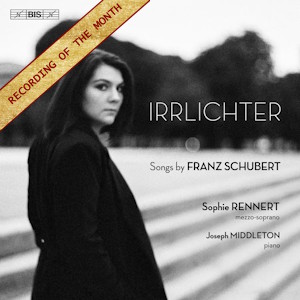
Franz Schubert (1797-1828)
Irrlichter
Sophie Rennert (mezzo-soprano), Joseph Middleton (piano)
rec. 2024, Hohenems, Austria
German texts and English translations included
Reviewed as a download
BIS BIS2458 SACD [70]
The Austrian mezzo-soprano Sophie Rennert has been pursuing a successful career for nearly ten years, based latterly in the Staatstheater am Gärtnerplatz in Munich. She has performed mostly but not exclusively in operas from the Baroque period and in those by Mozart and Rossini, but Lieder recitals have also been a regular activity of hers, and her several recordings on CD include a solo album of Brahms songs. It is therefore logical that she should make this recording of Schubert Lieder, accompanied by Joseph Middleton; and it is indeed a valuable, welcome contribution to the already considerable catalogue of Schubert Lieder recordings.
The logic of the selection she has made here is revealed by the title, Irrlichter (will-o’-the-wisps), which is for Rennert, as she writes in the accompanying notes, a symbol of the way in which many of Schubert’s songs create a feeling of uncertainty, a hesitation between the narration of recalled experience and the expression of a longed-for state.
The word “Irrlicht” appears in Des Fischers Liebesglück, a song which Rennert says epitomises this ambiguity. It is one of the more rarely-performed songs in this selection, and it is a pleasure to discover it executed with such care. The singer and pianist create and maintain a delicate, magical atmosphere; there is something hypnotic about the repetitions, but the expressive variations of the voice and the subtle rhythmic ambiguities of the keyboard ensure that it never becomes monotonous.
Several more of the songs here use twilight or night-time as the setting for melancholy contemplation or reminiscence, in particular some of the less-performed ones, like Im Freien, Schwestergruss or Der Winterabend. Rennert sings them all with considerable sensitivity, and with the constantly pleasing timbre which is characteristic of her voice. The catalogue of course contains recordings of Schwestergruss, for example, by some illustrious forbears, like Gundula Janowitz or Janet Baker, to mention only a couple of women singers, and Rennert’s performance can be very favourably compared to them, as indeed can those of other songs. The texts are dealt with very sympathetically, and there is considerable expressivity, without ever sacrificing vocal quality. I was particularly pleased to discover these little gems, which have beautiful piano introductions – I find the start of Der Winterabend particularly touching – played with a sort of appropriate tentativeness by Middleton. Im Freien is typical of Schubert’s songs, in the sense that, though there is nothing sad about the poem, and the song is basically in a major key, the Lied is pervaded by a sort of melancholy, which the artists render very affectingly.
Nachtstück and An den Mond in einer Herbstnacht round off the songs with a melancholy, nocturnal setting. The former provides a perfect example of Rennert’s art. Listening to the first verse, one can hear the careful control of colours, dynamics and vibrato, at the service of the music and the text, and the quotation of the old man’s words (“Du heilge Nacht …”) is delivered with a beautiful legato. Fine singing indeed. In An den Mond in einer Herbstnacht, we have a different treatment of the happiness/sadness dichotomy by Schubert: the song opens in a major key, with a melody which, though falling, has a rather lively rhythm. But as the poet contemplates the moon and all the earthly activities it looks down on, this rather complex song moves through various moods and tonalities, and he comes to envisage his own demise. The initial major theme returns with its upbeat rhythm when he envisages the moon continuing to shine down, a symbol of permanence, and, after another tonally ambiguous passage anticipating his disappearance, the song finishes with gentle serenity in the major key. It is again a pleasure to discover this song performed with such sensitivity.
I have, understandably I hope, spent quite a lot of time examining the less-known songs here, because aside from the quality of all the recordings on the CD, one of the reasons for acquiring this album would be to become acquainted with works which even quite keen fans of Schubert lieder may not have come across before. The last song in this category is Kolmas Klage, maybe the least know of all here, and which certainly deserves to be performed more often. It is more dramatic than the previous songs I have discussed, with its stormy first section which is replaced by a central section whose 6/8, almost dancing rhythm and superficially serene mood are in ironic counterpoint to the despairing content, before a final, much more static section in 2/4, expressing Kolma’s resignation. Rennert’s colouring of the voice enables her to express the full dramatic potential and urgency of this song, and the artistic visions of singer and pianist seem to be in total agreement. The performance is in no way inferior, for example, to the excellent recording by Margaret Price and Graham Johnson; there is a gracefulness and expressiveness here which are second to none.
The rest of the songs are all very well known, but it is still a pleasure to hear Rennert and Middleton perform them so interestingly. From Gretchen am Spinnrade – a remarkable composition for a 17-year-old – to Die Taubenpost – one of his very last songs – they span the whole of Schubert’s short but productive life. Rennert captures convincingly the obsessive, almost despairing, love of Gretchen for Faust, and Die Taubenpost, while not bouncing along as Gerald Moore makes it do for Hotter, has its own, more lyrical, charm. There is a certain restrained enthusiasm in the way she sings Im Abendrot, to which Middleton provides a harp-like accompaniment.
Like Kolmas Klage, Willkommen und Abschied develops the night-time setting less for the subtle ambiguity represented by the “will-o’-the- wisp” motif than in a more spectacular creation of gothic-type dread. Rennert conveys the youthful enthusiasm of the lover, not through extreme dynamics (as far as one can judge from the recording), but through total precision in the rhythm and the rendering of the text, skills which she has no doubt honed in her baroque and classical opera repertoire.
The two songs that remain to be mentioned are Der Zwerg and Erlkönig, both requiring dramatic intensity and the adoption of different roles by the singer. Rennert does this very successfully in both cases. In Der Zwerg, there is a feeling of foreboding in the voice from the very beginning, and an effective hardness of tone to portray the dwarf. At the moment of the queen’s death, the timbre takes on an expressive dryness. Middleton injects drama into the accompaniment (just before “Nie, nie…,” for example), the effect of which is very gripping. In Erlkönig, he gives the accompaniment haste and lightness, constantly moulding the phrases. Rennert embodies the various voices very convincingly.
On first hearing these performances, I immediately liked them, and they continue to grow on me with further listenings. There have, of course, been a lot of very good singers who have excelled in this repertoire (like Christa Ludwig, Margaret Price or Gundula Janowitz, to mention just a few female exponents), but I cannot think of any to whom I would prefer to listen singing Schubert. A more relevant immediate comparison would be with the recent Schubert recital accompanied by Joseph Middleton, with the British soprano Carolyn Sampson, reviewed on this site (review), which even has three songs in common with Rennert’s recital. My colleague notices, as I do, Middleton’s subtlety and eye for detail. But I must say that, for me, a comparison of the two voices comes down in Rennert’s favour. Without wanting to contest Sampson’s evident artistry, it seems to me that Rennert’s pronunciation of the German is, as one would expect, slightly, but audibly better, and Rennert’s voice itself has, to my ear, a more attractive vibrato, and is generally rounder and warmer.
Sophie Rennert’s partnership with Joseph Middleton seems to me to work to perfection: his playing is always interesting – a note brought out here, a delicate hesitation there – and they obviously share the same idea of how the pieces should be performed. Sophie Rennert’s expressive possibilities and her crystal-clear pronunciation of the German make her very well-suited to Lieder, and she has a purity of tone which makes her voice an absolute pleasure to listen to.
David James
Other review: Ralph Moore
Buying this recording via the link below generates revenue for MWI, which helps the site remain free
Contents
Der Zwerg, D. 771
Des Fischers Liebesglück, D. 933
Willkommen und Abschied, D. 767
Im Freien, D. 880
Kolmas Klage, D. 217
Gretchen am Spinnrade, D. 118
Schwestergruss, D. 762
Die Taubenpost, D. 965a
Der Winterabend, D. 938
Im Abendrot, D. 799
Erlkönig, D. 328
Nachtstück, D. 672
An den Mond in einer Herbstnacht, D. 614













