
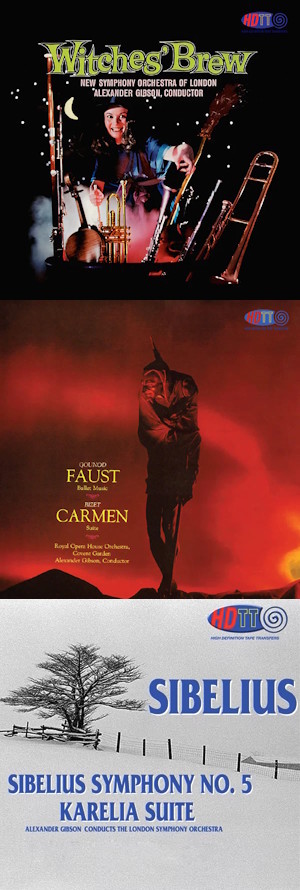
Witches’ Brew
New Symphony Orchestra of London/Alexander Gibson
rec. December 1957, Kingsway Hall, London
Reviewed from download
HDTT 23177 [44]
Charles Gounod (1818-1893)
Faust – Ballet Music
Georges Bizet (1838-1975)
Carmen – Suite
Orchestra of the Royal Opera House, Covent Garden/Alexander Gibson
rec. February and April 1959, Kingsway Hall, London
Reviewed from download
HDTT 15419 [44]
Jean Sibelius (1865-1957)
Symphony No. 5 in E flat, Op 82
Karelia – Suite
London Symphony Orchestra/Alexander Gibson
rec. February 1959, Kingsway Hall, London
Reviewed from download
HDTT 2202[43]
Alexander Gibson did his musical apprenticeship in Glasgow and London. He supplemented the experience his first paid role as repetiteur at Sadler’s Wells gave him, with summer schools studying with the likes of Igor Markevitch and Paul van Kempen on the continent. In 1952 he assisted Ian Whyte at the BBC Scottish Orchestra, soaking up more of the repertory and gaining valuable experience. From 1954, after two years in Scotland, he took the long road southbound again as he took up a role as staff conductor back at Sadler’s Wells. In the mid-50s he gained huge experience conducting opera in London and on many tours. He was appointed Music Director at the Wells in 1957. A contemporary of another musical knight: Colin Davis (Gibson was eighteen months senior), their career paths sometimes overlapped. Davis too worked with the BBC Scottish and led Sadler’s Wells, following Gibson’s tenures in both cases. I wonder if there was any rivalry between the two. Gibson certainly got to do Berlioz’s The Trojans and Wagner’s Ring in Scotland before Davis ventured them in London.
After enjoying Warner’s new set devoted to Gibson: “Opening the Doors”, I wanted to explore his recorded legacy a little more. The first experience Alexander Gibson had in a recording studio was in December 1957. Kenneth Wilkinson set up his equipment in Kingsway Hall and the New Symphony Orchestra of London duly assembled. Gibson would have been fresh from conducting a run of Il Trovatore at Sadler’s Wells. The rum-tee-tum of this middle period Verdi was just the right preparation I think for the program he would conduct. I wonder if any of the players in this group of musicians had played in the Verdi. The resulting record, RCA’s Witches’ Brew is rightly famous and highly prized by audiophile collectors. The album has been transferred to CD by Decca and Australian Eloquence. I sampled the remastering offered by the American label HDTT, available in a range of high-resolution download formats.
Arnold’s Overture Tam O’Shanter gets things going. This work was only a couple of years old at the time of this recording. It is a wonderful piece and the performance it gets here is superb. From the opening whistling on piccolo, Tam himself in his wobbly, inebriated state on bassoon, the muted, slithering brass and that trombone solo. The bagpipe drones and reels as those ghouls really start to party are stunning, too; and what about those whooping horns? I adore the work and this must surely be the best-ever recording of it. Mussorgsky follows: ‘Gnomus’from Pictures at an Exhibition and Night on the Bare Mountain. These have been bettered in terms of interpretation, it has to be said. The sound is vintage, however. I really liked Saint-Saëns’ Danse Macabre (from the start of side 2 of the original record). Gibson loves a tune and when it is a big dominant one like this, he really milks it – this is especially true in Sibelius (see later). The Liszt Mephisto Waltz goes splendidly and has a real swing. Check out those cellos between 3:10 and 4:30!
This record was released in the US six months before it became available in Britain. Shaded Dog original pressings are much sought after, I believe. HDTT use a first stamper original clean copy. They normally work from reel-to-reel tapes but here it is definitely the LP they have transferred. It is an explosive up-front sound for sure. The bass is very prominent which is great, but I find the recording a bit too strident at the top end. There is blasting too and pre-echo in the Liszt and other places. This is classic 2-track Hi-Fi from the golden age, nonetheless. I was glad to hear it again.
In February 1959 Alexander Gibson returned to Kingsway Hall and was reunited with engineer Kenneth Wilkinson for a couple more records. I rather think the great Decca man was using a four-mic set up in these sessions. HDTT has used reel-to-reel tapes running at 15 inches per second (ips), a high standard of audio playback with maximum resolution and little noise. The Gounod/Bizet album couples the Faust ballet music with a suite from Carmen. These transfers really are top quality. There is a wide stereo separation, and the sound is so colourful. In pieces like Cleopatra’s Dance and the Dance of the Trojan Maidens, Gibson’s experience as a man of the theatre really tells. There is an elegant swagger and a delightful twinkle to the phrasing. The chirping woodwind in the latter dance is charming. In this record the orchestra is that of the Royal Opera House, Covent Garden. The Faust sequence is completed very deftly with the Funeral March of a Marionette. The Carmen suite comes up just as freshly as well. Unlike the LP transfer of Witches’ Brew the sonics are immaculately presented; there’s no blasting and not a hint of pre-echo. This type of repertory was at the time “owned” by the great Sir Thomas Beecham. Gibson glows with a familiar hue and exhibits the same panache and style, I think.
In my review of the “Opening the Doors” collection, I mentioned Gibson’s affinity with the music of Sibelius. His first encounter in the recording studio with the composer happened a few days before the sessions for Faust. This occurred in Kingsway Hall, again with the same technical team but this time the London Symphony Orchestra played under Gibson’s baton. The work was the Symphony No. 5. A few years before, Decca had recorded this with Anthony Collins in the same hall and with the same orchestra. That mono record had a competitor in the Columbia catalogue in the form of Karajan with the Philharmonia. These two records are important in the discography of this great symphony, but so is this Gibson stereophonic version. Back in 2010, my colleague Rob Barnett in an early appraisal of HDTT issues, reviewed this set. That incarnation, which included Morton Gould’s Swan of Tuonela has been remastered since and the hiss he mentions is now all but gone (as is Gould’s sad swan).
The symphony gets a performance of two halves. At one point you will admire the vision and sweep and will marvel at the perfect pacing and control. Then for some reason, I feel they lose their way a little, in a haze almost. There is some simply stunning playing throughout, but I feel Gibson’s best Sibelius performances were some years into the future. I consulted the 1975 edition of The Penguin Stereo Record Guide and found a similar response. They call it a “lack of tautness”. The sonics are once again magnificent. HDTT using American reel-to-reel tapes have produced an immaculate image of the master 2-track. The original coupling was the Karelia suite. I enjoyed this perhaps more than the symphony. The swagger of the intermezzo may be a bit cavalier, but I love it – another one of those big tunes Gibson relishes. The Alla marcia is demonstration class in every aspect.
These three titles in the superb HDTT catalogue are available in a range of high-quality downloads. In a previous review I wrote last year of a Charles Munch Living Stereo record, I talked about the different formats the label offers and I refer you to that if you need a little help deciding which is best for you. I listened to the 24/96 FLACs.
My little retrospective on the recorded legacy of Sir Alexander Gibson will conclude shortly with a review of one last record.
Philip Harrison
Availability: High Definition Tape Transfers
Contents: Witches’ Brew
Malcolm Arnold – Tam O’Shanter Overture, Op. 52
Modest Mussorgsky – ‘Gnomus’ from Pictures at an Exhibition
Modest Mussorgsky – A Night on Bare Mountain
Camille Saint-Saëns – Danse Macabre Op. 40
Engelbert Humperdinck – ‘Witches’ Ride’ from Hansel and Gretel
Franz Liszt – Mephisto Waltz













It’s nice to be reminded just how good Gibson could be at his best. I had season tickets to the SNO concerts in Edinburgh during my student years there (1971-75) as well as attending all the Scottish Opera performances during that time, ranging from The Merry Widow to the première of Iain Hamilton’s The Catiline Conspiracy. I can’t pretend Gibson was always on top form but I have many treasurable memories.
I read somewhere that, after a performance of Tam O’Shanter early in his reign with the SNO (maybe the work’s première north of the border), Gibson turned to the cheering audience, said “Not bad for a Sassenach, eh!” and repeated the final section.