
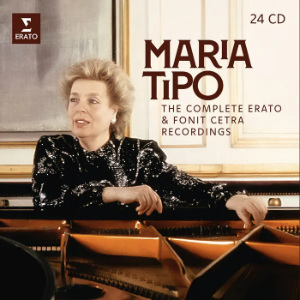
Maria Tipo (piano)
Complete Erato and Fonit Cetra Recordings
rec. 1978-94
Erato 2173286608 [24 CDs]
The Italian pianist Maria Tipo (1931-2025), hailed somewhat improbably as the ‘Neapolitan Horowitz’ early in her career, was a child prodigy but fortunately one with staying power. Studies with her mother were followed by some lessons with Alfredo Casella and Guido Agosti and a dispiriting time on the competition circuit, before she was propelled to some standing via winning the Geneva competition in 1949 and a third place in 1952 at the Queen Elisabeth Competition, which introduced her to Arthur Rubinstein. Her first recordings were made for Vox in the mid-50s. The 24 CDs in this box cover her EMI and Fonit Cetra legacy.
I reviewed discs 1 and 3 in this box when they appeared on an EMI twofer two decades ago so I’ll repeat what I wrote there, more or less unchanged, as it indicates my general feeling about her very personal approach to Bach. ‘No holds were barred when Maria Tipo took on the Goldberg Variations in Paris. Her recording has now been reissued in EMI’s uniform twofer series that revives lingering material and reshapes it into comfortable double discs. Tipo approaches the variations in true romanticist fashion. There are myriad agogics and colours on display. Try listening to the colouristic imperatives and ensuing line-breaking of the second variation, or better still the mosquito accents of the first canon. These are all part of her expressive arsenal, one that many will doubtless reject as impossibly mannered. Still, for those who stay the course we can try to take her on her own, if not necessarily Bach’s, terms. So, stick around and enjoy the way she turns variation seven into a limpid Sicilienne rather than a Gigue. She makes tremulous diminuendi in variation eleven, constantly varying her articulation, and gives us some ripe rallentandi in number fourteen. She has a “Tipo” sense of pulse – I was tempted to add that this meant “none” but that wouldn’t be fair – when she arrives at the canone alla quinta and manages to transpose up an octave for the right hand in number seventeen. She pets number nineteen half to death and indulges in stasis for Landowska’s Black Pearl.
The second disc was recorded four years later in Paris. Hess’s Jesu is unaccountably leaden but though still strongly romanticised I don’t find so many solecisms in the Chromatic Fantasia and Fugue in D minor. Her use of the pedal and the sheer richness of sonority she evokes are best shown by the Prelude and Fugue in E minor. She’s very free metrically in this selection, once again, not least in the Fugue of the A minor Prelude and Fugue BWV895. The Little Prelude in C BWV939 is richly voiced, and she pedals powerfully through the E minor BWV941, adding a panoply of metrical displacements as well. I rather like the vibrantly stabbing left hand accents of the C minor BWV999. When we arrive at the Italian Concerto we find her pawkily bringing out the left-hand lines of the opening movement and treating the central movement as a purely pianistic exercise in romantic expression.
As for some specifics, in the Goldberg Variations Tipo repeats only the first half, with the solo exception of the last variation. Here and elsewhere her watchwords are rubati, rallentandi and staccati, some bass octave doublings, heavy pedalling and a wide and ripe expressive arsenal. The recordings were always decent without being exceptional in any way. Therefore, the question for the prospective purchaser is a strictly stylistic one.’
CD 2 was devoted to Bach-Busoni hyphenations and recorded at roughly the same time in Paris. It includes a splendidly romantic take on the Chaconne – not a recording for everyone, however – and a sequence of Toccatas and Preludes and Fugues, variously grandiose, intimate, playful and virtuosic. Heretical though it may be, I prefer her in these hyphenations to authentic Bach. The last of her Bach is the Partitas recorded in 1991-92 and contained in CDs 4 and 5. Though they’re played with fluency they were recorded in the billowy acoustic of the Académie Diplomatique Internationale in Paris which blunts their impact to a considerable degree. If only they’d used the Salle Wagram as they did for her other Bach recordings, maybe the full range of her skills could have been better conveyed.
CD 6 is devoted to 18 Scarlatti Sonatas, which might remind collectors of her Scarlatti Vox legacy from the 1950s. This is much more the real Tipo and shows her formal control of Scarlatti’s sonatas, and her exploration of their quirky, surprising, vivacious wit. Her vivid playing is deployed with immediacy and quicksilver brilliance as well as lashings of Old School colour and terraced dynamics.
However, the core of this set is devoted to her magisterial, first-ever recording of Clementi’s complete piano works, made for Fonit Cetra between 1978 and 1984. Into each life, however, as the poet wrote, some rain must fall and the rain comes in the form of the recording location (again!), the church of San Stefano and Cecilia al Ponte Vecchio in Florence. It’s for the most part very, very dry. Persevere, though, and you will encounter Clementi playing of tremendous insights and phrasal sensitivity. The slow movement of the G major, Op.40 No.1 is deeply expressive and its Presto finale is, in Tipo’s hands, deliciously droll. Her lyricism elevates the A major, Op.50 No.1 with a romantic fullness, virtuosity and poetry that is consistently captivating. Her rubati are in full flow in these sonata performances, here sounding naturally argued. I’ve only cited a couple of sonatas, otherwise you’d become wearied, but each sonata whether large-scale like the ones cited or small, like the Opp 8, 9, 10 and 11 sets, are alive and taken seriously.
Tipo even recorded the ridiculous two sets of Waltzes, Opp. 38 and 39, scored for piano, tambourine and triangle, shimmering percussive trinkets of sound, which can be enjoyed – or endured – according to taste on CD 12. Her comrades in unequal battle are Luciano Di Labio and Giannino Ferrari. Of more musical substance are the variations, not least the florid if somewhat conventionally-minded Fantasie with variations on ‘Au clair de la lune’, Op.48. In 1984 the sound quality improved noticeably – the sessions had moved to Fiesole in 1982 – and consequently her spirited but sensitively wrought performances of the Opp.34 and 12 Sonatas can be heard almost optimally in all their immediacy, and brio. CD 16 contains a sequence of light, charming duets and duettinos for piano 4-hands, with Alessandro Specchi.
She had recorded Mozart Concertos in the 1950s with Joel Perlea (K467 and K503) and returned to the genre in 1990-91 with Armin Jordan and the Ensemble Orchestral de Paris. These are all very proficient but to me they lack lightness and character. No.23 in A major is pianistically a touch heavy and she can be rhythmically rigid in No.21 in C major. Her Beethoven Sonatas disc is also rather unsatisfactory. On it she plays Op. 2 No.3, Op.53 ‘Waldstein’, and Op.109 which is particularly disappointing in its decidedly prosaic nature but there does exist a live performance that shows her in far more generous form. She recorded Beethoven’s First and Fourth Concertos with Hans Graf and the LSO in 1989 at Abbey Road. No.4 is rather measured with a very expressive central movement.
She recorded Chopin’s Nocturnes in 1993-94 in the acoustically unattractive setting, once again, of the Académie Diplomatique Internationale and once again the results are very mixed. Some, I’m sure, will respond more wholeheartedly than me to her approach but I found too many eccentricities to find the set convincing, however felicitous some individual Nocturnes. I can, however, honestly say that her Schumann Kinderszenen is a real disappointment, Tipo mistaking slowness for profundity, and essaying extreme rubati and blunt accents to no benefit.
The box has been well produced and there’s a helpful booklet note, in English and German, housed in a sturdy box. Tipo was a quixotic artist, sometimes seemingly impulsive, inconsistent and frequently bedevilled by recording acoustics, but colouristically vivid and, at her best – and Clementi and Scarlatti are her best here – an artist of vivid and generously expressive gifts.
Jonathan Woolf
Buying this recording via the link below generates revenue for MWI, which helps the site remain free

Contents
CD 1 BACH Goldberg Variations
CD 2 BACH/BUSONI Chaconne · Toccatas & Fugues BWV 564, 565 · Preludes & Fugues BWV 532, 552
CD 3 BACH Jesus bleibet meine Freude · Chromatic Fantasia and Fugue BWV 903 Klavierbüchlein für Wilhelm Friedemann Bach BWV 924-928, 930, 953 Preludes BWV 933-943, 999 · Fughetta BWV 961 · Fugue BWV 962 Preludes & Fughettas BWV 900, 902 · Preludes & Fugues BWV 895, 899 · Italian Concerto
CD 4-5 BACH Keyboard Partitas Nos. 1-6
CD 6 SCARLATTI Keyboard Sonatas Kk. 20, 32, 39, 79, 109, 124, 125, 128, 342, 381, 394, 425, 454, 470, 491, 495, 547, 551
CD 7-17 CLEMENTI Keyboard Sonatas Op. 8 Nos. 1-3, Op. 9 Nos. 1-3, Op. 10 Nos. 1-3, Op. 12 Nos. 1-4, Op. 13 Nos. 4-6, Op. 25 No. 5, Op. 34 Nos. 1-2, Op. 37 Nos. 1-3, Op. 40 Nos. 1-3, Op. 46, Op. 50 Nos. 1-3 · Sonata & Toccata Op. 11 · Capriccios Op. 47 Nos. 1-2 Batti, batti from Mozart’s Don Giovanni · Fantasie and variations after Au clair de la lune Minuetto by Mr. Collick with variations · The Black Joke · Allegros Wo 26, Wo 27, Wo 28 Duetti Op. 1a No. 6, Op. 12 No. 5 · Duo Op. 6 No. 1 · Duettino Wo 24 24 Valzer per pianoforte, tamburino e triangolo
Luciano Di Labio (tambourine) and Giannino Ferrari. (triangle)
Alessandro Specchi (piano)
CD 18-19 MOZART Piano Concertos No. 21, Piano Concerto No. 22, Piano Concerto No. 23 and Piano Concerto No. 27
CD 20 BEETHOVEN Piano Sonata No. 3, Piano Sonata No. 21 “Waldstein” & Piano Sonata No. 30
CD 21 BEETHOVEN Piano Concertos No, 1 & Piano Concerto No. 4
CD 22-23 CHOPIN Nocturnes Nos. 1-21
CD 24 SCHUMANN Kinderszenen · Blumenstück · Symphonic Études












