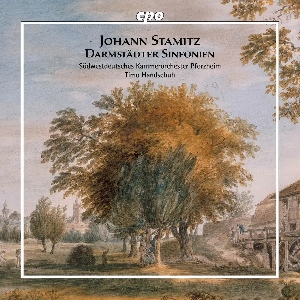
Johann Stamitz (1617-1757)
Darmstädter Sinfonien
Sinfonia in A major, A 3
Sinfonia in D major, D 21
Sinfonia in G major, G 8
Sinfonia in D major, D 23
Sinfonia in D major, D 24
Sinfonia in B flat major, B 4
Südwestdeutsches Kammerorchester Pforzheim/Timo Handschuh
rec. 2019, Evangelische Matthäuskirche Pforzheim, Germany
cpo 5551212 [76]
The undemonstrative charm and simplicity of these early three movement Symphonies bely their historical importance in the development of that genre. If Haydn was the father, then Stamitz is really the grandfather – at least in terms of musical culture north of the Alps, as Giovanni Battista Sammartini was instrumental in the evolution of the symphony in Italy. The half dozen pieces recorded here are called the ‘Darmstadt’ Symphonies because they exist in a manuscript which was copied for that city’s court in the 18th century and is still held by the University and State Library there. Stamitz was most closely involved with the court at Mannheim not too far away, and with the development of what came to be one of the most famous orchestras in Europe during that century. But there was considerable musical exchange between the two centres, and so it is not surprising that works by Stamitz ended up in Darmstadt.
These Symphonies are thought to date from around 1750, and perhaps earlier than that. They are in the three-movement form of the Italian opera overture or sinfonia, though the finales of a couple of them are in ‘tempo di minuet’ form, as Haydn would continue writing into the 1770s, foreshadowing what would become the penultimate section of more expansive four movement symphonies. The performances by the Südwestdeutsches Kammerorchester Pforzheim under Timo Handschuh bring spirit and elegance to this music which straddles the Baroque and Classical eras. Although the furious energy of repeated semiquavers in the opening movements of the Symphonies D21 and D24 bear the traces of a Vivaldi sinfonia for strings, the ensemble skate over these with brisk effortlessness. Antiphonal exchanges in Stamitz’s imaginative writing between the two violin parts bring some drama and expressive tension, but these are poised and well sprung in execution rather than pointed up with jarring contrasts between them.
Handschuh identifies the Affekt of rustic vigour associated with the key of G major, and so the Symphony G8 is invested with an earthy vitality: the syncopations of its unison opening theme are crisply articulated while, in the Andante, the violins sound bright and forthright, without exaggeration or affectation. The two Symphonies D23 and D24 add a pair of horns to the standard scoring for strings. The repeated quavers and snatches of fanfare in the opening movement of the former is like a prototype for Haydn’s ‘Hornsignal’ Symphony, but the horns here act discreetly instead of rasping, again suggesting courtly entertainment rather than a too obvious, programmatic depiction of the hunt. In the slow movement the violins magically weave together their arpeggios or snatches of melody in chains of thirds.
This is music that breaks new ground with a subtle, sophisticated air, and the performances articulate that character to a tee.
Curtis Rogers
Buying this recording via the link below generates revenue for MWI, which helps the site remain free