
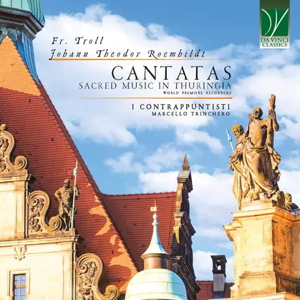
Sacred Music in Thuringia
Marco Grattarola (bass), Matteo Straffi (tenor)
Valerio Febbroni (recorder), Roberto Passerini (organ)
I Contrappuntisti/Marcello Trichero
rec. 2025, Chiesa di Ognissanti di Trino, Italy
German texts and English translations included
Reviewed as lossless download
Da Vinci Classics C01098 [57]
This is a fascinating glimpse into the world of little-known composers working in Thuringia around the time of JS Bach. The four cantatas, recorded here for the first time, were part of a collection of manuscripts found in the loft space of a church in the small Thuringian village of Grossfahner in 1968. Unsurprisingly, many of the manuscripts were damaged by exposure to the elements and were taken to Weimar for restoration. Alongside works by Telemann and Stölzel were those by composers obscure even in their own time (known as “small masters”). One of those on this recording doesn’t even have a completely known given name, and is shown as Fr. Troll, the assumption being that his first name began with those letters.
In one way, these four cantatas are quite modest, in that each requires only a single vocal soloist, and only one (two movements of RoemV201) has a choir. However, each is scored for at least one trumpet, and three for timpani, so that gives them a more substantial and impressive sound.
The notes describe the Troll cantatas (written that way, it makes them seem as though they were something from Lord of the Rings) as “severe” and “akin to Buxtehude”. However, I don’t believe you can listen to the exultant opening to the Easter cantata with its glorious trumpet fanfares, and use the adjective “severe”. The musical style, as well as the absence of recitatives, suggests that they are a little earlier than Roemhildt’s, whose career was only getting underway in 1715, the year shown on the manuscript of Troll’s Easter Cantata. The writing for the strings is relatively simple across all four works; the heavy lifting in melodic impact is done by the trumpets, and done very effectively. Roemhildt’s seven-movement Herr wie groß ist deine güte is probably the most impressive of the four, simply by virtue of the variety contained within: two sonatas, two choruses, two arias and one recitative. Roemhildt has received attention on record, with several others of his cantatas – there are apparently more than 200 of them – on releases by cpo (review ~ review) and Sarton (review).
The closing Aria of Roemhildt’s Herr Jesu, deiner tröst ich mich has a very strong resemblance to the opening of Rejoice, greatly from Messiah. As there is no date ascribed to the work, it is not clear whether this is a case of the lesser-known composer borrowing from the famous one, the reverse (it seems unlikely that Handel would know the work) or just a coincidence.
Flute concertos, even Mozart’s, aren’t really my thing, and when the instrument employed is a recorder, it sinks further down my list of preferences. Nevertheless, I found this piece, which does not have an identifiable author, quite enjoyable, especially the lovely slow movement.
The composers of the three organ chorales – Johann Gottfried Walther and Friedrich Zachow – are slightly better known than Troll and Roemhildt, though more for their connections than their music: the former was a first cousin of JS Bach, the latter Handel’s teacher. I’m not an organ aficionado, so can’t really comment on them with any particular authority. The organ of Ognissanti di Trino sounds relatively small, but having seen a YouTube video of it, it is clearly a consequence of the way it is being played, rather than its size.
Bass Marco Grattarola has the majority of the work as soloist in three of the cantatas, and while the bass voice isn’t my favourite, I felt he did a mostly good job, though in both of Troll’s cantatas, there were passages which took him a long way down his register, and seemed a little bit of a struggle. Tenor Matteo Straffi’s solo part in Herr wie groß ist deine güte is confined to two slow arias, and he shaped his voice around the restricted accompaniment of organ and violin well. I Contrappuntisti comprises just four string players and three in the basso continuo, plus the trumpets and timpani, and I very much enjoyed their contributions. The notes do a remarkably informative job, given the paucity of information available, and the sound quality is all that one could want.
I decided to review this recording, partly out of curiosity, but also to support the very enterprising Da Vinci label, which releases a remarkable number of recordings of mostly obscure music every month (their list for January numbers eighteen). I have been rewarded by a thoroughly enjoyable group of works, which, to quote a sporting cliché, illustrates the depth of talent in the “squad” (by which I mean 18th century Thuringian composers not bearing the initials JSB).
David Barker
Buying this recording via the link below generates revenue for MWI, which helps the site remain free

Contents
Fr. Troll
Christmas Cantata: Siehe ich verkündige euch (c. 1715) *
Johann Gottfried Walther (1684-1748)
Organ Chorale: Von Gott will ich nicht lassen
Johann Theodor Roemhildt (1684-1756)
Cantata for the 6th Sunday after Trinity: Herr Jesu, deiner tröst ich mich, RoemV 129 *
Anonymous
Flute (Recorder) Concerto *
Johann Gottfried Walther
Organ Chorale: Herr Christ, der einig Gottes Sohn
Johann Theodor Roemhildt
Cantata for the 18th Sunday after Trinity: Herr wie groß ist deine güte, RoemV 201 *
Friedrich Zachow (1663-1712)
Organ Chorale: Christ lag in Todesbanden
Fr. Troll
Easter Cantata: Singet dem Herrn ein neues Lied (1715) *
* first recordings













