
Pyotr Tchaikovsky (1840-1893)
The Nutcracker – ballet in two acts
Choreography by Peter Wright, after Lev Ivanov
The Royal Ballet
rec. 2025, The Royal Opera House, Covent Garden, London
Opus Arte OABD7336D Blu-ray [113]
The Nutcracker is a ballet that tends to divide audiences. For many it is a once-a-year family excursion, a seasonal treat for children with many little girls dressed up in tulle and tiaras. Others consider their tastes too sophisticated to overdose on sugared almonds and the other sweets depicted in the magical kingdom… For Covent Garden, I had no intention of producing something tasteful for an opera house audience. I wanted to honour the spirit of the original by giving a sense of period and bringing the story to life. Above all, I wanted magic. (Peter Wright, Wrights & Wrongs: My Life in Dance, Oberon Books, London 2016, pp.287-288)
Sir Peter Wright is due to celebrate his 100th birthday on 25 November this year. In the course of his long career, he has been associate director of the London-based Royal Ballet (1969-1977) and artistic director of the company that was to become Birmingham Royal Ballet (1977-1995). The productions of The Nutcracker that he devised for each are still in their respective repertoires. Whenever they are staged during the Christmas holidays, they invariably fill the auditoria at the Royal Opera House, Covent Garden, and the Birmingham Hippodrome.
It will, I think, be helpful at this point to distinguish one staging from the other. The earlier, premiered at Christmas 1984 at the Royal Opera House, Covent Garden, and revised in 1999, is the one that the Royal Ballet performs. As the disc under review presents a recording of that particular version, I will defer for the moment any more detailed discussion.
Wright’s second production, created for Birmingham Royal Ballet and impressively designed by John Macfarlane, was first seen on the Hippodrome’s stage in 1990. It has since clocked up more than 600 performances. Following a £1 million overhaul in 2022, its refreshed sets and costumes look quite splendid. At the same time, up-to-date technology that was unavailable 36 years ago has now been incorporated into the production. The on-stage action at Birmingham is very different from that seen at Covent Garden. For instance, the Hippodrome’s 1990s stage could not accommodate something on the scale of the Royal Ballet’s famously-growing centre-stage Christmas tree. So, Wright introduced an alternative coup de théâtre: the rat king’s army bursts out of a massively enlarged version of the blazing fireplace in the Stahlbaum family’s drawing room. The subsequent waltz of the snowflakes proves a particularly successful exercise in re-imagination, as the addition of male dancers, designated “winds”, brings some welcome visual and choreographic variety to the scene. The first act also concludes with a striking, bring-a-smile-to-the-face moment: Clara and the prince exit stage right, flying through the air on the back of a giant bird.
Peter Wright himself describes his Birmingham Nutcracker as “a freer, more youthful and romantic telling” of the story than his earlier Royal Ballet version (op. cit., p.295). It is, he adds, “much more the Wright Nutcracker” (ibid.). A Sunday Times critic, quoted in Birmingham Royal Ballet’s own advertising material, suggests that “No other version comes close” and awards the production a top five-stars rating.
You will, then, understand that it is certainly not only the much cheaper price of seats that, more often than not, tempts me and many others to head at Christmas for the West Midlands rather than London. Incidentally, although the Birmingham production has been filmed only once, you may still be able to find a recording of that vintage 1994 performance that starred Miyako Yoshida and Irek Mukhamedov. It has been issued on Kultur DVD D1491 and on a Covent Garden Pioneer series disc (whose only claim to be pioneering at all, as far as I can see, is that it has not been allocated an individual release number). In view of the Birmingham production’s superb quality – and particularly after that 2022 £1 million revamp – it is surely time for a new filmed performance. Peter Wright’s Midlands legacy deserves to be preserved more comprehensively and at 21st century technical standards – and it needs to be shared with a wider audience.
Let us move back down south to Covent Garden, London. This Blu-ray disc memorialises a performance given last year – see Jim Pritchard’s review – and adds to the rich tradition of filmed Royal Ballet Nutcrackers. The earliest by far was recorded in black-and-white for BBC TV in 1958 (ICA Classics DVD ICAD 5050). Margot Fonteyn and Michael Somes took the star roles of the Sugar Plum Fairy and the Nutcracker Prince. Although only the ballet’s second Act was filmed, we are fortunate that this example of Wright’s Nutcracker choreography at the earliest stage of his career has, unlike many old television productions, been preserved at all.
Since then, more Royal Ballet performances featuring various star partnerships have been released on disc for home viewing. All of them are iterations of Peter Wright’s 1984 production. A 1985 account, headlined by Lesley Collier and Anthony Dowell (Warner Music Video/NVC Arts DVD 0630-19394-2) was followed 11 years later by another featuring Miyako Yoshida and Jonathan Cope (BBC/Opus Arte DVD OA 0827 D). The pace of releases has accelerated somewhat since the turn of the century. Ms Yoshida once again took the leading role, this time partnered by Steven McRae, in 2009 (Opus Arte DVD OA 1036 D), while in 2016 it was the turn of Lauren Cuthbertson and Federico Bonelli (Opus Arte Blu-ray disc OA BD7229 D). They were very quickly followed, just a couple of years later, by the superstar partnership of Marianela Nuñez and Vadim Muntagirov (Opus Arte Blu-ray disc OA BD7259 D). Anyone who wants to appreciate Peter Wright’s importance to the world of classical ballet – and, specifically, to Tchaikovsky’s three great works, for he has choreographed all of them – is, therefore, rather spoiled for choice when it comes to his Royal Ballet Nutcrackers.
The performance under review was edited together from shows filmed on 5 and 10 December 2025. Jim Pritchard may not have experienced exactly what is presented on this disc when he reported back after watching a live relay at Cineworld Basildon on 10 December last year. Yet I am sure that it will have been pretty close. Jim’s review pinpoints the main difficulty of any Nutcracker: how effectively to integrate the “reality” of most of the first Act with the “fantasy” of the second. He asks “who really knows what’s going on in this almost plot-less version of The Nutcracker with its Act I Stahlbaums’ Christmas party and Act II divertissements in the Sugar Garden of the Kingdom of Sweets”.
As Peter Wright himself observes, however, that very narrative deficiency actually offers an opportunity. “The Nutcracker is the exception among the classic ballets in that it never had a satisfactory story from the outset”, he writes, before adding with, one suspects, a sly smile that “[t]his provides the producer with considerable scope” (op. cit., p.287). Exploiting that opportunity, Wright seeks to forge links between the ballet’s two disparate halves. In some of those second at divertissements, for instance, he makes Clara and her prince active participants rather than merely uninvolved observers who sit politely at the edge of the stage.
Wright also clarifies the role of the enigmatic character Drosselmeyer. Unlike some other productions that fail to offer any rational motive for the toymaker/magician’s somewhat bizarre actions, he comes up with the idea that Drosselmeyer is desperately searching for a lost nephew, Hans-Peter, who has been transformed into a nutcracker. He makes that point explicit by adding two brief, newly-devised scenes, set in Drosselmeyer’s workshop and placed at the very beginning and end of the whole ballet. We are still, it is true, left with the mystery of why some malevolent force is randomly transforming handsome young men into kitchen utensils. Yet Wright’s scenario at least begins to clarify what Drosselmeyer is up to, while, at the same time, the thematic distance between the two potentially disparate acts is somewhat reduced and The Nutcracker’s story brought full circle. Jim’s criticism remains, nevertheless, a fair one. The spatial and even metaphysical relationships between the Stahlbaums’ drawing room and the Kingdom of Sweets will, in all probability, always remain more than a little murky. Thankfully, the odd non-sequitur or two in the plots of ballets – and operas – do not, in practice, seem to bother audiences too much at all.
In spite of any remaining structural problems, the successful combination of Wright’s inventive and very winning choreography with Tchaikovsky’s masterful score has won over Covent Garden audiences for more than 40 years. In view of all those previous filmed Royal Ballet accounts, however, do we need another? Is there anything about this newly-filmed performance that distinguishes it significantly from its predecessors?
The most obvious and important point of difference lies in the casting. The 2018 performance starred the two biggest names in the company at the time, Marianela Nuñez and Vadim Muntagirov, a pairing that has been so effective that it has been deployed in filmed recordings of all three Tchaikovsky ballets and of several other productions. Both dancers still perform at Covent Garden; there would obviously have been little point in filming them a second time. The Royal Ballet is, though, nothing if not a company that exhibits strength in depth. Its principal dancers sometimes enjoy working lives of up to 20 years at that level, so it can easily field several other pairings that are ready, willing and, most importantly, able to take centre stage. As a consequence, Covent Garden audiences are now increasingly used to seeing performances headlined by some of the new generation of dancers who have attained that elevated rank within the past decade. Earlier this year, I strongly recommended the company’s newly filmed version of Swan Lake that starred Yasmine Naghdi (promoted to principal dancer in 2017) and Matthew Ball (2018). Now, with The Nutcracker, it is the turn of Mayara Magri (2021) and Reece Clarke (2022) to take their places in the spotlight in a performance thought significant – and commercially viable – enough to transmit to cinemas worldwide and, consequently, to release on disc.
When Jim Pritchard visited Cineworld Basildonback in 2022 (the year in which, he proudly informs us, it was named Cinema of the Year), he found Ms Magri’s Nutcracker performance to be “elegant, expressive and precise”. As it happens, on that day she had been taking the role of the Rose Fairy in the Waltz of the Flowers but Jim’s description is equally apt when applied to her dancing, three years later, in the role of the Sugar Plum Fairy in the performance under review. As you might expect of dancers performing at this level, the qualities of elegance and precision can be taken as read. Ms Magri is, indeed, clearly mistress of both, as she demonstrates most conclusively in an exquisitely delivered account of the Dance of the Sugar Plum Fairy.
Expressiveness is not, however, as important a feature of the Sugar Plum Fairy’s role as elegance and precision for, to be honest, her character is only vaguely delineated in Nutcracker’s story. While she may live in the Kingdom of Sweets, she is not, as far as we know, its queen. She is partnered by someone designated as a prince, yet she does not appear to be a princess. We understand that she is a fairy but – unlike, for instance, The Sleeping Beauty’s Lilac fairy – she does not wave a magic wand to perform even the slightest piece of supernatural trickery. Thus, it is never even very clear what qualities she has at all, let alone which ones she might be expressing as we see her on stage. As seen in Peter Wright’s production at Covent Garden, the Sugar Plum Fairy is simply the personification of charm and benevolence. Such a role is a perfect fit for Ms Magri’s demeanour. Her pas de deux with the Prince provides, in practical terms, a welcome change of focus and of pace from the second-act divertissements’ succession of delightfully entertaining grotesques.
Ms Magri’s partner in this performance is Reece Clark. He is a true danseur noble whoradiates strength and masculinity to a degree not always seen in other performances. That initial impression of physical strength, subsequently emphasised by a series of confidently delivered lifts, makes Clarke a fine and fitting partner for Ms Magri. When, moreover, he dances solo in his athletic variations, he is demonstrably something rather more than that.
Allow me an aside. Am I the only one who finds the effete costume with which designer Julia Trevelyan Oman saddles the Royal Ballet Nutcracker Prince particularly unappealing? Dressing the Sugar Plum Fairy quite rightly as the acme of femininity surely does not necessitate the sartorial emasculation of her partner. A blond wig looks rather odd, to say the least, when affixed to the head of a dancer whose eyebrows give him away as obviously dark-haired. Meanwhile, the Prince’s rather generic coronet looks like it has been designed by a six-years-old child, and his bumfreezer jacket simply looks very silly. Even if he lives in a fairytale realm of candyfloss and bon-bons, would he not be more effectively costumed in a more masculine fashion? Something like the smart military get-up that Hans-Peter sports in Act 2 – but perhaps in a different colour to distinguish it – might look good. In one of the extra features included on the disc, we very briefly see Reece Clarke rehearsing while not wearing that dreadful blond wig. Completely transformed, he looks like a dashing Romantic hero, straight out of a novel by Georgette Heyer or Barbara Cartland.
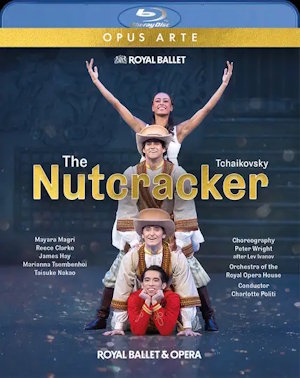
Marianna Tsembenhoi and Taisuke Nakao dance the roles of young Clara, the ballet’s ostensible heroine, and Hans-Peter. Given the rather limited opportunities that she actually gets to dancein The Nutcracker, Ms Tsembenhoi demonstrates an impressive range of technical skills. She is clearly very gifted and seems to be a particularly fine interpreter of character. Many Claras make, I’m afraid, somewhat insipid impressions on stage. Not so this one. Tsembenhoi believable and sympathetic portrayal holds our attention throughout. She is, I suspect, something of a star in the making and I look forward to seeing how she tackles more ambitious roles in the future. While her partner, Mr Nakao, may not be quite yet at the same level in the acting stakes, he, too, is a superb technician. That quality was apparent as far back as 2017 in a prizewinning performance at the Prix de Lausanne, and it has clearly been refined since then. He dances exceptionally accurately, cleanly and elegantly. He may be no danseur noble, but his more slightly built frame proves no handicap when it comes to effective partnering. I now look forward to seeing him, too, stretched and challenged in a few roles that require more than sheer technical skill. It is a nice touch and, perhaps, a nod to the future, that an image of a beaming Tsembenhoi and Nakao, taken at the climax of the Russian Dance, has been chosen for this new disc’s front cover.
You may recall my recent review of a performance of Frederick Ashton’s ballet Le fille mal gardée,in which James Hay debuted as Widow Simone. Here, he once again takes on a new role, this time as Drosselmeyer. As Mr Hay tells us in one of the disc’s featurettes, he has danced a range of roles in this Nutcracker production since he was just 11 years old. Over time, he has been a child at the Stahlbaums’ Christmas party, a toy soldier, Clara’s annoyingly wilful brother Fritz, a cavalier (which I take to be one of the Rose Fairy’s escorts) and the nephew/nutcracker Hans-Peter. Clearly, therefore, he is very much at home on thisstage. He has already established a strong personality as Drosselmeyer, and, most important, mastered his character’s magical party tricks sufficiently well that I still cannot see how they are done. Jim Pritchard finds his portrayal “less avuncular than some […] slightly demonic […] a second cousin to von Rothbart in Swan Lake”. While I entirely understand that point, I still find myself somewhat relieved that Mr Hay’s Drosselmeyer does not immediately put me in mind of the sort of man that you were strictly warned to steer clear of as a child.
None of the rest of the dancers, whether in brief featured roles or as members of the corps de ballet, let the side down. Indeed, the air of slickness and professionalism that characterises the whole production is worth recognising. Other companies’ Nutcrackers can sometimes seem somewhat rough-edged, especially when some of the children deployed on stage are really far too young. It is no doubt a thrill for their doting mums and dads, but it is an irritating pain for others in the audience who have paid premium prices to watch what is billed as a professional production (yes, I’m thinking of you, New York City Ballet).
As ever, the Orchestra of the Royal Opera House plays Tchaikovsky’s score skilfully and idiomatically. The Royal Ballet’s associate conductor Charlotte Politi exercises fine dynamic control. She knows exactly when to ramp up the levels of orchestral excitement or, indeed (this being Tchaikovsky), to play up the episodes of lush sentimentality. Morever, she appreciates the importance of adopting tempi that always remain danceable, neither so fast that dancers cannot keep up nor so slow that they will be in danger of losing their balance. All in all, she delivers the goods.
Incidentally, I have recently come across Leopold Stokowski’s completely manic and utterly undanceable Phase 4 Stereo Rose Adagio from The Sleeping Beauty. If anything proves my point about ballet conductors needing to be sympathetic to the dancers’ physical limits, that is it. As my colleague Dan Morgan observed in 2014, “Stokowski presses ahead rather too much. Goodness, was he late for an appointment elsewhere? […] this is a Sleeping Beauty on amphetamines”. It is, nonetheless, I would add, great fun to listen to at home as long as you can temporarily banish any images of real-life dancers from your mind’s eye.
Most of the Royal Ballet’s filmed productions have, over the years, been directed for the screen by Ross MacGibbon, but this one is helmed by Peter Jones. He filmed the Swan Lake that I so much admired last year and is, it seems, a veteran of well over a hundred international broadcasts of operas and ballets. We might therefore assume that he is a safe pair of hands, but in fact he is rather more than just that. This Nutcracker emerges, in his direction, as an experience somewhat more distinctively theatrical than usual. Let me explain. While watching the film, I began to notice that the director seems surprisingly fond of shots that allow viewers to catch sight of all or part of the proscenium arch as it frames the on-stage action. As I have previously observed, sometimes filmmakers intend that sort of thing to create a Verfremdungseffekt, deliberately reminding viewers of the essential artificiality of what they are seeing. Here, however, I think that the purpose is, once in a while, to remind us subtly of the experience of watching the show from the front stalls. It is an interesting – if, let me stress, delicately and only occasionally applied – alteration of focus.
We might perhaps speculate that – while Ross MacGibbon’s background as a former Royal Ballet dancer inclines him to recreate the onstage action at close quarters as subjectively recalled by a stage performer – Mr Jones who, as far as I am aware, has never danced professionally, sees things more from the objective and quite literally distanced perspective of a theatregoer. Both approaches would, of course, be entirely legitimate. The more important point to stress is that both men are clearly expert in their field. They ensure that we see everything we need to see whenever we need to see it. The technical quality of both vision and sound on this Blu-ray disc – which is surely the format that committed balletomanes will want to own – is first-class.
I hope that I have made clear that the performance preserved on this disc is most enjoyable. It is, moreover, particularly interesting in that it brings some new personalities to the fore. Some of them – the dancers Mayara Magri, Reece Clarke and James Hay – are already very familiar to Covent Garden patrons but are now receiving greater exposure in leading roles on discs marketed to a much more diverse audience. Other names – those of Marianna Tsembenhoi, Taisuke Nakao, conductor Charlotte Politi and film director Peter Jones – may be less familiar at the moment. Yet, on the basis of what I have seen here, I have no doubt that we can look forward with pleasurable anticipation to encountering them again in the future.
This welcome filmed performance is also important as a means of preserving Sir Peter Wright’s choreographic legacy and making it available to a wider audience. Many, I am sure, will watch it with immense pleasure, and will want to join me in sending best wishes to Sir Peter as he celebrates his 100th birthday.
Rob Maynard
Buying this recording via the link below generates revenue for MWI, which helps the site remain free

Cast and production staff
The Sugar Plum Fairy – Mayara Magri
The Prince – Reece Clarke
Herr Drosselmeyer – James Hay
Clara – Marianna Tsembenhoi
Hans-Peter / The Nutcracker – Taisuke Nakao
Drosselmeyer’s assistant – Caspar Lench
Dr Stahlbaum – Thomas Whitehead
Mrs Stahlbaum – Christina Arestis
Fritz – Milan Yep
Clara’s partner – Daichi Ikarashi
Grandmother – Isabel Lubach
Grandfather – James Large
Housekeeper – Barbara Rhodes
Aunts – Olga Sabadoch and Clare Lumley
Dancing mistress – Annette Buvoli
Captain – Téo Dubreuil
Harlequin – Marco Masciari
Columbine – Scarlett Harvey
Soldier – Harrison Lee
Vivandière – Chisato Katsura
Mouse king – Francisco Serrano
Snowflakes – Artists of the Royal Ballet
Spanish dance – Isabel Lubach, Olivia Findlay, Maddison Pritchard, Giacomo Rovero, James Large and Blake Smith
Arabian dance – Nadia Mullova-Barley and Harris Bell
Chinese dance – Martin Diaz and Harrison Lee
Russian dance – Francisco Serrano and Joshua Junker
Dance of the mirlitons – Yu Hang, Ella Newton Severgnini, Viola Pantuso and Amelia Townsend
Waltz of the flowers: Rose fairy – Claire Calvert
Waltz of the flowers: Rose fairy escorts – Leo Dixon, Téo Dubreuil, Joonhyuk Jun and Aiden O’Brien
Waltz of the flowers: Leading flowers – Mica Bradbury, Hannah Grennell, Chisato Katsura and Charlotte Tonkinson
Waltz of the flowers: Flowers – Artists of the Royal Ballet
The Schola Cantorum of the London Oratory School
London Oratory Junior Choir
Students of the Royal Ballet School
Artists of the Royal Ballet
Orchestra of the Royal Opera House/Charlotte Politi
Production and scenario – Peter Wright
Designer – Julia Trevelyan Oman
Lighting designer – Mark Henderson
Staging – Christopher Carr and Samantha Raine
Directed for the screen by Peter Jones
Technical details
1080i High Definition Blu-ray disc
Filmed in High Definition and mastered from an HD source
Picture format: 16:9
Sound format: LPCM 2.0 and DTS-HD Master Audio
Region code: all regions
Subtitles: English, French, German, Japanese and Korean (extra features only)













