
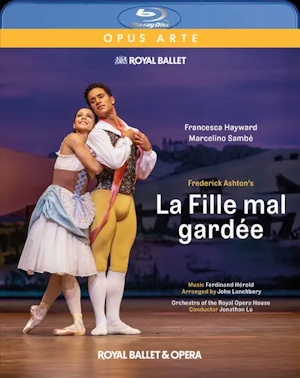
Frederick Ashton’s La fille mal gardée
Ballet in three acts
Music by Ferdinand Hérold (1791-1833), arranged and orchestrated by John Lanchbery (1923-2003)Choreography by Frederick Ashton
Lise: Francesca Hayward
Colas: Marcelino Sambé
Widow Simone: James Hay
Artists of The Royal Ballet
Orchestra of the Royal Opera House / Jonathan Lo
rec. 2025, Royal Opera House, Covent Garden, London, UK
Opus Arte Blu-ray OABD7334D [108 (ballet) + 12 (extra features)]
La fille mal gardée is probably the best-loved of Frederick Ashton’s many choreographic creations for the Royal Ballet. Regularly revived since it was first performed 66 years ago, it invariably fills the Covent Garden auditorium and is a guaranteed cash-cow for the company.
A number of Royal Ballet performances have, over the years, been preserved on film and released on DVD or Blu-ray disc. Given the 1960 premiere’s rapturous reception, its dancers, led by Nadia Nerina and David Blair, were quickly invited into the BBC’s television studios. There they recorded a version that, albeit cut to 90 minutes from the usual 110 or so, and filmed in black-and-white, still conveys the ballet’s sheer high spirits and joie de vivre. A second vintage performance from 1981, starring Lesley Collier and Michael Coleman, was also filmed. You may be able to find it on an old Warner Music Video / NVC Arts DVD (0630 19395-2). A running time of 96 minutes indicates that a little judicious trimming has also been undertaken, but many potential buyers will be won over by the fact that the production was filmed in colour – and Ms Collier’s performance is one to be treasured.
Marianela Nuñez, one of the Royal Ballet’s best-loved principal dancers today, as far back as 2005 starred alongside Carlos Acosta in a performance filmed at the Royal Opera House. That remains many balletomanes’ favoured choice, thanks to its leading dancers’ sheer charisma and to its availability not only on DVD but in the technically superior Blu-ray format. A decade later, a performance boasting a cast headed by superstar dancer Natalia Osipova and Steven McRae conclusively demonstrated the Covent Garden company’s continuing commitment to preserving Ashton’s legacy and to presenting La fille with dancers and productions of the highest quality (Opus Arte Blu-ray disc OA BD7187 D).
Now, it seems, we are to have a new filmed performance for the 2020s, as danced last year by regular Royal Ballet partners Francesca Hayward and Marcelino Sambé. In light of all those previous versions, it might be asked whether a new one is really necessary, but the company’s philosophy seems to be that significant and accomplished new casts deserve permanent memorialisation on film. Dance historians of the future will, no doubt, find that practice – unique in the world, as far as I know – invaluably enlightening. It goes without saying that, from a balletomane’s point of view, it is also very welcome.
As they tell us in the course of one of this release’s accompanying extra features, Ms Hayward and Mr Sambé have, during the past decade, appeared together several times in the roles of farmer’s daughter Lise – the badly-guarded girl of the ballet’s title – and her ardent but impecunious suitor Colas. They have thereby, both there and in other ballets, become very well attuned to each other’s characteristics and capabilities as dance partners. Moreover, as is self-evidently demonstrated in the extra feature Francesca Hayward and Marcelino Sambé in conversation on La fille mal gardée, the pair of them clearly have a genuinely close personal rapport.
Not every heroine of a classical ballet is a put-upon Odette from Swan Lake, or a fatally betrayed Giselle. Indeed, La fille’s spunky central character Lise is right up there with Don Quixote’s Kitri and the eponymous heroine of Paquita: she rejects society’s preordained assumptions and vigorously seizes control of her own destiny. While the composition of full-length 19th century ballet scores may have been institutionally limited to men, feminism was clearly in the air. Ms Hayward is a complete delight in this performance. As she darts around the stage in the most spirited fashion, she completely captures not only Lise’s winning charm but also that all-important element of determined wilfulness. Her technique is, unsurprisingly, impeccable. Her acting, too, is very impressive. You can see that she is carefully watching what is going on around her and interacting (or, perhaps more accurately, inter-acting) entirely appropriately with her fellow dancers. [While that might be taken as axiomatic practice, it is not. Onstage dancers are, quite understandably, so preoccupied with the technicalities of their physically taxing craft that they sometimes fail to pay sufficient attention to acting their roles in a believable fashion. Of course, a few may simply be unable to master the required techniques at all.]
The case of Ms Hayward’s co-star is rather less straightforward. I have recently lavished the highest praise on Mr Sambé, observing that “he displays tremendous ability in acting as well as dancing”. On this latest occasion, however, my admiration is somewhat more qualified. The aspect at issue is not his acting. The role of Colas is a perfect fit for Sambé’s genially cheeky-chappie persona, and his depiction is absolutely spot-on. To see what he brings to the role, it is interesting to compare his approach to that of Covent Garden’s current star ballerino Vadim Muntagirov. The latter, a dancer of naturally aristocratic bearing and a technician at the finest level, gives a softly restrained interpretation of the role. He plays up Colas’s endearing tenderness and cuts down on the character’s brash exuberance and laddishness. Those latter qualities are, however, the very ones that Sambé chooses to emphasise. Mutagirov’s Colas would worship his beloved from afar; Sambe’s, one suspects, would be more likely to whisk her off for a (surely not unwelcome) tumble in the nearest cornfield.
Much to my own surprise, the issue that I have with Sambé in this performance is with his dancing. Most of it is, of course, of a standard that’s almost beyond criticism. I do, however, sense that there are just a few moments where his concentration seems to lapse. A slightly awkward gesture here, a rough landing or a hint of unexpected wobble there… each inevitably standing out somewhat when set against Ms Hayward’s sustained exhibition of precision, grace and vivacity. I wonder whether, on this occasion, the very noisily appreciative Covent Garden audience – far louder than I have ever heard them before and not confining their appreciation to the natural breaks between numbers – may be somehow responsible. Perhaps the noisy patrons are simply disturbing Sambé’s concentration? Or maybe he is momentarily unable to resist playing to the stalls and so physically over-extending himself? Perhaps, on the other hand, the audience does not come into it at all, and he is merely having an off night? While, on balance, Sambé’s very winning characterisation outweighs any slight technical issues, I cannot help thinking that his performance would have benefited from a little less spontaneity and a tad more precision.
James Hay, meanwhile, makes the most of the role of Lise’s mother, Widow Simone. Not only has he been made up to appear rather younger than previous Widows, but he also delivers a distinctive interpretation of the role. This is a woman who is, it appears, almost perpetually irritable, and less likely to give her wayward daughter a motherly caress than a brisk slap on the bottom or across the face (which she actually does at one point, rather harshly at that). Her rarely expressed moments of maternal affection thereby come across as somewhat jarring and inauthentic. When this performance was filmed, Hay was very new to the role. I expect that he will refine his interpretation and introduce a few subtler touches as he engages with it more often in the future.
Dutch dancer Joshua Junker makes a positive impression as Lise’s unsuccessful suitor, the nice but (very) dim Alain, but his performance is very much circumscribed by its unique choreography. Even when he joins in the communal merrymaking that brings the first act to its stormy conclusion, Alain is given an idiosyncratic, jerky style of dancing very much his own. Ashton has, moreover, given him the character of a loner who hardly interacts physically – let alone on an emotional level – with any of the other principal dancers at all. He really is, as the phrase has it, in a world of his own. There is, as a consequence, little if anything that a performer can do to put his own individual stamp on the role, and virtually nothing that his onstage colleagues can do to help. Instead, all the Alains that I have seen have pretty well followed the original template set down at the 1960 premiere by Alexander Grant, a dancer whom Ashton so much admired that he left the rights to La fille to him in his will. Grant’s performance has, of course, been preserved in the aforementioned film, so we can see that Junker does a fine job of following precedent and thereby adding, as was the choreographer’s undoubted intention, to the gaiety of nations.
The other featured cast members – Alain’s father, the notary, the notary’s clerk and the cockerel – all make the most of their brief moments in the spotlight. Meanwhile, the members of the corps de ballet dance enthusiastically, energetically and skilfully. As we often see in Royal Ballet productions, the dancers’ individuality is prioritised over absolutely exact unanimity. That is an especially important feature of La fille because it serves to emphasise the ballet’s informally relaxed and happy tone. It also adds to the believability of a story that eschews fairies, princes and princesses in favour of an everyday story of clog-dancing country folk.
While on the subject of the cast, let us give credit to Oscar the pony. Not only is he a particularly handsome beast, but he is also a very well-behaved one. La fille’s livestock have, over the years, acquired an unfortunate reputation for less than perfect bowel control, which may be one of the reasons why Covent Garden management has decided that, in future, live animals will no longer be seen on its stage. As well as this production’s ponies, the avians of Ashton’s The Two Pigeons who bring the house down in a memorable final coup de théâtre are also for the chop (though not, one hopes, literally). All we will soon be left with are the pigs, mice and other assorted livestock in Anthony Dowell’s popular 1992 ballet The Tales of Beatrix Potter, which, charming though they are, are not quite the same thing at all. Let us, then, use this opportunity to pay a final tribute to Oscar, the pigeons and all their predecessors.
John Lanchbery’s arrangement of Hérold’s music is, after sixty-odd years, something that one suspects that the Orchestra of the Royal Opera House could play blindfold. On this occasion, they are conducted by Jonathan Lo who, as music director and chief conductor of The Australian Ballet, is a specialist entirely at home with the score.
The performance has been directed for film by the very experienced Ross MacGibbon who, as an former Royal Ballet dancer, knows exactly where to position his cameras to best purpose and effect. The reproduction on my Blu-ray disc was first-class in picture and sound. While in every other circumstance that is something to be welcomed, it unfortunately meant that on this occasion the aforementioned over-enthusiastic audience became, from time to time, an annoyingly prominent distraction. I am sure that I am not alone in hoping that, if the same issue reoccurs in future, it can be addressed for repeated home viewing by the judicious use of technology.
As usual, Opus Arte has been less than generous in the provision of extra features. The Joy of Performing La fille mal gardée and Francesca Hayward and Marcelino Sambé in Conversation on La fille mal gardée come in together at just 12 minutes. I would have loved to hear more of what Ms Hayward, Mr Sambé and Mr Hay have to say. They are interesting and engaging speakers, and I am sure that, given the opportunity, they would have willingly obliged. I cannot see why, if extra features are going to be added to these releases at all, they are not made more substantial and helpful to viewers who might thereby be inspired to explore the world of ballet further. Any extra cost would surely be marginal. The producers of these discs are surely missing an easy trick here.
This release will certainly give a great deal of pleasure to balletomanes and to general viewers. It memorialises and captures in state-of-the-art vision and sound one of the jewels in the Royal Ballet’s crown. Anyone who watches it will easily appreciate why, for almost seven decades, Ashton’s Le fille mal gardée has retained a secure place on the Covent Garden stage and in the affections of the ballet-going public.
Rob Maynard
Buying this recording via the link below generates revenue for MWI, which helps the site remain free

Other cast and production staff
Thomas: Christopher Saunders
Alain: Joshua Junker
Cockerel: Liam Boswell
Hens: Madison Bailey, Bomin Kim, Leticia Stock, Marianna Tsembenhoi
Lise’s friends: Mica Bradbury, Annette Buvoli, Leticia Dias, Hannah Grennell, Chisato Katsura, Sae Maeda, Mariko Sasaki and Charlotte Tonkinson
Notary: Aiden O’Brien
Notary’s clerk: Liam Boswell
Villagers, harvesters and grooms: Artists of the Royal Ballet
Design: Osbert Lancaster
Lighting design: John B. Read
Staging: Christopher Carr
Directed for the screen by Ross MacGibbon
Technical details
1080i High Definition Blu-ray disc
Audio formats: LPCM 2.0 and DTS-HD Master Audio
All regions
Subtitles for extra features in English, French, German, Japanese and Korean













