
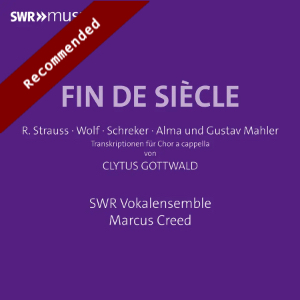
Fin de siècle
Transcriptions for a cappella Choir
SWR Vokalensemble/Marcus Creed
rec. 2012-25, SWR Funkstudio, Stuttgart, Germany
SWR Music SWR19174CD [69]
Fin de siècle brings together a series of choral transcriptions of music by Strauss, Wolf, Schreker and the Mahlers that were created by Clytus Gottwald for small vocal ensembles of anywhere from six up to sixteen voices. The music he chose was all drawn from the period of the shift from the 19th, into the 20th centuries. This was a period time when a cappella choir music seemed to be waning, in Europe especially. Gottwald chose his pieces mostly from among the song repertoire, although there is a gorgeous sounding version of the adagietto from Mahler’s Fifth Symphony also included here. In the notes for the excellent booklet that accompanies the disc it states :
The greatest change in transferring the piano songs into choral texture lies not necessarily in the broad fanning-out of the voices , which spread like a net across the tonal space. It also lies in the disappearance of the piano as the singer’s independent counterpart.
This is an important point in how one experiences these pieces. Some of the works seem barely recognizable in their new choral setting because the contrast between the solo lines and the accompaniment seems to dissolve completely. However, one should not take this as a criticism on my part; it is just to recognize that hearing a song such as Richard Strauss’ Die Nacht, may strike the listener who may be acquainted with that work as an almost new and unfamiliar sounding piece.
The disc opens with the heavenly sounding SWR Vokalensemble in a rapturous and haunting account of Schreker’s Im Lenz. I recommend sampling this track to anyone wanting to hear an example of what delights are in store on this excellently produced CD. The vocal ensemble of the Südwestrundfunk have long been known for the sheer excellence of their work. Since 2003, under their current leader Marcus Creed, they seem to be dwelling in a new renaissance of artistic glory, if this CD is anything to go by.
This choir is a top notch ensemble, crisp and well-trained in their task. They are masters of how to obtain shifting colours of sound in a work such as in Schreker’s Auf ein Altes Bild. Yet this is perfectly contrasted with the almost spiky counterpoint in the same composer’s Umsonst, also superbly realized here by this ensemble.
It is difficult not to be awestruck by the even more elaborate counterpoint required of the ensemble in the final song of the Hugo Wolf group, Der Gärtner. Here the difficult vocal lines and text interweave with one another into what amounts to a duet for two choirs. This is one of the most impressive feats of music making on the entire CD.
To hear a well known song such as Gustav Mahler’s Die Zwei Blauen Augen in this arrangement leaves one with an unsettled feeling, as the familiar impression of bitterness and wandering created by the soloist and piano is here veiled by the sumptuous arrangement for the voices.
The one track that most retains its original form for this listener is the transcription of the Urlicht movement from Mahler’s second Symphony. Here the choir is able to draw on its skill with long, drawn-out vocal lines almost to the point of infinity. This impression is also reinforced on hearing the arrangement of the Adagietto from the Fifth Symphony; here it has been provided with words by using the same poem that Richard Strauss used for the final song of his Vier Lezte Lieder: Im Abendrot by Joseph von Eichendorff. This too is performed gently and sensitively by the vocal ensemble.
When it comes to the three songs by Alma Mahler Werfel which conclude this recital, one’s impression of entering into a new musical age is reinforced by the chorus evoking a much bolder musical style. Alma’s music has always seemed to reside in the shadows of Gustav Mahler’s larger works. However, on this disc with the musical forces being similar between the two composers, Alma certainly impresses one as possessing more of a cutting-edge style. Her songs as performed here, seem to be very much at home in the new age of early twentieth century music.
Thanks to the superbly spacious sound on this disc the choir seems to emanate from above the sound spectrum, making this one of the most completely delightful choral discs I have encountered in a long time. I have no doubt that this disc will re-visit my CD player on a regular basis and this will surely be one of my choices for Recording Of The Year.
Mike Parr
Buying this recording via the link below generates revenue for MWI, which helps the site remain free
ContentsFranz Schreker
5 Gedichte von Paul Heyse, Op. 3:
No. 2, Im Lenz
No. 5, Umsonst
Und wie mag die Liebe
Hugo Wolf
Italienisches Liederbuch:
No. 17, Und willst du deinen Liebsten sterben sehen
Mörike-Lieder:
No. 7, Das verlassene Mägdlein
No. 23, Auf ein altes Bild
No. 17, Der Gärtner
Richard Strauss
8 Gedichte aus Letzte Blatter, Op. 10, TrV 141:
No. 3, Die Nacht
No. 8, Allerseelen
3 Lieder, Op. 29, TrV 172:
No. 1, Traum durch die Dämmerung
8 Lieder, Op. 49, TrV 204:
No. 1, Waldseligkeit
Gustav Mahler
Lieder eines fahrenden Gesellen, GMW 10:
No. 4, Die zwei blauen Augen
Symphony No. 2 in C Minor, GMW 30 “Resurrection”:
IV. Urlicht
Lieder und Gesänge aus der Jugendzeit:
No. 12, Scheiden und Meiden
Ruckert-Lieder:
Um Mitternacht, GMW 42
Clytus Gottwald
Im Abendrot (After Gustav Mahler)
Alma Mahler-Werfel
5 Lieder:
No. 1, Die stille Stadt
No. 3, Laue Sommernacht
No. 4, Bei dir ist es traut













