
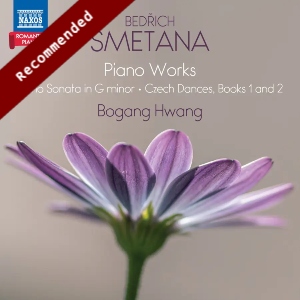
Bedřich Smetana (1824-1884)
Piano Sonata in G Minor (1846)
Czech Dances Book 1 (1877)
Czech Dances Book 2 (1879)
Bogang Hwang (piano)
rec. 2024, Zipper Hall, Colburn School, Los Angeles, USA
Naxos 8.574718 [87]
Bedřich Smetana’s statue stands in Litomyšl’s Smetanovo Square. (When I visited the town to give a concert, our guide and chauffeur was too busy bemoaning the amount of traffic – a grand total of three cars – to point it out to us.) He was born in Litomyšl, a couple of hours drive east of Prague. By the age of six, he played in public an Auber overture on the piano. Though he seems to have had no significant teacher, he was playing Liszt, Henselt and Thalberg by his mid-teens. Josef Proksch took over his tuition in 1843 when he moved to Prague, where he remained until 1848.
The G minor Sonata from his time with Proksch – competent, even impressive as it is it – does not shout “Smetana” from the rooftops. There are elements of Schumann, Liszt, Chopin, Beethoven and others in the opening movement whose main motif is expressed in the sostenuto opening bars. Once the allegro proper begins, there is a halting staccato motif. It is Beethoven-like in style that Smetana combines with the opening motif against a driving, syncopated accompaniment. More themes are added, a descending triplet scale and a jaunty dotted rhythm that soon join the party. The sostenuto returns but, instead of having a repeat of the exposition, goes straight into the rather contrapuntal development section. The writing throughout the sonata requires virtuoso technique to bring it off but I find that, especially in this opening movement, there is quite bit of padding. That said, it is generally enjoyable listening, and there are tiny hints of Smetana’s mature writing in the dotted rhythms of the contrapuntal sections.
The adagio is an interesting movement. It begins with a broad repeated-note theme that suggests Beethoven in the way it is developed over a few bar,s but the second theme belongs more to Schumann or his ilk. Smetana goes on to develop the themes in ways that suggest Beethoven and Schubert while managing to bring in Liszt in some of the later textures. As I am adding influences, let us also put Thalberg in the mix – if only becaue, as the movement reached its climax, I considered that there was a sense of an aria being developed in a kind of operatic fantasy. For all its derivation, it feels the most successful of the four movements.
The light-hearted tripping scherzo once again follows classical models. I am still not sure about the success of the scalic theme in the outer sections but perhaps it has its own humour. The finale is a mad tarantelle, where hands play different rhythms appearing in a different guise each time it returns; the high treble in fast repeated notes is a lovely touch. Again I am not convinced that the slower sections match up to the inspiration of the tarantelle, the first real sense of Smetana the work has offered, but he does at least make effective use of its stiff theme.
The Sonata was not published until the 1940s, when Věra Řepková edited it; she went on to record Smetana’s complete piano works. Bogang Hwang matches her in temperament and virtuosity, and gives us a chance to show how skilled Smetana was at writing for the instrument even before he found his own voice.
The rest of this jam-packed CD contain probably the best of Smetana’s piano works, his two collections of Czech Dances. The polka was to Smetana what the mazurka was to Chopin, even if many are slight works. It was the connection to national identity that was important, and to this end he wrote these two impressive collections. The first book focuses on polkas, four wonderfully crafted dances that advance this jolly dance into the realms of high art. Certainly the subtlety of harmony, texture and interweaving of parts in the first polka sets it aside from mere dance music. The second continues, adding a healthy dose of grandeur to its Slavic melancholy. The third is the most extrovert of the four, gloriously laid out for the piano and irresistible in its ebullience. The final polka combines aspects of all the others from its very Czech sounding theme in sixths to the suddenly ignited fire that lights up its central section.
Smetana goes even further in his second book of dances in technical demands, style and variety of form. That is rather astonishing considering Smetana was deaf and in failing health by the time he began them. He was living in Jabkenice in what was to be his final home. A musical neighbour helpfully wrote out Bohemian and Moravian dances for Smetana to use. A Furiant opens proceedings – a swaggering dance in triple time, though it is given extra rhythmic vigour by its use of duple time crossing the bar. Dvořák’s influence, via his Slavonic Dances, published in their four-hand version in 1878, can be heard in many of these themes, none more so than the contrasting lyrical theme of this first dance. Little Hen, the second dance, is an absolute treasure, its jaunty three-four theme punctuated by three-eight bars that give it a limping folk-dance feel. Its music may be buoyant but it requires fleet finger-work and a muscular technique.
Grain Dance is an elegant concert waltz with inner lines singing below the five-bar folk theme and one sunny outburst. Bear Dance features the gruff main theme and a light-hearted theme that suggests a smaller, daintier creature playfully dodging the bear’s irritable paw swipes. A change of texture comes with a theme that mixes duple and triple time, and with a bass that suggests a drone; it moves to beautiful filigree writing in the treble of the piano.
The engagingly titled Little Onion is another triple-time dance with staccato chordal writing a feature and an alluring waltz that – though it is in folk style – is an original theme of Smetana’s. Stamping Dance is an energetic, primal dance, highly virtuosic that Bogang Hwang swallows whole. For joyous and exhilarating pianism, she even outstrips Garrick Ohlsson in his Hyperion collection (review). She gets a little breather in contrasting sections which Smetana marked “bagpipes”, all based on a drone accompaniment. A maiden’s longing for her absent lover, the Lancer of the seventh piece’s title, is evoked by a bittersweet folk-tune. The treatment reminds me of Liszt as song transcriber, bringing ever more involved texture to the melody without ever overwhelming it. The tranquil ending also owes something to Liszt’s harmonies.
Variation is the name of the game in Stepping Dance too. Hwang captures its bluff humour brilliantly, quickly changing tack in the scherzo-like first variation that shows the utter security of her finger technique and allows shape and phrasing to still shine through. The spirit of Brahms hovers over Neighbour’s Dance, in its syncopated first theme, grand chordal passages and charming central waltz. The theme here is passed from hand to hand, seamlessly managed by Hwang. The set concludes with a Skočná, a fast dance whose form may be familiar to listeners who know the Dance of the Comedians from Smetana’s opera The Bartered Bride. The introductory chords, a sort of here we go followed by perpetual motion running semiquavers make for an exciting, if breathless, conclusion to these wonderful dances.
I know these two books of old through Jan Novotný’s recording on a Supraphon double LP set; book two was released on CD (review). Yet I am even more bowled over by Hwang’s vivid characterisation, all-embracing technique and impeccable sense of style. She is recorded in wonderful sound and the timing is extremely generous. The parts of Ohlsson’s set that I have heard are impressive but I find myself more attracted to the lighter-fingered Hwang. Her energy and clarity of thought are astonishing. Listening anew to the kaleidoscopic colours, textures and sheer range of imagination on offer, I find it hard to understand why the popularity of Smetana’s orchestral works on the concert platform has not extended to even the best of his piano music. I hope this marvellous disc stirs some interest; it is definitely my favourite in Naxos’s Romantic Piano series so far.
Rob Challinor
Buying this recording via the link below generates revenue for MWI, which helps the site remain free













