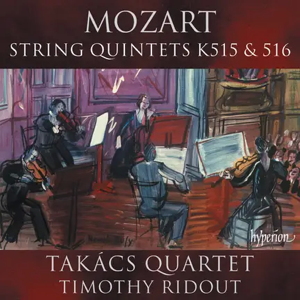
Wolfgang Amadeus Mozart (1756-1791)
String Quintet in C major, K515 (1787)
String Quintet in G minor, K516 (1787)
Takács Quartet, Timothy Ridout (viola)
rec. 2025, Wigmore Hall, London, UK
Hyperion CDA68488 [70]
Mozart’s six string quintets are among his most revered compositions. The two on this disc, particularly popular, often appear together. The recording features the Takács Quartet in their last recording with the founding member, cellist András Fejér, according to Richard Wigmore’s substantial booklet note. Following Fejér’s retirement, Mihai Marica joins the ensemble as cellist. The other members of the original quartet have been replaced over the years. The guest violist, playing second viola on this recording, is the up-and-coming Timothy Ridout. He blends in seamlessly with the rest of the quartet, not calling undue attention to himself.
Wigmore, who is a specialist in the music of the Classical period, observes that the keys of these quintets are the same as Mozart’s last symphonies, No.41 “The Jupiter” in C major and No.40 in G minor. While it is true there are some similarities in the treatment of this music, I found the G minor Quintet more closely related to its symphonic counterpart than the C major Quintet. Indeed, the cadence in the G minor work’s first movement (starting at 0:42 on this recording and repeated several times) is almost identical to that in the finale of the Symphony No.40.
As with the symphonies, there is a real contrast between the two quintets. The booklet describes the C major Quintet as luminous, an apt epithet. Takács Quartet’s account puts special emphasis on the bass lines. Fejér’s eloquent cello begins the first and longest movement in dialogue with violin. The intonation and balance among the five musicians are impeccable, and the first violin does not dominate. The sound is full and present. There is nothing extraneous, just solid music-making where everyone is equally involved. After the elegant second-movement minuet, the slow movement is a love song between violin and viola. The finale has one of those catchy themes, like a folk or dance tune, that is an earworm. Basically light and happy, it has complex contrasting episodes, and it concludes boisterously and decisively.
The dark G minor work could not be more different. Although it begins quite tragically, it switches to the major key with a yearning, almost-Schubertian melody in the development. This is followed by no ordinary minuet, but one that contains violent chord interruptions and a lyrical trio that also looks forward to Schubert. The third movement, marked Adagio non troppo, commences with a hymn with the instruments muted. This beautiful beginning reminds me of late Beethoven! Its minor-key episode features the second viola and is quite Romantic. Wigmore describes it as a “crisis of deep pain”. The finale begins darkly and tragically in G minor before a jig-like theme takes over at 2:45 to relieve the tension. As in the minuet, the music can turn forceful with loud intrusions. The work concludes on a unison chord with Fejér’s cello resonating long afterwards.
There have been numerous recordings of these quintets. The Takács and Ridout, who clearly have the measure of the music, can easily join the upper ranks of the discography. Hyperion, as usual, have provided a high-quality product. The attractive booklet has The Quintet, a painting by Raoul Dufy, on the cover. In addition to Richard Wigmore’s essay, the booklet contains detailed notes on the musicians and colour photos of them.
Leslie Wright
Buying this recording via the link below generates revenue for MWI, which helps the site remain free