
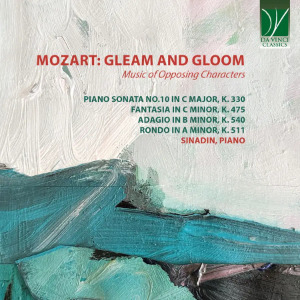
Wolfgang Amadeus Mozart (1756-1791)
Gleam and Gloom – Music of Opposing Characters
Piano Sonata No.10 in C major, K. 330
Fantasia in C minor, K. 475
Adagio in B minor, K. 540
Rondo in A minor, K. 511
Sinadin (piano)
No recording details provided
Da Vinci Classics C01202 [64]
I have commented previously that the Da Vinci Classics label is quite remarkable for the number of recordings it releases most months, typically in double figures. More often than not, the repertoire is quite obscure, but not this time. These four Mozart piano works might not be his best known, but they each have many recordings, from the Adagio with 159 listings on Presto to the Fantasia with 347.
Sinadin, whose real name is Dejan Sinadinović, explains his choice of the four works here as seeking to “juxtapose contrasting expressive worlds”, hence the title. I have some reservations about his selections, but let me consider his performances of each work first.
My two comparisons are Mitsuko Uchida (Philips), for all four works. and Marc-Andre Hamelin (Hyperion CDA68029 – review) for the Sonata and Rondo, which might seem to be giving Sinadin a mountain to climb, but – spoiler alert – he acquits himself quite well. I should say that despite the reputation that her Philip set has, I’m not totally sold on Uchida, because I find it a little precious in places, treating Mozart like a fragile porcelain ornament. I prefer a more robust and earthy Mozart, which is where Hamelin is so good. I’d also add Víkingur Ólafsson but his Mozart and Contemporaries doesn’t have any crossover with Sinadin’s, so I won’t include him in my comments.
Sonata No. 10 is the gleam among the gloom, or more accurately, before the gloom. While it might not have the recognition of its numerical successor with its famous “Turkish” rondo finale, No. 10 is overflowing with lovely melodies and infectious rhythms.
From the start, it is evident that Sinadin’s style is very smooth and makes use of the richness of the piano, in comparison with the more constrained sound of Uchida. Nevertheless, the opening Allegro moderato has a lightness of spirit that is not quite brought out in Sinadin’s burnished playing. Sinadin observes repeats in both outer movements, taking the runtime out past 25 minutes. By comparison, Hamelin and Uchida do not take the repeats, and their playing times are under 20. That lightness of spirit would seem to be better supported by leaving the repeats out. In the Andante cantabile, Sinadin’s approach is far more singing than Uchida, who is a little stilted, but both are bettered by Hamelin, who is quite superb. The Allegretto finale has a tripping rhythm which Sinadin smooths out a little too much, but again Uchida seems too restrained, while Hamelin is wonderfully playful. Overall, Hamelin’s version wins out by some margin, but Sinadin’s relaxed and rich reading has much to admire, and I far prefer it to Uchida’s.
The Fantasia is one of Mozart’s most recorded solo piano pieces, and one of his most substantial and complex creations in that genre. In seven continuous sections, it runs through a series of moods, but more of them are, if not gloomy, then brooding and stormy, rather than gleaming. Sinadin and Uchida have almost identical timings, and my comparisons from the sonata hold true here to an extent, at least as far as playing style goes. However, in the tempestuous middle of the piece, Uchida is far more dramatic than Sinadin, and therefore, gives a more contrasting and dynamic performance, which keeps things progressing better.
We move from the brooding Fantasia to the wistful and meandering Adagio, where again Sinadin takes the repeats, drawing the work out to more than fourteen minutes; Uchida takes less than eleven. Here Sinadin’s smoothness and compression of dynamics does him no favours. It simply doesn’t maintain this listener’s interest over that period. I’m not saying that I was glued to Uchida either, but her greater contrast between the quietest and loudest episodes did keep attention more focussed.
Finally the Rondo, another predominantly slow work, and another over ten minutes in duration. Here Sinadin and my two comparisons all adopt a similar tempo, and there is little in the way of contrast in the dynamics in the piece itself, so the performances are much of a muchness. I can’t say that the piece impresses me greatly, and to put it last on the recording does mean things rather fizzle out.
You will have gathered that I had mixed feelings about Sinadin’s playing, finding it lacking in contrast in the slow pieces, but good in the sonata. The notes, contributed by the pianist under his full name, are more philosophical than musicological, while the sound quality is good.
While I enjoyed Sinadin’s smooth and rich style, even if it was a little too much so in places, my main criticism is of the choice of music. There is simply too much gloom and not enough gleam. The Fantasia, Adagio and Rondo, all in minor keys, occupy 38 of the 64 minutes in a continuous block. One of them, the Rondo springs to mind, needed to be swapped for a more upbeat – gleaming – piece, another sonata perhaps.
David Barker
Buying this recording via the link below generates revenue for MWI, which helps the site remain free













