
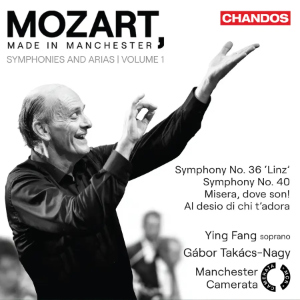
Wolfgang Amadeus Mozart (1756-1791)
Made in Manchester – Symphonies and Arias Volume 1
Misera! dove son!, KV 369 (1781)
Symphony No. 36 in C major, KV 425 ‘Linz’ (1783; rev. 1784-5)
Al desio di chi t’adora, KV 577 (1789)
Symphony No. 40 in G minor, KV 550 (1788-91)
Ying Fang (soprano)
Manchester Camerata/Gábor Takács-Nagy
Italian texts and English translations
rec. 2026, The Stoller Hall, Hunts Bank, Manchester, UK
Chandos CHSA5393 SACD [73]
This well-filled disc presents an attractive Mozart programme of two mature symphonies and two arias for soprano as part of the Manchester Camerata’s ongoing ‘Made in Manchester’ flagship project.
The arias alternate with the symphonies; the first is a concert piece set to an opera text by Metastasio; the second was written specifically for the soprano singing Susanna in the Viennese revival of Le nozze di Figaro. The first recitative section of the latter will be familiar but the aria is different. Chinese soprano Ying Fang has sung at the Met; she has a considerable background in the lighter, lyric repertoire, especially Mozart, as per here. She has refined, cultivated tone of great evenness and bell-like purity, sings excellent Italian and fine technique, including a good trill and agility in runs – although I would like to hear more depth and solidity in the lower reaches of her voice and I wonder how large it is in person. Everything she does here falls most pleasantly on the ear and as Susanna she is assisted by some particularly virtuosic writing for wind instruments and horns. Although the aria affords opportunity for vocal display, its musical content strikes me as rather less interesting and more conventional than the familiar number which it replaced, “Giunse al fin il momento.”
The ‘Linz’ symphony begins weightily and throughout the bass brass and wind sections are given considerable prominence, though whether that is due to the sound engineering or the actual performance is hard to say. Timpani, too, are nicely prominent and these instrumental balances provide an interesting variation on the usual bias towards the strings. The result is a dark, dramatic sound. The Andante begins in gentle mode but that same darkness soon obtrudes with minor key brass statements then a similarly sombre development. The piano passages in the final two minutes are attractively delicate and restrained. The fast waltz Menuetto is despatched in spritely fashion and the brilliant Presto finale is taken very fast with no repeat. It might for some come across as breathless and even rushed but is certainly arresting played thus and the hard drum thwacks add to the drama. My own preference is for the very slightly steadier delivery we hear from Michael Collins who also observes the repeats (review).
Takács-Nagy also adopts very fast tempi for No. 40; certainly it is marked “Molto Allegro” and in my review of the Krips set of later symphonies, I remarked that his opening movement was “rather stately but so beautifully and affectionately phrased” but on balance I would still favour that approach to Takács-Nagy’s urgency – but this is purely a matter of taste. The Andante, too, is decidedly swift but elegantly played, with the repeat. The pressing ahead confers unity and coherence on the symphony as a whole. The Allegro assai finale is highly energised, its scurrying main theme, the brief, delightful duet between the clarinet and bassoon and the unpredictable octaves of the development all delivered with aplomb; the whole effect is breathlessly exciting.
Ralph Moore
Buying this recording via the link below generates revenue for MWI, which helps the site remain free













