
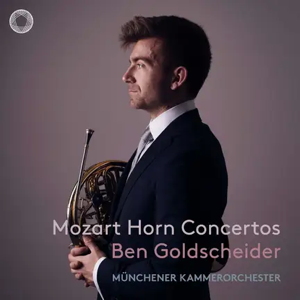
Wolfgang Amadeus Mozart (1756-1791)
Horn Concerto No. 4 in E-flat major, K. 495
Horn Concerto No. 3 in E-flat major, K. 447
Horn Concerto No. 2 in E-flat major, K. 417
Horn Concerto No. 1 in D major, K. 386 b (K. 412 & 514)
Ben Goldscheider (horn), Münchener Kammerorchester / Susanne von Gutzeit
rec. 2025, Bavaria Musikstudios, Munich, Germany
Pentatone PTC5187608 [53]
Every Mozart lover has Dennis Brain’s classic recording with Karajan, now considered the reference version; it has been extensively discussed and praised here both on this website and elsewhere and I refer you to older reviews by two colleagues, Chris Howell (review) and Colin Clarke (review). I also have on my shelves David Pyatt’s account, comprehensively reviewed in comparison with other recordings by Brian Wilson (review). Finally, for a period instrument version on a “natural” horn I favour Anthony Halstead with Christopher Hogwood on Decca. He is praised for his accomplishment and refinement playing an awkward instrument and Hogwood’s direction is similarly valued for its stylish accompaniment and sensitive support of the soloist. Reservations are that Halstead is somewhat restrained rather than flamboyant, and inevitably his cadenzas lack the bravura and assurance of those played on a modern instrument, but some minor blips, occasional technical blemishes and a touch of flatulence are considered a fair trade-off in exchange for hearing a HIP account with its own unique timbres, just as we put up with the mono sound of Brain’s recording in order to savour his virtuosity.
Ben Goldscheider is still a young man but has been living with the scores for twenty years, having picked up the horn at nine years old. He has chosen to present the concertos in reverse chronological order, as he believes that “this offers the most engaging and coherent experience from beginning to end”; hence we start with No. 4, supposedly the latest and most mature work, but which was probably written before No. 3, which scholars believe dates from 1787. His playing is melodious and assured, suffused with a warm, aureate tone. Operatic echoes of the roughly contemporaneous Le nozze di Figaro may be heard and the famous Rondo is joyfully despatched; the Munich Chamber Orchestra supports him discreetly without being too bland or retiring and the balance between soloist and band is ideal. The latter is particularly nifty in the Allegro finale of No. 3. The finales often have an inescapable association with hunting and roistering and everything about this recital reinforces those sentiments. Most of us will be used to hear these concertos in numerical order and the grateful tune of the opening to No. 1 sets the tone; even if the Beatles apparent borrowing – with rhythmic adjustments – of that melody for “Ob-La-Di, Ob-La-Da” was accidental, the consonance was a happy one.
Is this Mozart’s most moving and profound music? No; it is mostly cheerful, melodious and uplifting, offering some opportunities for the soloist to display prowess but its prevailing mood is one of genial good nature intent upon entertaining.
The cadenzas and lead-ins throughout were supplied by pianist and harpsichordist Andreas Staier (b. 1955).
Ralph Moore
Buying this recording via the link below generates revenue for MWI, which helps the site remain free













