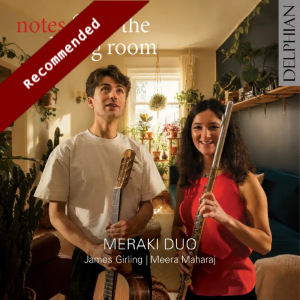
Notes from the Living Room
Meraki Duo
Roberto Carrillo Garcia (double bass)
rec. 2025, St. Cuthbert’s Parish Church, Edinburgh, UK
Reviewed as a download
Delphian DCD34356 [64]
This summer, I read a review by the late Brian Wilson of some flute and guitar pieces from the early 19th century by a composer named Francesco Molino (review), and it inspired me to give the album a spin. I’ve always had a soft spot for classical flute chamber music: the Mozart quartets, Boccherini trios, Quantz sonatas … for me, they represent the apex of ‘comfortable music’. By this I mean something entirely undemanding, and yet still enjoyable all the way through. Both the form and the style contribute to this effect. You can hardly make an unpleasant sound following the principles of classical harmony, and the timbre of flute-against-strings provides enough interest to prevent things from getting dull. It’s a little bit difficult to review that sort of music without sounding unintentionally backhanded, but most people who really love music understand that there’s a place for effortlessly pretty sounds.
Of course, flute repertory need not be ‘easy listening’. Take the recent recommended album Darkness into Light, featuring works by Edward Cowie (review). That, too, is a wonderful disc, but in quite a different way. Cowie demands and rewards attention: Molino, largely, does not.
In trying to explain this, I am hardly breaking new ground. This dichotomy is one that practically every classical listener will have encountered before. I bring it up to propose that what makes Notes from the Living Room so special is that it really scratches both of those itches at the same time. The programme is interesting and varied with star modernist composers like Olivier Messiaen and Tōru Takemitsu, but the mood of the album is intimate and warm. If I had to put my finger on the facet of this album that feels most special, that would be it.
Let’s start with the ensemble’s name. ‘Meraki’ is a Greek word, derived from the Turkish ‘merak’, meaning a concern or interest. In Greek ‘meraki’ means something like a hobby that you really put yourself into – it’s one of those words frequently touted as ‘untranslatable beautiful concepts that only exist in other languages’ by people who don’t really understand how linguistics works. Actually, I am reminded of the etymology of amateur: Latin ‘amator’ via French, someone who loves. ‘Meraki’, perhaps, retains more of that character of passion. It’s quite a good name for a chamber ensemble, either way.
Neither flautist Meera Maharaj nor guitarist James Girling is Greek: they met at the Royal Northern College of Music where, to quote the booklet, “they immediately connected through a shared passion for chamber music, jazz, Latin American music traditions, and contemporary works.” In 2014 they founded Meraki Duo, and have picked up a number of competition wins over the last dozen years, including first place in the second International Flute and Guitar Chamber Music Competition, which would seem to be their thing, wouldn’t it?
Notes from the Living Room, however, is their debut album. They’ve chosen seven works, of which four were originally composed for flute and guitar, and three are performed in arrangements done by Girling. He is, by the way, an excellent arranger, and I enjoy his willingness to use extended techniques to, for example, imitate other instruments from the original piece.
We open with just such a successful arrangement. William Grant composed his three songs over a period of nine years, from 1944 to 1953. The first and third set lyrics by his wife, Verna Arvey; while the second used a poem by Harlem Renaissance author Countee Cullen. All three can be described as somewhat melancholy. The first, Bayou Home, is a little lighter and more wistful, with a lovely, instantly memorable tune. Much more introspective is If You Should Go, the middle song, which is quite emotionally affecting for a runtime of less than 90 seconds. Song for the Lonely is tranquil and spacey. All three of these songs may be heard on this recent album (review) in their original arrangements for voice and piano.
Throughout, Meraki Duo take these the way you’d expect: Maharaj sets forth the vocal melody on her flute perfectly, while Girling accompanies, although he does more than merely keep time. His sensitive embellishments and lovely, lute-like timbre add so much to the expressiveness of these pieces. As for Maharaj, it is cliché to describe a wind player as having a ‘singing tone’, but this is something else. One could easily be fooled into thinking there is actually a singer on this record at times, so closely does she imitate the human voice. She plays an alto flute on the album, rather than the more typical C flute. Alto flutes have those curved headjoints, which I, personally, think are quite visually appealing: they also have a rich, somewhat mournful tone that’s just exquisite here.
Dominique Le Gendre hails from Trinidad and Tobago, and has written, among other things, two suites inspired by the music of her homeland. The first was for clarinet and piano, the second added double bass and percussion. From that original suite, Girling selected a Biguine, a dance associated with Saint-Pierre in Martinique. As early as 1935, Cole Porter made use of its rhumba-like rhythm in the song Begin the Beguine. As with many Latin dances, there are sudden, dramatic shifts from major to minor. Meraki Duo really sound like they’re dancing here, with outspoken enthusiasm from the guitar and a shimmering playfulness from the flute. I defy anyone to listen to this and not feel slightly happier. The second piece, You know one Joseph Keeba is an arrangement of a sly, storytelling song collected by ethnomusicologists in Trinidad about a cuckolded husband. Some of the humour comes through in Meraki Duo’s performance: speeding up and slowing down, phrases that sound a bit like ‘weeping’, which suddenly turn into raucous laughter. The third song, Kalinda, actually refers to a martial art slash war dance from the 18th-century Caribbean. By this point, I don’t think the dance form still has any of those associations – but it’s quite a tricky rhythmic study, with lots of different sections. At one point, the flute sounds quite a lot like an Irish reel, and the guitar often has the force of a plucked bass.
I don’t believe Dominique Le Gendre has yet had an album fully dedicated to her music, but I, for one, would love to hear the full and original versions of both suites.
Animal Banter is the longest track here, written by Jamaican composer Eleanor Alberga. As the booklet essay points out, Alberga has quite a lot of works referencing animals in some way. You can hear Alberga’s three string quartets on Navona (review), and her violin concertos on Lyrita (review). The structure of the piece is quite interesting: there are three instruments (Meraki Duo are joined by double bass player Roberto Carillo Garcia) and they begin in rather calm dialogue (or trialogue) before steadily getting more heated and involved, which is represented by cramming in more and more beats per measure – shades of Reich, but jazzier. This creates increasingly complex rhythms, until there is a very welcome key change leading to a bright, rapid-fire conclusion. Each listener can decide which animal they think is being represented by each instrument. In a live setting, this would be one of those pieces that draws genuine laughter and smiles from the audience.
I was a little bit nervous seeing that the next composer up was Olivier Messiaen. I adore Messiaen’s organ and piano music (see this recent disc for example) and his Quatuor pour la fin du Temps is one of the great pieces of chamber music of the 20th century, but it is undoubtedly not warm and cozy. In fact, his Cinq Leçons de Solfège maintains the atmosphere perfectly. These singing lessons were written when he was twenty-five, and they have a gentle, easy-going enjoyability one does not always associate with Messiaen. The first, Assez vif, has that sort of interwar French cabaret feel – it’d be right at home on a Poulenc disc. The second and third, marked Très lent and lent respectively, have gorgeous, romantic melodies, in which Maharaj’s alto flute really shines. The fourth is an exciting little Spanish dance (surely the only one in Messiaen’s oeuvre?), and the fifth finishes the set with a lot of open space and rubato.
Tōru Takemitsu’s All in Twilight is a suite of four pieces composed for Julian Bream. Girling takes the fourth of these and plays it, making a sort of interlude – a chance for the accompanist to shine, and give Maharaj a break. There certainly is a twilight mood to this meditative piece.
Takemitsu was inspired by Messiaen, nature, and classic literature, and all three come together in Toward the Sea, which was actually originally composed for alto flute and guitar. Here, the reference is to Moby Dick. Toward the Sea appeared as the title work on another album released this year (review). Listening comparatively convinces me just how good Meraki Duo are. While Emi Ferguson and Michael Poll acquit themselves well, the work sounds much more ‘avant-garde’ and challenging in their recording. Somehow, when Meraki Duo play the work, it sounds almost sensual. What came across as random and capricious in Ferguson and Poll sounds improvisatory in Meraki Duo, and that’s a pretty significant difference for me. It can also be heard somewhat more successfully on this Naxos release (review), which although not quite as superb, would make a good next album if you’ve enjoyed this one.
Miroslav Tadić is a Bosnian guitarist who has previously been recorded as part of a project somewhat humorously called Balkan Fever (review). His compositions, mainly for the guitar, have been recorded several times already. His Four Macedonian Pieces consists of two songs, each followed by a dance. The first song, Zajdi, zajdi is an elegy about the passage of time. After a flute solo, the guitar dramatically changes the mood with an ominous stop-start drone. Something about it feels mystical, quite the opposite of the subsequent piece, Pajdushka, which is a sort of frenetic, slightly Klezmer-esque folk dance. Both Maharaj and Girling sound effortless even with the speed set quite high. Then the cycle repeats: with Jovka Kumanovka we are back to a slower, more lyrical song, slightly wistful and ancient-sounding (at least to my ears). Then Gajdarsko Oro (meaning ‘bagpiper’s dance’) draws on Spanish and African music and seems calculated to get people on their feet and dancing. Meraki Duo have the gift of being able to really pack energy into whatever they play.
The sound quality is lovely. St. Cuthbert’s church provides lots of resonance and depth, but we lose no vividness or sharp rhythmic edges. There are excellent booklet notes by musicologist Lucy Walker. I really can only recommend this disc. The programme is varied, interesting, and fresh, and listening to it feels almost hedonistic.
Aidan Gray
Buying this recording via the link below generates revenue for MWI, which helps the site remain free
Contents
William Grant Still (1895-1978)
Three Songs (1944-1953, arr. James Girling)
Dominique Le Gendre (b. 1960)
Songs and Dances of the Islands (2017, arr. James Girling)
Eleanor Alberga (b. 1949)
Animal Banter (1989)
Olivier Messiaen (1908-1992)
Cinq Leçons de Solfège (1934, arr. James Girling)
Tōru Takemitsu (1930-1996)
All in Twilight – IV. Slightly Fast (1987)
Toward the Sea (1981 rev. 1989)
Miroslav Tadić (b. 1959)
Four Macedonian Pieces (c. 2000)