
Edward Cowie (b.1943)
Darkness into Light
La Primavera – Nine Figures in an Orange Garden, for solo flute (2022)
Harlequin Dances, for solo harp (1979/2019)
Australian Water Music for flute and harp (2025?)
Darkness into Light: Improvisation for flute, harp and piano (2025)
Laura Chislett (flute), Alice Giles (harp), Edward Cowie (piano)
rec. 2025, The Wesley Centre, Canberra, Australia
Métier MEX77143 [61]
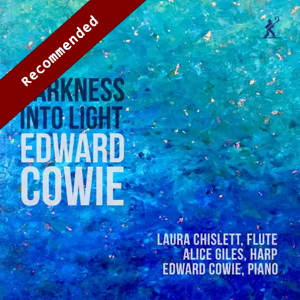
Edward Cowie’s outstanding booklet notes offer an exceptionally detailed introduction to the four works on this disc, with further commentary by flautist Laura Chislett and harpist Alice Giles. The booklet is generously illustrated with photographs of the performers and examples of Cowie’s pre‑compositional art studies. The cover reproduces Darkness into Light, a painting by Heather Cowie. I have drawn extensively on these programme notes in developing my review.
La Primavera – Nine Figures in an Orange Garden, a suite for solo flute, evokes Sandro Botticelli’s legendary painting La Primavera. Cowie notes that his “massive work” radiates light and movements. It is on display at the Uffizi Gallery in Florence. The gallery website says: “although the complex meaning of the composition remains a mystery, the painting is a celebration of love, peace, and prosperity”.
Cowie’s piece has seven sections preceded by a Prelude: The Orange Garden, which sets the scene. The musical journey follows the painting right to left. Zephyrus is embracing a nymph named Chloris before abducting and marrying her, then transforming her into Flora, the spring goddess. The central figure in the painting is Venus, the goddess of love and beauty. Over her, Cupid is firing his arrow of love. Then there are the Three Graces: Aglaia, Euphrosyne and Thalia. In the final movement, Mercury prepares to take wing. The liner notes suggest that Zephyrus “blows” the listener into the music and Mercury “flies” them out at the end.
The soloist creates “the limpid and hugely flexible sonorities” of the characters. The flautist’s breath symbolises the wind god Zephyrus. Cowie’s composition embraces complexity. In sharp contrast with Vivaldi’s pastoral, dance-like Spring from the Four Seasons, it explores the shifting terrain of human mood and memory.
To my ear, extended techniques and occasional vocalisation required spoil the overall effect. Cowie told me, however, that he felt it necessary to take music from the flute to human throat, and that he took tiny fragments from Dante to do it! Still, Laura Chislett’s performance makes it an impressive piece. Whether heard with the cast in mind or simply as an experience, it is an attractive, impressionistic work. One thought lingers: is the entire suite ultimately just a shimmer of light across the painting that inspired the composer?
Since having first seen Punch and Judy on the promenade at Fleetwood, Lancashire, I have had a soft spot for Harlequin and the 16th-century Commedia dell’arte. Cowie has produced several works inspired by this tradition, including his opera Commedia, Columbine for soprano and chamber orchestra, Commedia Lazzi for solo guitar, and Harlequin for solo harp from 1979. Forty years later, Cowie “re-shaped and re-composed” Harlequin to incorporate a deeper understanding of the harp and its possibilities.
Harlequin Dances for solo harp depict the protagonist’s “suicide lazzi” where he rehearses “dancing himself to death” after being rejected in love. Thehighly percussive work uses pedal buzzes, slides and soundboard knocks. The form presents complementary sections of restless passages and bell-like harmonics. Although ostensibly an entertainment, it is a black comedy. Harlequin tries out numerous methods of self-destruction. He tickles himself to death, hangs himself from a small bush, drowns himself in a jug of ale (how many of us have nearly done that?) and dances himself to death. It is this latter that is the focus of the piece. Ignore the programme if you wish, but be aware of the “transcendental beauty” found in human despair and loneliness.
It may not come as a surprise that Australian Water Music for flute and harp was inspired by Handel’s suite from 1717, commissioned in response to King George I’s wish for a concert on the Thames. Beyond that, however, there is little comparison. Cowie wrote his suite specifically for the “superb brilliance” of harpist Alice Giles and flautist Laura Chislett, and designed it to exploit the “tremendous velocities” and expressive richness of both instruments. Sadly, a movement is missing: due to recording and rehearsal time constraints, a section evoking the Great Barrier Reef was omitted. The three remaining ones focus on specific Australian locations: Kiama Blowhole in New South Wales, Black Swans at Dangar’s Lagoon again in New South Wales, and Humpback Whales – Hervey Bay in Queensland. The three movements of Australian Water Music reflect the behaviour of water in contrasting states: fountains, “limpid placid pools”, and coastlines.
The liner notes suggest allusions to the “liquid” qualities of water, conjuring the sound-worlds of Debussy and Ravel. A listener might be reminded of Debussy’s Syrinx for solo flute, or Ravel’s Introduction and Allegro for flute, clarinet, harp and string quartet. While both instruments carry their own invention, the duet also makes use of a ritornello form, where thematic materials are reworked in a lively dialogue. The performers employ extended techniques: knockings on wood, scraping strings, overblowing, and exploring the extreme upper registers in the harp. The overall effect is characterised by colour, imagination and a “wondrous iridescence”. This exquisitely played piece makes a splendid addition to the repertoire for the relatively rare combination of flute and harp.
As Cowie explains, Darkness into Light was inspired by a series of his wife Heather’s paintings titled Into the Deeps. This sequence depicted the colour shift from the “deepest, darkest blues” of the ocean abyss to “shimmering aquamarines” at the surface. To add to the uncertainty, it is explained that the performers had got into the “groove” by swimming (individually) in the waters of the Great Barrier Reef. In the subsequent improvisation they share their (presumably varied) experiences of transitioning from shallow, luminescent waters to the impenetrable blackness of the reef edge. There also is an implied “metaphorical journey” representing the progress of the mind and spirit from darkness into divine Light; that gives a clue as to what the piece should be like.
Cowie notes the performers’ initial “bemused doubt” about improvising this track, especially without using a pre-written score. It begs the question: was there any “given” material, or did they all just do their own thing, and could they recreate the experience? Or would they want to? There is a danger that the divine light becomes a one-time accident.
My opinion is that there are some lovely sounds, especially from the flute. Lots of extended techniques on the piano and the harp are deployed, but mostly it functions as an atmospheric backdrop rather than a careful exploration of Cowie’s usually complex metaphors. It leaves me pondering where his vision ends and where the performers’ intuition begins. For me, the “shimmering aquamarines” are beautiful, but I still find myself yearning for the solid ground of a definitive score.
This is a beautifully presented recording. The sound quality is ideal for such intimate exploration of flute, harp and piano music. Even if the repertoire is not your bag, there is no doubt that the performance is brilliant. Despite my reservations regarding the improvisational elements and occasional vocalisations, this is an absorbing release. The Métier label has produced another stunning disc of Edward Cowie’s unique, nature-inspired sound-world. Supported by virtuoso performances and lavish documentation, this is a must-buy for enthusiasts of contemporary chamber music.
John France
Buying this recording via the link below generates revenue for MWI, which helps the site remain free













