
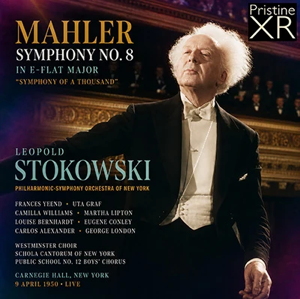
Gustav Mahler (1860-1911)
Symphony No. 8 in E-flat major, “Symphony of a Thousand”
Westminster Choir, Schola Cantorum, Public School No. 12 Boys’ Chorus
New York Philharmonic Orchestra/Leopold Stokowski
rec. live 9 April 1950, Carnegie Hall, New York
Ambient Stereo
Pristine Audio PASC775 [78]
Stokowski had a special attachment to this symphony, having attended the rehearsals conducted by the composer himself and the two subsequent performances in 1910. He then presided over the American premiere in 1916, having riskily retrieved the score from war-torn Europe. Boult had conducted a performance broadcast from the Albert Hall in 1948 but even in 1950, it was still considered something of a rarity rather than a standard repertoire work. Stokowski, like Boult, delivers a taut, fiery performance; other roughly contemporary performances by Scherchen, Flipse and Zillig are all several minutes slower and more modern recordings – with some exceptions such as both of Bernstein’s and Michael Gielen’s very speedy live performance of 1981 – are in general slower. However, given Stokowski’s pedigree with this work we must consider that as more authentic than some more protracted accounts, as much as we might admire them. He drives Part I on and his chorus and orchestra keep up with him but he relaxes noticeably before the “Infirma” passage led by bronze-voiced George London.
One great disadvantage in such a work, of course, is mono sound, but now Pristine has remastered this into Ambient Stereo, as they have done with so many vintage recordings. Within its limitations – a certain papery glare – it is now very acceptable even if, as usual, the quieter moments feature the usual coughing obbligato. It has previously appeared on various pirates but its commercial release was in a New York Philharmonic box set in which the organ was barely audible, and that has been much improved here. There were always compensations: not least, the quality of the soloists, amongst whom are numbered some true stars such as London and a terrific performance of the tenor role by Eugene Conley. Frances Yeend starts off very strongly, dominating the ensemble and the contraltos are strong and warm. Baritone Carlos Alexander is a weakness, being somewhat bland and shouty of timbre but he’ll do. They are all quite prominent in the recording balance but that will please voice mavens.
Some moments, such as the “Accende lumen sensibus” (track 5), are genuinely thrilling despite the limitations of sound and being just on the edge of hectic; the chorus sound disciplined, well-trained and really on fire and the tangy boys’ voices come through appreciably (I do dislike an “English choirboy” sound in this piece – they need to sound like the urchins in Carmen). The cumulative double fugue and coda concluding Part I are magnificent, too, eliciting an illicit outburst of applause from a no-doubt-delighted audience, most of whom would never have heard the work before.
The opening of Part II can be a bit of a bore if it outstays its welcome; Stoki navigates the danger by eschewing any lingering and the coughers also do their best to keep us distracted; at times the intrusions are fearsome. Tempi are brisk and flowing and the orchestra is on top form, the brass being exceptionally secure and sonorous. Alexander copes with “Ewiger Wonnebrand” rather lugubriously such that London launching in stentorian Wotan fashion into “”Wie Felsenabgrund” comes as a relief. The bounce and spring of the five-minute choral section beginning with “Gerettet ist” (tracks 13-14 into 15), before the solo by the second alto, are delightful, lifting the mood into a heavenly sphere. The spotlight the shifts onto the tenor and Conley is as good as any on any recording I know; he is clean and heroic of tone, employing excellent German diction – which is hard at full volume. As I say above, I have known Part II to drag; there is no hint of that here – but of course all is lost if the coughers cannot be defeated. The two altos are again strong in the long “Bei der Liebe” passage and Uta Graf acquits herself well as Una Poenitentium, but the crucial test comes with the tenor’s “Blicket auf”, heralding the long rise through ten minutes to a transcendent Chorus mysticus – and Conley and the chorus deliver. “Alles Vergängliche” is splendid if you can screen out the bronchial intrusions: broad, grand and stately despite the prevailing urgency of that which has preceded it; it seems to me that Stokowski gets the proportions between movements right and the explosive approbation following the final notes confirms what an experience it must have been to hear this performance.
Ralph Moore
Soloists
Magna Peccatrix – Frances Yeend (soprano), Una Poenitentium – Uta Graf (soprano), Mater Gloriosa – Camilla Williams (soprano), Mulier Samaritana – Martha Upton (contralto), Maria Aegyptiaca – Louise Bernhardt (contralto), Doctor Marianus – Eugene Conley (tenor), Pater Ecstaticus – Carlos Alexander (baritone), Pater Profundus – George London (bass)













