
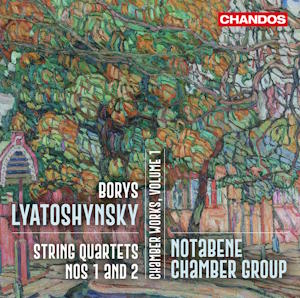
Borys Lyatoshynsky (1895-1968)
Chamber Music Volume 1
String Quartet No. 1 in D minor Op. 1 (1915)
String Quartet No. 2 Op. 4 (1922-revised, 1926)
Notabene Chamber Group
rec. 2025, National House of Music, Kyiv, Ukraine
Chandos CHAN20475 (59)
I must admit that up till now I have come across only a few symphonies by Borys Lyatoshynsky, powerful, epic works, sometimes with a political background and some of which were banned in Stalin’s era, so it refreshing to come across these very fine early works in such excellent recordings.
You will note that these works have been recorded in Kyiv, as may be the next volumes in this series. We all know how difficult life is in that city for all, not least musicians for whom concert work and finding rehearsal venues must be a constant headache – and it may well not have been any easier for Lyatoshynsky during World War One when the String Quartet No 1 was written while he was still a student under Glière, to whom the quartet is dedicated, at Kyiv’s music conservatoire. What a competent, skilful and enjoyable work it is. It has four movements and it is apparent throughout that some of the main melodic material appears to be influenced by Ukrainian and Russian folk songs (perhaps they are folk melodies in origin). For example, the second movement, which acts as a scherzo, has dancing rhythm which reminds me of a hornpipe. Movement three, which begins as a Lento, loses patience and develops into a passionate love song and movement four, marked Allegro energico, also has a dancing rhythmic outline to its simple but interesting main subject. The opening of the quartet, in which all four players double the melody in unison, is also very effective. Lyatoshynsky’s use of counterpoint is often busy and a strong feature throughout both of these quartets, is very apparent in this last movement. Although the key is given as D minor, the work ends boisterously in the major and is never sombre.
Composed only seven years later, the String Quartet No 2 marks a considerable advance on the first quartet, both harmonically and texturally. The booklet notes, written by Iryna Tukova, Associate Professor of the National Music Academy of Ukraine, are an ideal mix of biography and musical description. I make no apologies for quoting her, as her description of the work is succinct. She tells us that it was written when Lyatoshynsky, aged just twenty-seven, was deeply in love with his wife and quotes parts of a passionate letter by the composer to her and that this emotional world “permeates the themes of the work”. This is not, I should add, Janacek (2nd Quartet) but she points out the first movement’s ascending contour which “affirms the triumphant power of love” and “the shimmering opening theme of the intermezzo” which has “the atmosphere of Eastern fairy” – and I would also mention the memorable, light, folksy melody of the third movement. There is also a feeling of the more advanced textures heard in Szymanowski; this is not surprising as Lyatoshynsky had Polish family connections and often used Polish rhythms and melodies in later works.
It’s difficult to imagine a more ideal introduction to Lyatoshynsky’s chamber music than this and it’s wonderful to note that this is just volume 1. The Notabene chamber group (pictured in the booklet) was founded in 2016; they have a wide repertoire and are an important part of Ukraine’s musical landscape. The recording is of Chandos’ highest standard, and I look forward to the next instalment with eager anticipation.
Gary Higginson
Buying this recording via the link below generates revenue for MWI, which helps the site remain free













