
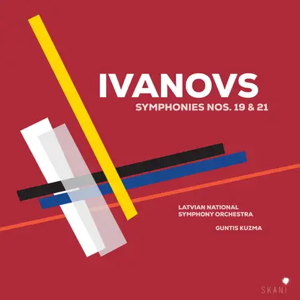
Jānis Ivanovs (1906-1983)
Symphony No.19 (1979)
Symphony No.21, unfinished, orch. Juris Karisons (1983)
Latvian National Symphony Orchestra / Guntis Kuzma
rec. 2006, Riga Concert Hall, Riga, Latvia
Skani LMIC180 [59]
The first few bars of Jānis Ivanovs’s 19th symphony immediately led me to think that I was listening to what could have been the darkly foreboding music to a suspenseful film. On reading the booklet notes, I discovered that Shostakovich once described Ivanovs’s 4th symphony of 1941, entitled Atlantis, as film music. From what I have read, his style changed between 1941 and 1979, so my reaction must have been coincidence.
The 19th symphony is the more interesting of the two works presented here. The 21st symphony was left incomplete and required orchestration. I did not find any thematic memorability. The 21st has a sort of generic tonal modernity in which melody is abandoned in favour of orchestral meandering.
The 19th is rather different. It relies quite heavily on a six- or seven-note theme, transformed as it is played by differing instrumental combinations. It is not a beautiful theme. You will not find it to be an earworm, but recognising it as it reappears in whole or in part is not difficult, especially in the first and last movements. Like in the 21st, there is no attempt at atonality. Given the lack of any really memorable tonal content, that is a probably good thing. It does not sounds like Shostakovich or Prokofiev, but I cannot really identify any personal style – except that the work exhibits a generalised modernity, and often reminds me of Myaskovsky’s sound-world.
The second movement, Allegro marcato, is a very dour march with a meandering central section. Like in the rest of the symphony, Ivanovs fails to conjure much by way of memorable material, and even the orchestration sounds befittingly dull.
The third movement, Andante, opens with what is the nearest thing to a melody in the entire work, a twelve- or thirteen-note theme. The composer evidently thought enough of it to repeat it in whole or in part several times in varying orchestration. He managed to bring it to an unimpressive climax towards the end of the movement, which finishes quietly.
Quite what the Soviet musical establishment thought of the 19th symphony, I rather wonder. It hardly corresponds to the official Party line of cheerful or at least descriptive patriotic music, designed specifically to appeal to the proletariat. Maybe Ivanovs was writing such lacklustre stuff to describe his own feeling of oppressive official demands laid upon composers. It is notable that he did not compose any vocal music during the period of Soviet occupation of Latvia.
Whilst it will be apparent that I am not particularly impressed by the music content of the disk, there is no doubting Skani’s high production values. The disk is presented in the now common cardboard gatefold with a plastic insert to support the disk and a booklet stuck to the opposite inner face. The notes are largely biographical, with much detail about the performers and rather less about the music.
The recording is absolutely splendid, full and well-focused, in a grateful acoustic. The orchestra and conductor perform these works, difficult to enthuse about, with commitment and excellent ensemble.
Jim Westhead
Buying this recording via the link below generates revenue for MWI, which helps the site remain free













