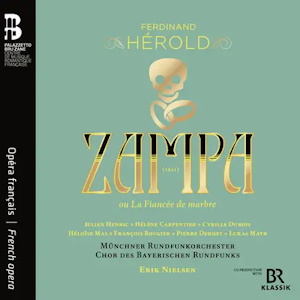
Ferdinand Hérold (1791-1833)
Zampa ou La Fiancée de marbre (1831)
Libretto by Mélesville; Zampa, Julien Henric (tenor); Camille, Hélène Carpentier (soprano); Alphonse, Cyrille Dubois (tenor); Ritta, Héloïse Mas (mezzo-soprano); Daniel, François Rougier (tenor); Dandolo, Pierre Derhet (tenor); Un corsaire, Lukas Mayr (baritone)
Chor des Bayerischen Rundfunks
Münchner Rundfunkorchester/Erik Nielsen
rec. 28 and 30 November 2025, Prinzregententheater, Munich, Germany
French libretto with English translation included
Bru Zane BZ1065 [2 CDs: 139]
If I describe the plot of Ferdinand Hérold’s Zampa ou La Fiancée de marbre to you, it might perhaps spark some associations. A notorious libertine turned pirate descends on a Sicilian village and forces the young woman engaged to his own brother to agree to marry him. But the villagers have placed themselves under the protection of a marble statue of one of his earlier victims, and on his wedding night she comes to claim him. In fact, as Pierre Sérié’s essay accompanying the set tells us, Don Giovanni was only known to Parisian audiences at the time in a ‘rearranged’ form. He credits Zampa with laying the ground to prepare audiences for a more faithful production of Mozart’s masterpiece at the Opéra in 1834. Zampa has much more arresting claims on our attention than this interesting piece of context though. It marks an important stage in opéra-comique’s movement away from the light 18th-century tradition to something darker. The catalyst for the opera’s creation was Émile Lubbert, at the time the new director of the Opéra-Comique. He had come from the much more serious Paris Opéra, determined to rescue the Opéra-Comique from its second-rate reputation and financial difficulties. While he was running the Opéra, Lubbert had seen Meyerbeer transfer his eagerly awaited Robert le Diable there from the Opéra-Comique, and he concluded that the future lay in scores mixing spectacle with intimacy, tragic with comic characters, and virtuoso with dramatic singing. Lubbert found a subject modelled on Molière’s Dom Juan and turned to Hérold to come up with something to meet those specifications. Hérold, an experienced man of the theatre who had written ballets for the Opéra, decided, with the help of his librettist Mélesville, to put the ‘s’ into spectacle, musically and dramatically. It worked. Zampa was one of the most performed works of the 19th century before disappearing almost without trace. This is its first recording.
Hérold’s boldest moves were firstly to write a score with no low voices in its principal characters: Zampa has four tenors (two of them character parts), a soprano and a mezzo. Secondly, he grounded himself in an eclectic musical mix: Italian virtuosity, French theatricality, Mozartian harmony and Weber’s taste for the supernatural all fuelled by an unmistakably Rossinian energy. Berlioz disliked the mixture. Judging by this recording, Berlioz was wrong. It perhaps shouldn’t work, but it does. The mix is thrilling and, as Alexandre Dratwicki argues in one of the book’s essays, was a very deliberate choice: Hérold and Lubbert wanted an eclectic style, much like the contemporary ‘Juste Milieu’ school of painting. The Weber of Der Freischütz is very much to the fore in the gorgeously theatrical supernatural episodes, not just the statue dragging Zampa into hell while Mount Etna erupts at the end (!), but also in the first act when Zampa places a ring on the statue’s finger and the marble hand closes around it. Erik Nielsen and the Münchner Rundfunkorchester have the measure of these scenes to perfection, where Hérold’s unsettling mix of chromaticism and decidedly occult harmonies provides a chilling soundtrack. The orchestra are equally good elsewhere, in music of great tenderness, not to mention frequent jollity: the latter fuelled by Hérold’s background in the ballet so that a variety of dance forms and rhythms infuse the work.
There’s a whole essay in the Bru Zane book by Gianmarco Rossi devoted to the issue of the right voice for Zampa. Hérold asks for athletic shifts between low notes that are frankly baritonal and frequent surges into the tenor register; he even wrote the part in the tenor clef in some numbers and the bass clef in others. As Rossi puts it, the role generally proved ‘too low for tenors and too high for baritones’. It was premiered by Jean-Baptiste Chollet, who by then was essentially a baritenor. Hérold himself allowed provincial theatres to give the part to either a baritone or a tenor, and once it travelled it drifted downwards. Baritones sang it in Germany, and the bass Luigi Lablache sang it in Naples, in a version so reworked that ‘Pourquoi trembler?’ was replaced by a new aria by the house répétiteur. Once the baritone Melchissédec took it at the Opéra-Comique in 1873, baritones became the norm in France too, and tenors only reclaimed it at Wexford in 1993 and the Opéra-Comique in 2008. Julien Henric is a tenor. He goes for swagger over subtlety, and sings with tremendous verve and charisma. Those baritonal lower notes don’t cause him difficulty exactly, but they don’t always feel wholly integrated. It really doesn’t matter much though; you’re persuaded by his belief in himself and his character. One of the many marvellous illustrations in the book is of Zampa veering back, almost doubling over in fact, from the statue during that ring scene in a pose of high melodrama so typical of the time and the genre. Henric has that mood off pat.
Hélène Carpentier as Camille has another demanding part. She’s probably the best actor of the cast but her top register has an undoubted edge to it which can detract from the warmth and pathos she’s trying to project. Cyrille Dubois is perfectly at home in the light tenor role of Zampa’s virtuous brother Alphonse: ardency and self-righteousness made more attractive for being wrapped in an infectious lyricism. There’s then a comic trio which makes up the rest of the principal cast. Héloïse Mas (Ritta), Pierre Derhet (Dandolo) and François Rougier (Daniel) are playing caricatures admittedly, but I yearned for a bit more sharpness and wit. Perhaps difficult to effect in the music, but there’s plenty of scope in the spoken dialogue, an opportunity not taken. One thing that Rossi says is essential for a successful performance — and it’s hard to disagree — is idiomatic French. All of the principals possess this, although even then, diction isn’t always flawless. Diction is unfortunately more of an issue for the Chor des Bayerischen Rundfunks. Without the libretto I would have struggled to make out quite a lot of what they’re singing. But this is Bru Zane so of course you have a beautifully presented parallel libretto in French and English, which even goes to the trouble of using different coloured fonts for each language.
The libretto is just part of what is provided, of course. There’s the usual covetable limited-edition hardback book, with five essays. As well as Sérié’s and Rossi’s, there’s an introduction and a second essay on Hérold’s musical style, both by Dratwicki, Bru Zane’s artistic director, plus Agnès Terrier on the cultural and theatrical ferment of Paris around 1830. I’ve read these with complete pleasure and absorption. Fascinating in themselves but also for the connections they invite. Read together, the essays argue with each other as much as with Hérold’s critics. Dratwicki presents the recording as ‘an act of reparation’ for foreign adaptations that obscured the work, but Rossi’s history of the role, sketched above, makes the case for flexibility instead. Berlioz turns up in three of the essays, quoted against Hérold in one and for him in another. Dratwicki and Sérié disagree about whether Zampa is a transitional work and whether the Don Giovanni comparison does it any favours. And Terrier and Sérié between them show how much of Zampa’s effect was theatrical: the stage director Solomé’s articulated statue, on which he claimed ‘the whole piece depends’, and the staging manual’s instruction that only Zampa sees the statue appear in Act Two, leaving the audience unsure whether it is real or a hallucination.
There’s so much to admire, indeed love, about every Bru Zane release that I always find I have to think very hard about the work at its centre. No question that I’m glad to have heard Zampa. There are a few issues, which I’ve mentioned, but the recording is unquestionably attractive and a credit to everyone involved, with excellent sound from Munich’s Prinzregententheater. I was completely won over by Hérold’s synthesis of styles. It’s so much of its time though and in the end the melodrama is a little wearing. Zampa will never make it to even the fringes of the core operatic repertory, I suspect, but as with so many of its predecessors in the Bru Zane catalogue it can live on in some style in this form.
Dominic Hartley
Buying this recording via the link below generates revenue for MWI, which helps the site remain free