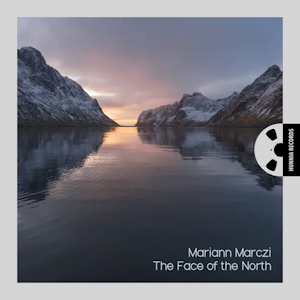
The Face of the North
Edvard Grieg (1843-1907)
Lyric Pieces
Arietta, Op. 12, No. 1
Waltz, Op. 12, No. 2
Watchman’s Song, Op.12, No. 3
Fairy Dance, Op. 12, No. 4
Vanished Days, Op. 57, No1
Evening in the Mountains, Op. 68, No. 4
Wedding Day at Troldhaugen, Op. 65, No. 6
Mariann Marczi (piano)
rec. 2000, Concert Hall, Franz Liszt Academy of Music Budapest, Hungary
Reviewed as download
Hunnia Records HRCD2619 [22]
For this album, recorded in 2000, but only released in 2026, Hungarian pianist Mariann Marczi performs a personal selection of just seven of Edvard Grieg’s Lyric Pieces (four from Op. 12 and one each from Op. 57, 68, and 65). By solely focusing on Grieg, The Face of the North has the spirit of the northern landscape that so fascinated this composer. As Marczi explained to me during our interview this October, the album is ‘an overview of the Norwegian people’s lives, landscapes, and celebrations’. At only twenty-two minutes, ‘overview’ is an apt word to describe the distilled essence of Grieg’s soundscape that Marczi provides.
Though short, the album can be enjoyed as an introduction to Grieg’s pieces for piano. During our conversation, Marczi also told me that Grieg’s miniature compositions can ‘open up immense horizons for both the performer and listener’. Indeed, Marczi’s selection covers some of the simplest, most expressive, and technically demanding pieces. Themes of folk-inspired dance (‘Arietta’ and ‘Waltz’), fairytale imagery (‘Watchman’s Song’ and ‘Fairy Dance’), nostalgia (‘Vanished Days’ and ‘Evening in the Mountains’), and a celebratory glimpse at Grieg’s personal life (‘Wedding Day at Troldhaugen’) provide the listener with an intimate portrait of the composer. Interestingly, the first and last tracks set up a clear contrast between Grieg’s early intimate voice and his later, more expansive compositions.
One of the most introspective and memorable pieces on the album is ‘Vanished Days’. It is in the key of D minor and moves through several tempo changes. It begins in a restrained way that touches on solemnity before progressing through increasingly dramatic sections and eventually returning to its slower, introspective conclusion. Grieg originally included ‘Vanished Days’ in a collection containing ‘Homesickness’ (appropriate given that Grieg composed these works when staying in Menton on the French Riviera), ‘Secret’, and ‘Illusion’, suggestive of his interest in different psychological states. The sound world of the pieces in this section is fuller with more chordal textures than in Grieg’s lighter, dance-based miniatures. Here, Marczi adds a measured weightiness to her playing, bringing out the melodic line in a way that adds expressiveness without sounding lugubrious. Her tempo changes also sound seamless rather than episodic, allowing reflective moments to bleed into the animated sections. There is an underratedness to Marczi’s interpretation which works very well indeed.
Overall, Marczi’s performance of this small selection of Grieg’s miniatures is appropriately restrained as she resists the urge for virtuosity, favouring a more intimate and melodic tone. For listeners looking for a slightly more extensive recording of Grieg’s miniatures, I recommend Leif Ove Andsens’s Greig: Lyric Pieces (released by Warner Classics in 2002) and, my personal favourite, Emil Gilels’s 1974 recording for Deutsche Grammophon. If any reader is interested in listening to the whole set, of which there were fifty-nine pieces categorised into ten collections that stretched from 1867 to 1901, Vladimir Feltsman’s recent recording is worth a listen (review).