
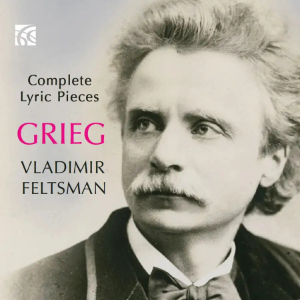
Edvard Grieg (1847-1903)
Complete Lyric pieces Opp. 12, 38, 43, 47, 54, 57, 62 (1867-1891)
Album Leaves Op. 28 (1864-1878)
Vladimir Feltsman (piano)
rec. 2023, Wyastone Leys, Monmouth, UK
Nimbus NI6467 [3 CDs: 207]
Grieg excelled at piano miniatures and wrote them all his life. There are ten collections, the first coming out in 1867 and the tenth and last in 1901. There are fifty-nine pieces in all. Looking at them, the early ones in particular, reminds me of what Busoni said about Mozart: ‘Too easy for amateurs; too difficult for professionals.’ Yes, the writing is largely simple and tuneful, with fewer demands on the kind of virtuosity which challenges the player and impresses audiences. Yet they call for subtle phrasing and articulation, a skilful use of the sustaining pedal, clear articulation of the melodic and accompanying figures, musical phrasing and a careful weighting of chords. And all this without calling attention to itself with affected phrasing, over-conscious or sentimental rubato or exaggerated expression. Many pianists and listeners are satisfied with a selection; here we have the complete set.
Grieg allows himself influences from other composers, which sometimes amount to an affectionate pastiche. So Op. 12 No. 5 Folk Melody is like Chopin, as is Op 38 No. 5 Leaping Melody. You might not have thought that Grieg would be interested in the bravura of Liszt, though he uses it in his Piano Concerto, but he did like the lyrical side of Liszt, as you can see from Op. 38 No. 3 Watchman’s Song and Op. 54 No. 4 Notturno. Op. 64 No. 3 Sadness, suggests the world of late Liszt. The immediate next piece, Op. 64 No. 4 Salon, seems to anticipate Scriabin. Elsewhere there are numerous evocations of Norwegian folk music, but whether or not Grieg used actual folk melodies I do not know.
From the Op. 54 set onwards, Grieg becomes more ambitious in his piano writing. The pieces now extend to three or four pages, or even more. There is more elaborate writing including running octaves, crossed hands and polyrhythms, sometimes in one hand. Op. 57 No. 1 Vanished Days is a particularly clear example, running to six pages with several changes of tempo and some very forceful writing. Op. 65 No. 1 From Days of Youth has a virtuoso middle section in blind octaves. No. 6 from the same set is the well-known Wedding Day at Troldhaugen, which rises to a thunderous climax, with the main theme filled out with chords in the right hand and running arpeggios in the left hand, all marked fff.
At least once Grieg revisited an idea which perhaps he was not satisfied with the first time round. Op. 59 No. 3 Trolls has an arresting first idea, but nothing that follows is really its equal. Op. 71 No. 3 starts with a similar idea but has much better working out.
In addition, we are given the Four Album Leaves Op. 28, also charming miniatures, rather reminiscent of Chopin.
The veteran pianist Vladimir Feltsman is the pianist here. Although he is no stranger to virtuosity – he has, after all, recorded the Hammerklavier Sonata – I think of him as primarily a subtle pianist. He displays the qualities I noted earlier for a good performance of these pieces. He tells us in the sleeve note that he first learned them as a boy from his teacher E. M. Timakin, provides a photograph of him at the time, and says that the recording is a tribute to him. The recording is excellent. There is, however, a fair amount of competition. One-disc selections from Gilels, Crossley, Gavrilov and Andsnes come to mind, and there are complete cycles from Håkon Austbø, Gerhard Oppitz and Eva Knardahl, among others. I haven’t heard these, but have been very satisfied by Feltsman.
Stephen Barber
Buying this recording via the link below generates revenue for MWI, which helps the site remain free













