
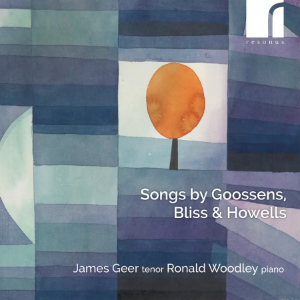
Songs by Goossens, Howells & Bliss
James Geer (tenor)
Ronald Woodley (piano)
rec. 2025, Wyastone Concert Hall, Monmouth, UK
Texts included
Resonus RES10381 [65]
Three eminent British contemporaries share space in this disc of their songs which date predominantly, but by no means exclusively, to the period 1915-1936. It’s unusual to find their songs presented in this way, certainly those of Goossens and Bliss, but therefore all the more valuable.
Eugene Goossens’ Chamber Music sets poems from James Joyce’s collection published in 1907. They enshrine a distinct but, in some ways, unidentifiable stylistic sense – sometimes of Ravelian clarity and expressive neutrality (‘O Cool is the Valley Now’) but also Englishness in solidity and lyric purposefulness (‘All Day I Hear the Noise of Waters’). One shouldn’t overlook the piano postludes either, which are not merely decorative but artful and integral. His Four Songs of 1936 covers quiet a lot of expressive ground for such compact settings whether dappled or stormy and still irradiated with French colour.
In 1929 Herbert Hughes and Bliss commissioned a collection of thirteen settings of Joyce’s Pomes Penyeach from thirteen composers. All three composers in this disc contributed to the publication which appeared in 1933. Goossens’ contribution is terse and tart, Bliss offers a long-breathed, decidedly romanticised Simples whereas Herbert Howells’ setting of Flood releases from him deeply unsettled and powerfully introverted writing.
Arthur Bliss is represented by Three Songs of 1923, the slightly earlier Three Romantic Songs and a few other miscellaneous ones. Bliss revised the 1923 collection many years later in 1972, not too long before his death, and they are more obviously in the lineage of British song than the more cosmopolitan works of Goossens – more direct, less ambiguous, but witty when required. His 1921 collection of three songs offers crispness, sublimated folklore and high spirits.
The examples culled from Howells include a very early work called Longing, specially edited for this release and here receiving its world premiere recording. It’s dated to around 1911 and is unusually spare for Howells though obviously it’s the work of a teenager. Elsewhere, dissonances fleck Here She Lies, A Pretty Bud. The other examples show how, though apparently simply conceived, Howells’ songs are effectively organised, how deft is his imitative writing (especially in The Lady Caroline) and how appealing his lyricism. Lethe (1936) also receives its first recording here, as do two bluff Bliss songs – simple, tuneful, direct – which were probably composed in 1970 for the ‘Westminster Society for Handicapped Children’.
Full texts are provided and there’s a fine booklet note from pianist Ronald Woodley whose playing is admirable throughout. James Geer is the tenor soloist and he sings with directness, sensitivity and a true awareness of the poems. He also sings without mannerism.
This is perhaps an unusual disc for the light it sheds on the songs of Bliss and Goossens which haven’t often been recorded but it also sheds some important light on Herbert Howells too. It does so with great accomplishment.
Jonathan Woolf
Buying this recording via the link below generates revenue for MWI, which helps the site remain free
Contents
Eugene Goossens (1893-1962)
Chamber Music (1930)
A Memory of the Players in a Mirror at Midnight (pub 1933)
Four Songs (1936)
When Thou Art Dead (c.1926)
Herbert Howells (1892-1983)
Here She Lies, A Pretty Bud (1917)
Longing (c.1911)
O Garlands, Hanging by the Doors (1920)
Flood (pub 1933)
The Widow Bird (Four Songs, Op.22/3) (1915-16)
The Little Boy Lost (1920)
The Lady Caroline (Lovelocks) (1936)
Lethe (1936)
Arthur Bliss (1891-1975)
Three Songs (1923)
Rich or Poor (1925-26)
Simples (pub 1933)
Three Romantic Songs (1921)
Sailing or Flying? (1970)
Tulips (1970)













