
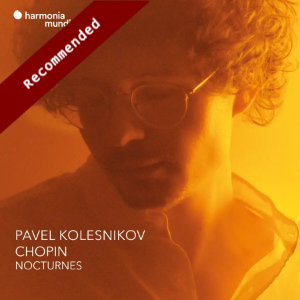
Frédéric Chopin (1810-1849)
Complete Nocturnes
Pavel Kolesnikov (piano)
rec. 2025, Merritt Hall, Sherborne Girls, Sherborne, UK
Reviewed as a digital download from a press preview
Harmonia Mundi HMM90279192 [155]
The central paradox of Chopin’s music is the paradox of the instrument for which he wrote most of his music, the piano: in effect a percussion instrument that is meant to sing. Never more than in the Nocturnes, Chopin’s voice is operatic but it sings to itself sotto voce, almost as if he doesn’t want to be heard and is singing for and to himself at the keyboard. We are not an audience but eavesdroppers. So, we have music that tries to make an instrument that can’t sing, sing, and uses the most public and demonstrative of music styles, opera, in the most introverted manner possible. Regardless of any reservations one might have about this new recording there is no denying that that description applies as well to Kolesnikov’s playing on this set of the complete Chopin Nocturnes as it does to the music he plays.
This is playing as a recreative exercise rather than a classical strict adherence to the notes on the pages. That it is essentially introverted playing shouldn’t blind us to the sometimes surprising liberties Kolesnikov takes with the letter of the score.
Kolesnikov is not given to vast Romantic gestures. He is no Cortot. The reference point for his Romanticism seems to look back toward Chopin’s love of Mozart. But within that frame he is happy to pull tempi around and is fond of making quite pronounced rallentandi to make a rhetorical point. His pedalling, to cite another example, is much more about emotional effect or evocation of mood than what is written on the page.
At this juncture, I must point out that I am writing this as a caveat emptor rather than because I have any issue with this style of playing. It has been a long time since a creative approach to these pieces has stimulated my imagination as much as these recordings have done.
In his self-penned notes, Kolesnikov, in effect, gives us little prose poems about what each nocturne stirred up in his mind or perhaps one might better say in his soul. For some this might seem the height of indulgence but the result is that every nocturne emerges uniquely formed evoking its own distinctive mood and character. Instead of a general mood of unrelieved Chopinesque Romantic moonlight we get the bewildering diversity of dreams themselves.
I could choose literally any of these pieces to illustrate this point but since I am currently listening to Op. 55 No1, that will do as well as any. Kolesnikov presents it with the Chaplinesque tottering gait of a piece by Satie (if the double metaphor can be forgiven). Sounds terrible? Try it – and try and resist its magic and if the fluttering butterfly wings of its last bars don’t win you over then you will at least know that this recording is not for you. Incidentally, for the pianist this nocturne reminds him of the eerie near-vulgarity of Goya and those final bars for him are stardust. Listening to him play it is not hard to see what he means.
My reference recording for this music remains Ingrid Fliter who manages to square the circle of Romantic liberty and Classical fidelity with elegance and panache though I retain deep affection for Arrau’s underrated set. Much though I love Rubinstein, I find his studio recordings too safe and well-behaved not least in contrast to those nocturnes that were recorded by him live.
In relation to those recordings, Kolesnikov now takes a special place. Can a recording as subjective as this ever be a general recommendation? But to counter such thoughts, in a catalogue stocked to the brim with great recordings do we even need to think in terms of general recommendations any longer?
I have somehow managed to get this far into this review without mentioning the quality of Kolesnikov’s playing. As anyone who knows his stunning recording of the Goldberg Variations already knows, he commands an absolute banquet of colours and rhythms. Like his contemporary Víkingur Ólafsson, he likes to tread a very fine line between the artfully refined and the precious – try his almost neuralgically sensitive touch at the start of the C sharp minor Nocturne with which he chooses to open this set. It is as if he is afraid he might bruise the piano. It is pretty outrageous and pretty typical of the recording as a whole. Not only is it gorgeous, it is very hard not to conclude that it sounds vividly and heart-stoppingly like Chopin rather than Chopin as an excuse for the display of Kolesnikov’s ego.
We get two versions of this particular nocturne on this recording, by the way, following two different editions of the score. Once, for me at least, was never going to be enough anyway.
By way of balance, it should be pointed out that he can also be surprisingly brutal when needs be but even those outbursts never break the dream-like strangeness of the world Kolesnikov takes us to. Some dreams, after all, are nightmares.
In writing about Chopin’s demands on the pianist in the second nocturne, Kolesnikov is driven to exclaim, “An exotic, exquisite, impossible sonority!” That seems as good a description as I can imagine for what he achieves in this extravagant, improbably delightful recording that comes as close as I can imagine to making that impossibility possible.
David McDade
Buying this recording via the link below generates revenue for MWI, which helps the site remain free













