
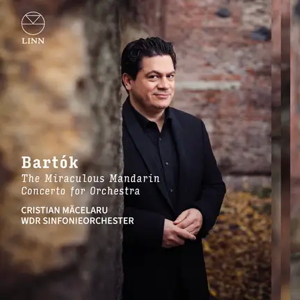
Béla Bartók (1881-1945)
Concerto for Orchestra, BB 123, Sz.116 (1943)
The Miraculous Mandarin, Op.19, Sz.73 – complete ballet (1923)
WDR Sinfonieorchester / Cristian Măcelaru
rec. 2024, Cologne Philharmonie, Cologne, Germany
Linn CKD806 [71]
Romanian-born Cristian Măcelaru has been steadily building his reputation as a conductor over the past dozen or so years. His discography is also diverse in terms of repertoire, ensembles and record labels. I have found everything I have heard to be intelligently and sensitively performed, with a clear and cogent sense of musical identity. So it was with considerable interest and anticipation that I listened to Béla Bartók’s two largest and best-known orchestral scores: the Concerto for Orchestra from late in the composer’s life and the scandalous Miraculous Mandarin premiered in 1926. Although the disc cover is not clear, the performance here is of the complete Miraculous Mandarin, not the suite in which Bartók chopped the closing ten minutes off the ballet to encourage concert hall performances of a work too sordid for the 1920s stage.
Given the significance of the two works and the way they generously fill a CD, it is quite surprising that they do not appear more often as a coupling. The Toronto Symphony Orchestra and Choir under Gustavo Gimeno released this combination on Harmonia Mundi early this year. In the mid-nineties, Simon Rattle in Birmingham offered these two works on EMI. Other than that, there was Riccardo Chailly with the Concertgebouw on Decca about 20 years ago, and Leonard Slatkin in St Louis on RCA around the same time. So, there is certainly room for a new recording. The engineering is very good if not demonstration class. The session dates spread over a week do not make it completely clear if these are patched live performances or ‘studio’ recordings. The back of the booklet includes the “WDR – The Cologne Broadcasts” logo and says the disc is “licensed by WDR mediagroup”. The sound of the excellent WDR Sinfonieorchester is well caught from a slightly distanced perspective.
The programme begins with the Concerto for Orchestra. It must be said that neither work is played with the kind of muscular, visceral excitement that someone like Georg Solti brought to these scores in his famous early 1960s Decca recordings with the LSO, although that was the ballet suite. Technically and musically, those recordings from 60+ years ago measure up remarkably well. But, as Măcelaru proved in his collection of Ravel performances (review), he is happy to trade out-and-out spectacle and physicality for a more focused sinewy power. The trade-off of earthy energy for lithe, carefully balanced and superbly executed orchestral playing is something individual listeners will need to assess for themselves.
Much as on the Ravel disc, the actual playing is never less than wholly impressive, and passages of expressive lyricism as especially successful. Măcelaru favours nimble tempi where appropriate, and he ensures that even in the fullest orchestration detail and balance is very well controlled. Perhaps with this control comes a lack of unbuttoned release. Certainly the brass of the WDR never dominate textures or musical landscapes like they can in other performances. Each movement of the concerto illustrates this literal balancing act in different ways. The second movement, Presentando le coppie,is wholly successful. I also enjoyed the focused precision of the strings in the following Elegia very much. But the crass crudities of the Intermezzo interrotto cocking a snook at Shostakovich’s Leningrad Symphony surely need to be harsher in their judgement. The opening of the bustling Finale is played with genuine impressive brilliance but I miss the wall of sonic splendour sections like the Chicago brass are allowed to unleash towards the end of this movement. In place of that, one is again aware of the careful layering of textures and attention to greater detail which underlines the work’s role as a showcase for orchestra without allowing it to become a show-off instead.
Barbarity and sensuality lie at the heart of the remarkably condensed and dramatically powerful Miraculous Mandarin. I wondered if the chosen recording style of slightly distanced empty concert hall mitigated against some of the detail Măcelaru sought. Inner details like the orchestral piano are barely audible in the opening street scene. I must also admit the organ pedals seemed wholly absent (check out Dorati’s Detroit version on Decca for the opposite audio extreme, not particularly desirable either). Even with Măcelaru’s clearly remarkable ear for texture and detail, following the score for the ballet on IMSLP shows how much of Bartók’s painstaking and meticulous orchestral detail is hard to discern.
The seductive passages in this rather garish story are predictably fine, sensuous and febrile. Indeed, the famous “wild chase” that concludes the shortened suite is played with exciting virtuosity at a headlong speed. Oddly, the liner notes list every member of the orchestra but fail to even mention the ghostly wordless choir which sings as the body of the mandarin begins to glow. Its a wonderful musical piece of grand guignol, perfectly caught in this recording – no wonder the murderous tramps shudder as they do. The closing pages as the Mandarin quivers in his death throes are disturbing and atmospheric.
At the time of the 1926 premiere – in Cologne no less, so played here by the home-team orchestra! – the scandal of the staging provoked as much of an uproar as Stravinsky’s Rite had more than a decade earlier. The liner notes say that, before cancelling all further performances, the Mayor of Cologne summoned the conductor and accused him of staging filth. That mayor was Konrad Adenauer, destined to become Germany’s first post-War Chancellor.
While this disc does not supersede the dozens of excellent versions already available, I do feel that Măcelaru offers a different view, rich in poise and precision alongside rapier-sharp energy when required. It is a valid alternative to the more commonly adopted orchestral showcase approach. From first note to last, the playing of the WDR Sinfonieorchester is a genuine joy, so overall this is a impressive new release worthy of serious consideration.
Nick Barnard
Buying this recording via the link below generates revenue for MWI, which helps the site remain free













