
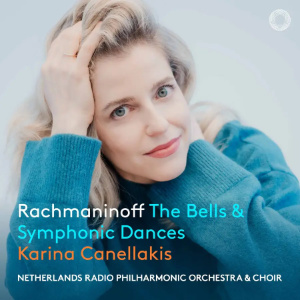
Sergei Rachmaninoff (1873-1943)
The Bells, Op.35 (1913)
Symphonic Dances, Op.45 (1940)
Kristina Mkhitaryan (soprano), Dmytro Popov (tenor), Alexander Vinogradov (bass)
Netherlands Radio Philharmonic Orchestra & Choir / Karina Canellakis
rec. 2025, Heuvellaan, Hilversum, The Netherlands
Russian text (transliterated) & English translation included
Pentatone PTC5187523 [74]
This Pentatone issue presents two of Rachmaninov’s greatest works the Symphonic Dances, Op. 45 and The Bells, Op. 35.
A work that deserves a wider circulation, The Bells from 1913 greatly rewards with repeated hearings. Rachmaninov described the four-movement score at different times as a choral symphony and a cantata. He was inspired to compose the work after receiving an anonymous Russian text in Rome, believing it to be an original poem by Konstantin Balmont, whereas it was in fact Balmont’s free adaptation of Edgar Allan Poe’s ‘The Bells’. Rachmaninov knew the deep significance of bells in Russian culture and the score evokes a bittersweet range of emotions from joy to mourning through sleigh bells, church bells, alarm bells, wedding and funeral bells.
Tenor Dmytro Popov gives a satisfying performance in the opening Allegro ‘Silver sleigh bells’ which is exuberant and aptly communicates a festive mood. In the second movement, marked Lento, soprano Kristina Mkhitaryan sings ‘Mellow wedding bells’ calmly, with an undertone of melancholy, but her vibrato becomes slightly wearisome after a time. Storm clouds rage in the choral Presto movement ‘Loud Alarum Bells’, where the chorus creates a sense of dark foreboding as if anticipating peril. Marked Lento lugubre, the Finale ‘Mournful Iron Bells’ is for chorus and bass, sung by Alexander Vinogradov. He expertly and movingly communicates the heavy aching sorrow felt at the death of a loved one and the doleful playing of the prominent cor anglais solo is striking. The Netherlands Radio Chorus is clearly well drilled by its director Benjamin Goodson and sings well throughout.
There are a number of excellent recordings of The Bells. The live 2016 Herkulessaal, Munich account from Maris Jansons and his Bavarian Radio Symphony Orchestra and Chorus on the BR Klassik label has three impressive soloists and is inspiring and powerful. Worthy of praise, too, is Simon Rattle’s live 2012 Philharmonie, Berlin performance with the Berlin Radio Choir and the Berlin Philharmonic and a satisfying trio of soloists on Warner (review). As with Jansons’ account, Rattle’s coupling is also the Symphonic Dances. I also appreciate the exciting and committed 1979 from the Yurlov Russian Choir and USSR Symphony Orchestra under Evgeni Svetlanov (review). Originally released on Melodiya, it has now been reissued on Regis and on Alto. Also worth consideration is the finely judged 2000 recording from the Moscow State Chamber Choir and the Russian National Orchestra conducted by Mikhail Pletnev on Deutsche Grammophon (review).
Completed in 1940 on Long Island, New York, the Symphonic Dances was Rachmaninov’s final major score and his last orchestral work. Eugene Ormandy and the Philadelphia Orchestra gave the premiere the following year. Its origins reach as far back as 1915, as sketches for a projected ballet titled The Scythians rejected by dancer-choreographer Michel Fokine. Later, Rachmaninov had the notion of naming the score the Fantastic Dances and toyed with the notion of naming the three movements Midday, Twilight and Midnight.
Its sharply contrasted movements are lavished with sumptuous orchestral colour. In addition, the score is reflective of Rachmaninov’s creative life with echoes of Russian Orthodox chant, the shadow of the Dies irae motif and quotations from earlier works, which all contribute to a score that I’ve seen described as ‘at once valedictory and defiantly alive.’
Marked Non Allegro, the first movement soon develops a rhythmic vivacity combined with a profound yearning for Rachmaninov’s Russian homeland. At 3:42–5:52 (track 5), the alto saxophone’s haunting solo provides one of the score’s most characteristic touches. The chromatic, pulsating writing reveals the prominent influence of Rimsky-Korsakov’s operas. In the coda, Rachmaninov returns to his own music, quoting the opening theme of his First Symphony. Here, Karina Canellakis doesn’t quite attain the degree of rhythmic thrust that I prefer.
Marked Andante con Moto (Tempo di valse) the second movement opens with threatening chords from horns and muted trumpets that later repeat. Next, the music is imbued with swirling waltz rhythms that begin amiable and relaxed. Soon, they take on an agitated character of increasing anguish, maybe for his lost homeland. Here, Canellakis is generally a little too polite, and the brass chords don’t provide sufficient tension.
Beginning in a relaxed manner the Finale: Lento assai – Allegro vivace soon gains in vitality and momentum in a scheme that goes back and forth. One notices that Rachmaninov continues his preoccupation with the Dies irae motif. To conclude, a sense of joy appears in a brilliant contemporary manner but it sounds as if Canellakis isn’t wholly comfortable with Rachmaninov’s complex harmonies and rhythmic changes.
A few years ago, when selecting a best recording of the Symphonic Dances I felt spoiled for choice. Of those I know here are several impressive recordings led by Maris Jansons’ live 2017 performance with the Bavarian Radio Symphony Orchestra at Herkulessaal, Munich on BR Klassik, Simon Rattle and the Berlin Philharmonic’s live recording from Berlin in 2010 on Warner, and Vasily Petrenko’s 2008 Liverpool account with the RLPO on Avie. I also admired the recordings by the Berlin Philharmonic under Lorin Maazel from 1983 on Deutsche Grammophon and André Previn conducting the LSO in 1974 on EMI Classics. After repeatedly coming back to Eugene Ormandy’s recording, I have now settled on his passionate and powerful account with the Philadelphia Orchestra on Sony Classical, although the 1960s sound might be a problem for some.
There is much beautiful playing from the Netherlands Radio Philharmonic Orchestra here; my reservations concern conductor Karina Canellakis who might have given the orchestral sound more weight and pushed the range of dynamics further.
This was recorded in 2025 in the Heuvellaan at Hilversum, the orchestra’s base, and the engineering team has provided warm and clear sound quality.
In the booklet notes there is a short article by Karina Canellakis and another helpful note by Philip Ross Bullock. It’s heartening to see that Konstantin Balmont’s Russian text is provided for The Bells alongside Fanny S. Copeland’s English translation.
The Symphonic Dances and The Bells are undeniable masterworks, though there are several recordings superior to this.
Michael Cookson
Previous review: John Quinn
Buying this recording via the link below generates revenue for MWI, which helps the site remain free













