
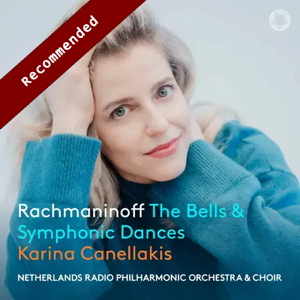
Sergei Rachmaninoff (1873-1943)
The Bells, Op.35 (1913)
Symphonic Dances, Op.45 (1940)
Kristina Mkhitaryan (soprano), Dmytro Popov (tenor), Alexander Vinogradov (bass)
Netherlands Radio Philharmonic Orchestra & Choir / Karina Canellakis
rec. 2025, Heuvellaan, Hilversum, The Netherlands
Russian text (transliterated) & English translation included
Pentatone PTC5187523 [74]
The American conductor Karina Canellakis will be familiar to UK readers for her work with the BBC Symphony Orchestra (including the First Night of the Proms in 2019) and, more recently with the London Philharmonic Orchestra, whose principal guest conductor she has been since 2020. She has been Chief Conductor of the Netherlands Radio Philharmonic Orchestra (NRPO) since the 2019/20 season and I believe I’m right in saying that her contract has now been extended right through to 2031; on the evidence of this CD, I’m not surprised. This is by no means her first recording with the NRPO but I’ve not previously encountered them on disc together.
It’s appropriate to hear The Bells performed by a Dutch choir and orchestra because, as Philip Ross Bullock reminds us in his useful notes, Rachmaninoff dedicated the work to Willem Mengelberg and what was then the Concertgebouw Orchestra. Sensibly, though, three soloists who will be completely comfortable with the Russian language have been engaged: Dmytro Popov is Ukrainian and his two colleagues are Russian. In fact, it’s not all that long ago that I heard Popov and soprano Kristina Mkhitaryan in this work; they both sang for Edward Gardner in his live 2023 recording (review). Both of them impressed me then and they make an equally good impression here.
Right from the start of ‘The silver sleigh-bells’ it’s evident that one of the many virtues of this CD is to be the recording itself; the sound of the orchestra and choir has ample presence and clarity. Canellakis invests the music with life and detail is keenly observed. Popov’s ringing tenor is just right for the music; both he and the choir sing very well. The orchestral opening of ‘The mellow wedding bells’ is gorgeously phrased. I liked the singing of Kristina Mkhitaryan on the Gardner recording; here, if anything, she’s better still. Her singing is highly expressive and she vividly communicates both the words and the music.
‘The loud alarum bells’ receives a performance of almost frightening intensity. The orchestra is potent but the choir is by no means put in the shade. The singing of the Netherlands Radio Choir is incisive; furthermore, the chorus not only responds acutely to Rachmaninoff’s dark vision but also displays the wide dynamic range that’s essential if the music is to make its full impact. It’s difficult music but this choir is undaunted. I was especially impressed by the weight and drama that’s on display in the passage that begins (in the English translation) ‘I shall soon / Leaping higher, still aspire…’ (4:51 – 5:43). This is a tremendous performance of the movement. The final movement, ‘The mournful iron bells’ is no less successful. After a broodingly atmospheric orchestral opening – the doleful nature of the music is ideally captured – we hear Alexander Vinogradov. He’s commanding and mournful at the same time; his is a real vocal presence. Soloist, choir and orchestra combine to give an arresting performance; at ‘Bear the message, that a brother passed away to endless sleep’ Vinogradov’s grief-stricken delivery also has a magisterial dignity. This compelling account of the movement culminates in the unexpected but welcome consolation of the major-key orchestral coda (from 9:50).
This is a tremendous performance of The Bells which on its own would make the disc highly recommendable. However, Karina Canellakis then seals the deal with an equally fine account of the Symphonic Dances.
In the booklet, Philip Ross Bullock points out that Rachmaninoff wrote very little music after he went into self-imposed exile from Russia; indeed, he completed only six works – all of them very fine – after 1926 and the Symphonic Dances was the very last of these. As Bullock justly observes, there is “no sense of creative fatigue about the Symphonic Dances”. I wholeheartedly agree; in fact, this work is, in my opinion, one of his finest achievements of all. Mind you, it’s a very challenging work for both the conductor and the orchestra; happily, Canellakis and her players are more than equal to the task.
The first movement (Non Allegro) is punchily delivered; the rhythms are strong and precise; the conductor’s own description of the music as being “earthy” is borne out by the performance she leads. The weight of the orchestral tone is just right. At 3:45 the husky sound of the alto saxophone brings us a choice example of the composer’s nostalgic lyricism and when the strings take up this haunting melody (5:51), their tone is ideally warm. Canellakis impresses me in this section; her conducting invests the music with plenty of feeling yet this is never done at the cost of momentum; the music flows very well indeed. The transition back to the quick music is skilfully achieved and I love the way the coda, at first suave, then delicate, is brought off. The shadowy waltz that forms the middle movement is expertly judged by Canellakis; the hesitations and uncertainties in the music all register but are never exaggerated. The playing of the NRPO is alert and responsive throughout.
The Allegro vivace material in the finale is played with knife-edge precision and exciting thrust. At 3:45 we hear for one last time Rachmaninoff writing music of lingering melancholy and nostalgia. Canellakis and her orchestra don’t indulge in any sentimental wallowing but neither do they short-change us in terms of emotion. When the fast music returns (from 9:45) the performance will have you on the edge of your seat. The music-making is urgent and full of excitement. Canellakis drives the music forward thrillingly and the orchestra plays it with passion and panache; it’s memorable. At the very end of the piece the final tam-tam crash is left to resonate and decay naturally. In live performance you rarely if ever experience the effect because audiences are understandably anxious to show their appreciation. Here, the sound of the tam-tam dies away over 13 seconds; that’s ideal. This is a magnificent, compelling rendition of the Symphonic Dances
Over the years I’ve heard several superb accounts of Rachmaninoff’s final masterpiece. Among live versions, Edward Gardner’s recent account is very fine (review) though it doesn’t displace my go-to version, which is the incandescent 2002 performance led by Evgeny Svetlanov (review). Among studio versions, I greatly admire Vladimir Ashkenazy’s recording with the Royal Concertgebouw Orchestra (review) and, even more so, Vasily Petrenko’s superb account with the Royal Liverpool Philharmonic (review). I’d say without hesitation that this new Canellakis performance is more than worthy to be ranked alongside these outstanding versions.
I’m delighted that Karina Canellakis’s performances of these two works have been captured in marvellous recorded sound. The recordings were made by a team from Polyhymnia. I’ve greatly admired their work over the years and this disc is another example of their quality. The sound has impact, presence and clarity; the engineering shows off and complements the excellence of the music-making. The booklet, which is nicely illustrated, has two good sets of notes, one by Philip Ross Bullock and one by Karina Canellakis herself.
If you like the music of Rachmaninoff, you must hear this outstanding disc.
Other review: Michael Cookson
Buying this recording via the link below generates revenue for MWI, which helps the site remain free













