
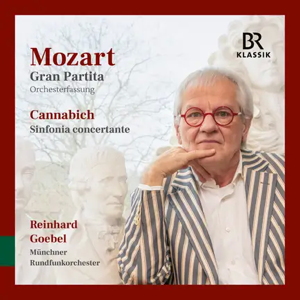
Wolfgang Amadeus Mozart (1756-1791)
Serenade in B-flat major for 12 wind instruments & double bass Gran Partita
(orchestral version arranged by Franz Gleißner published as Sinfonia concertante, K361/370a Gran Partita)
Christian Cannabich (1731-1798)
Sinfonia concertante in E-flat major for two violins & orchestra
Stanko Madić & Eugene Nakamura (violins)
Munich Radio Orchestra/Reinhard Goebel
rec. 2025, Studio 1, Bayerischer Rundfunk, Munich, Germany
BR Klassik 900358 [54]
This new release features renowned early music specialist Reinhard Goebel conducting the Münchner Rundfunkorchester in Mozart’s Serenade in B flat major Gran Partita, K361 in an orchestral arrangement by Franz Gleißner. Also included is the Sinfonia concertante in E-flat major for two violins and orchestra by Mozart’s close contemporary Christian Cannabich.
Goebel founded the legendary Musica Antiqua Köln in 1973, a period instrument ensemble that disbanded in 2007. Crucially, around the millennium, Goebel’s approach to performance practice extended to conducting modern chamber and symphony orchestras. Since 2018, he has served as music director of the award-winning Berliner Barock Solisten, an ensemble that combines historically informed performance practice with modern instruments or old instruments with modern set-ups. Here, the Munich Radio Orchestra uses modern instruments.
Mozart’s Gran Partita was written in 1782 to meet the popular demand for woodwind music in Vienna and Bohemia. Mozart wrote a large amount of this so-called ‘music for entertainment’ including serenades, divertimenti, dances and cassations for outdoor festive events and inside to accompany banquets. It is scored for wind ensemble of two oboes, two clarinets, two basset-horns, four horns, two bassoons and double bass. A performance of the Gran Partita given in Vienna in 1784 at a benefit concert for celebrated clarinet soloist Anton Stadler is firmly documented; a concert advertisement announced it as a ‘great wind piece of a very special kind composed by Herr Mozart.’
After Mozart’s death in 1791, it was arranged circa 1800 by German composer Franz Gleißner (1761-1818) for a standard orchestra of the time and that is what Reinhard Goebel’s conducts here. Gleißner published his accomplished arrangement as a Sinfonia concertante however it is still widely known as the Gran Partita, which was written on Mozart’s manuscript score in another hand.
In seven movements, it opens with a good-humoured Largo-Molto Allegro, the orchestra providing a principally vivacious character. Next is the first of two Minuetti containing two distinctive trio sections given a splendidly graceful and pleasing performance. In the third movement, the players come into their own with a captivating Adagio – in effect, a terzetto for oboe, clarinet and basset horn, each revelling in its delightful melodies. Another, shorter Minuetto also has two differing trio sections with the second featuring another terzetto of oboe, basset horn and bassoon. The playing of the swirling Ländler-like dance set against the stately Menuet is delightful. Movement five is anattractive, song-like Romanze whose middle section has a rather recondite quality. The sixth movement, Tema con Variazioni, has a melodious Andante theme which is mainly for the clarinet and is then given a set of six diverse variations which are impressively played. The work ends splendidly with an upbeat and melodic Finale concluding with a buoyant Coda. Credit is due to the orchestra for producing a feast of instrumental colour.
Those who enjoy period instruments may hear an outstanding account of this on a wonderful recording of the Mozart Wind Serenades played by the Amadeus Winds under Christopher Hogwood, from 1985 in New York on Double Decca 458 096-2.
A pupil of Johann Stamitz and friend of Mozart, German composer, violinist and conductor Christian Cannabich has been largely ignored and known mainly as a footnote in Mozart biographies. Born in Mannheim, he spent much of his life with its renowned court orchestra, from being a student to becoming its concertmaster and director. Also a prolific composer, he wrote over seventy symphonies, some of which have received recordings. Mozart was friendly with and admired him, although his father Leopold didn’t rate the man or his music.
Cannabich is represented here by his Sinfonia concertante in E-flat major for two violins and orchestra with violin soloists Stanko Madić first concertmaster and Eugene Nakamura principal second violin, both of the Munich Radio Orchestra. It is a most attractive work that deserves further recordings, yet as one might expect, it doesn’t match the quality of Mozart’s.
In two movements, as was the convention then, the first in Allegro ma non tanto is an engaging and very agreeable movement. It is briskly played here by the two violins which have satisfying roles and work suitably together. Marked Allegro molto moderato,the second movement seems close in style to the first movement. Buoyant orchestral playing is matched by Madić and Nakamura’s attractive violin interplay.
Throughout both works under conductor Reinhard Goebel, the Munich Radio Orchestra makes an impressively attractive sound, at turns vivacious and expertly nuanced. The brief instrumental solos and the interwoven dialogue of the small chamber combinations are unerringly gratifying and as mentioned earlier, the variety of orchestral colour created by the players is remarkable.
The recorded sound is excellent, with clean, focused sound from the brass, expressive woodwind and no edginess on the strings to bother about. One senses the orchestra’s joy of performing here; enthusiasts of the classical era should not hesitate to hear this first-class album.
Michael Cookson
Buying this recording via the link below generates revenue for MWI, which helps the site remain free













