
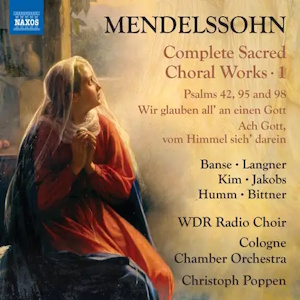
Felix Mendelssohn (1809-1847)
Complete Sacred Choral Works vol. 1
Julianne Banse (soprano); Charlotte Langner (soprano); Seil Kim (tenor); Thomas Jacobs (tenor); Äneas Humm (baritone); Manfred Bittner (bass-baritone).
WDR Radio Choir
Cologne Chamber Orchestra/Christoph Poppen
No English text included
rec 2024-25, Kammermusiksaal, Cologne, Germany.
Naxos 8.57640 [79]
One of the first pieces of music I remember hearing as a child was the overture to Mendelssohn ‘s A Midsummer Night’s Dream. Something of its magic caught me, and has held me ever since. Mendelssohn is a composer who has come and gone throughout my life. Recently I have embraced Elijah and all of his symphonies rather than just the popular ones. I recently reviewed the new Maasaki Suzuki recording of his second symphony Lobgesang here and the first thing I noticed was that it was very clearly the composer of these two works whom we find in this first volume of the composer’s complete choral music on Naxos. The similarities are there from the start, but the clearest example is in the third item on this disc, where the music for the final line, Denn er kommt, zu richten des Erdreich, could have been lifted from the beginning of the choral section of his second symphony Lobgesang.
Lobgesang itself was composed to celebrate the two hundredth anniversary of Caxton’s invention of the printing press, but was at the same time a highly religious work. In contrast, these works are wholly about the reverence and joyful worship of the Christian God. Mendelssohn might have been Jewish by birth, but he was as strictly Lutheran as Bach in both his background and beliefs. His sacred output ranges through seventy works, from the liturgical Lutheran, to chorales and the sacred oratorios Paulus and Elijah, (his other oratorio Christus remained unfinished). Then, there is not only one symphony, Lobgesang, which is a straight hymn of praise using extensive settings from the bible, but his final symphony The Reformation, uses Martin Luther’s well-known Ein feste Burg ist unser Gott as its theme and variations. Once again there are musical and thematic similarities in the first and third items in this selection.
This volume is the first in a laudable attempt by Naxos to bring together all those choral works into a full edition. This is the first of two volumes of the smaller stuff. I am happy to say that if this is a representative sample of Mendelssohn’s choral future with Naxos, then I will be investing. What makes easy access so difficult for the casual listener is that, unforgivably, Naxos provides only the German text. I’m lucky enough to be able to more or less get by on my German ‘A’ level, but where does that leave everyone else? Furthermore, Naxos has the temerity to advertise the fact that texts are provided in German on the back cover, as if this is something to be proud of. They then go on to advertise that the same German texts can be found on their website in print so small that I shall need a magnifying glass to read it. This is simply not good enough and if Naxos are not careful, it will completely negate the musical care and attention they’ve put into the project, by their being such cheapskates with the accompanying material.
That initial peeve over, we can now go back to the music, and despite the overall strength and at times, sheer class of this recording, there is something rather odd going on with the two sopranos. The first, the highly experienced Lieder and opera singer Julianne Banse, who, for example, my esteemed colleague Ralph Moore praised highly for her recording of Schumann’s gorgeous cycle of songs, Frauenliebe und Leben, appears to be singing on all of the relevant arias but one. Her colleague, Charlotte Langner, it would seem, sings only a single item, with her fellow soprano in the lovely duet Denn in seiner hand ist, which is the third part of the Psalm 95 Opus 46 piece, Kommt, lass uns arbeiten. However, unless my ears are deceiving me, there appear to be two versions of Julianne Banse: one who hits the notes dead on and sings with a quiet liquid subtlety which perfectly suits the music, and another version, who is more wayward in tone and has at times a distinct wobble. This doesn’t happen otherwise, but is enough to be noticed. One possible answer is that Julianne Bansewas clearly at her best in the material recorded in 2025, (items 1-9), whereas in items 15-17, recorded the previous year, she seems to struggle. None of this, I should stress, should be enough to put you off a pretty fine performance, let alone an excellent collection of Mendelssohn.
The remaining singers are good, especially the tenor Seil Kim, and the baritone Äneas Humm. Manfred Bittner is a bass-baritone who, like soprano Charlotte Langner, and tenor Thomas Jakobs only appears in the single item, 20’s Quintetto, Der Herr hat des Tages verheissen seine Gute, from Psalm 42, Wie der herz schreit auf frischen wasser (How the heart cries out for fresh water) but their contribution is small, so there is little chance to appreciate the nuances of these singers.
The choir, who throughout make a very nice sound, at times reminding me of other more famous choirs in more famous works by Mendelssohn, which can only be a compliment. The Cologne Chamber Orchestra are the last and most important part of the ensemble, along with their highly able and rhythmic conductor Christoph Poppen, and they acquit themselves admirably in music that they obviously enjoy and feel is worthy of their attention.
The most overt similarities are to Mendelssohn’s most famous oratorio Elijah, from which the hymn to Baal could have been lifted whole, but let me look in detail at the six pieces chosen to both begin, and represent this potentially fine project from Naxos. The opening item, Psalm 95, Kommt, last uns anbeten, (Come, let us worship), is for me the piece which has the most overt Mendelssohnian feel, especially when the chorus sweeps in so powerfully like ‘Lobgesang, and at twenty-five minutes is both the longest and most enjoyable. The first performance of the revised performance was given at the Gewandhaus on 22nd November 1941, and it’s not surprising to find those musical echoes and similarities, as the above work, although performed much later posthumously, was written the year before. The Psalm 95 E minor work flashes between moments of light and dark, with a lovely tenor aria following the sturdy opening, and the chorus move from major to minor in a salutary warning about false idols. Later, the same tenor serves more as an evangelist with his warnings, with the choir, brass and timpani echoing the sentiment.
The choir’s abilities are shown very nicely in the second piece, a beautifully tender chorale setting of the Credo from Luther’s Deutsche Messe from 1831, Wir glauben all’ an einer Gott. The later inter-action with the strings is tastefully understated.
The third piece, a setting of Psalm 98, is a more festive piece with the onus on the interplay between baritone and choir, brass and harp. Orchestrating this text got Mendelssohn in trouble briefly with the church authorities, and things were not helped by a miserable sermon at the first performance.
The second chorale cantata, Ah Gott von Himmel sieh darein, (God sees us from heaven) that follows is quite simply beautiful in both its four-part setting and just in general. The choir’s’ singing and again the subtlety of the chamber ensemble produce quite lovely results, and Seil Kim is a fine soloist.
The fifth item on the programme is the second longest piece and surely the most like Elijah – which is hardly surprising, as it was first performed only two years before the great oratorio. It is here in the soprano aria, sadly, that Julianne Banse sounds a wobbly shadow of herself a year later, but happily, that suggests she may have been having an off day in 2024. It is in the chorus piece ‘Was betrubst du ich, meine Seele, und bis du unruhig in mir that echoes of the future priests of Baal make their appearance in Harre auf Gott, (wait for God) Julianne Banse has more difficulty again with her intonation in the quintet that follows. In the final section repeat of Betrubst du mir all forces are brought together finally in a triumphant restatement of Harre auf Gott. Another gentle and understated Luther setting in the chorale Christe, Du Lamm Gottes completes this first splendid and often moving first volume of Naxos’s collected Mendelssohn choral music.
My verdict is that if this first volume’s treasures are a sign of what’s to come from Naxos’s complete Mendelssohn Choral Music, we should eagerly await the remainder.
Stephen John Wray Gladwin
Buying this recording via the link below generates revenue for MWI, which helps the site remain free
CD Contents
1-5. Psalm 95 Kommt, lass uns arbeiten. (1838. Rev 1841) – 25.00
6-8. Chorale Cantata Wir glauben all‘ an einer Gott. (1831) – 6.36
9. Psalm 98 Singet den Herren ein neues Lied (1843) – 7.30
10-13. Chorale Cantata Ach Gott, von Himmel sieh‘ darein (18.32) – 11.22
14-21. Psalm 42 Wie der Herz schreit nach frischen Wasser (1837) – 21.30
22. Chorale Cantata Christe, du Lamm Gottes’ (1827) – 6.39













