
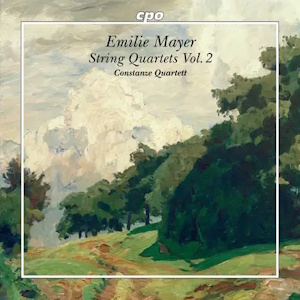
Emilie Mayer (1812-1883) String quartets vol. 2
String Quartet in G minor Op. 14
String Quartet in F major
Constanze Quartett
rec.July 2023 at Orchesterhaus, Salzburg, Austria
cpo 555 601-2 [68]
This was my first encounter with the music of Emilie Mayer. She had both a considerable talent and independent means. She was based mainly in Berlin where she financed the performance of several of her works, though her mentor the composer and teacher Carl Loewe also promoted her. She wrote eight symphonies and twelve string quartets, not all of which survive. In recent years the cpo label has been doing her proud, with a steady programme of releases. Two of these have been reviewed on MWI (review review) but not the first volume of string quartets.
We have two of these in this second volume. Her idiom is early Romantic, with the influence of Beethoven and Mendelssohn evident. The quartet in G minor carries an opus number and is presumed to be the last of her (extant) quartets, though we have dates for none of them. It is Mendelssohn who is particularly called to mind in this work. There are the usual four movements. The opening theme is wistful and attractive, and there is a gentle transition to a more vigorous second subject, but still with a rather melancholy tone, though shot through with some brighter moments. The development has some anguished passages before moving to a more Mozartian serenity. The recapitulation is still wistful but now with some flickers of light. The scherzo is playful and skittish. The slow movement features a long, winding melody on the first violin with slower moving harmonies underneath. The finale is a sonata rondo, fast and full of ideas. This is an excellent work, fully comparable to the Mendelssohn quartets.
The string quartet in F major is slightly less impressive but still worthwhile. The opening is lyrical for a sonata first movement, and it proceeds in an equable flow but not without some darker moments. The scherzo, in D minor, is quick minuet. The trio carries echoes of the opening of Beethoven’s Eroica symphony. The slow movement is a theme and variations, but the last of these is free and goes into strange places before returning to the theme. The finale is a surprisingly short sonata rondo.
I was glad to make the acquaintance of these works and shall be looking out for more of Mayer’s music. The performances by the Constanze Quartett are polished and elegant and the recording is good. The booklet is very helpful. The rehabilitation of Emilie Mayer proceeds apace.
Stephen Barber
Buying this recording via the link below generates revenue for MWI, which helps the site remain free













