
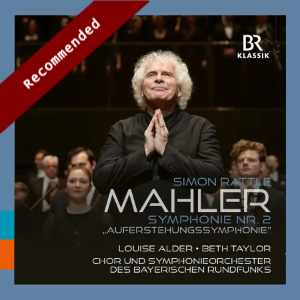
Gustav Mahler (1860-1911)
Symphony No. 2 in C minor ‘Resurrection’ (1888-94)
Louise Alder (soprano); Beth Taylor mezzo-soprano)
Chor des Bayerischen Rundfunks
Symphonieorchester des Bayerischen Rundfunks / Sir Simon Rattle
rec. live 18-20 March 2026, Isarphilharmonie im Gasteig, Munich
German text included
BR Klassik 900240 [83]
It now seems clear that a new Mahler symphony cycle is slowly taking shape involving Sir Simon Rattle and the Bavarian Radio Symphony Orchestra. They’ve already released live accounts of Das Lied von der Erde, given in January 2018 (review) and of three symphonies: the Ninth, in a performance from November 2021 (review); the Sixth, recorded in September 2023 (review); and, most recently a magnificent 2024 traversal of the Seventh (review). The latest instalment is this 2026 account of the Second symphony.
The ‘Resurrection’ symphony has always been something of a signature work for Simon Rattle, going back at least to his Birmingham days. This is his third recording of the work. He made a studio recording for EMI/Warner, way back in 1986 with the City of Birmingham Symphony Orchestra. Like most of his CBSO recordings, I doubt it’s now available singly but I recall that Tony Duggan was very impressed by it. There followed a 2010 recording, again for EMI/Warner but this time taken from live performances. This was made with the Berlin Philharmonic and I admired it very much – I still do – while feeling that the earlier CBSO version was not entirely superseded (review). Now Rattle has returned to the symphony with his current orchestra in Munich.
The booklet includes some photographs of the performance which confirms what our ears tell us: Rattle divides his violins left and right with the violas positioned to the left of the first violins and the cellos between the violas and the seconds. The basses are in their customary position, far to the conductor’s right. The benefits of the divided violins are most evident in the second and third movements and throughout the symphony it’s advantageous to have the violas and cellos at the heart of the orchestral sound.
The first movement goes very well indeed. Right at the start, I was impressed by the weight and sense of purpose, although there’s also welcome momentum. There’s considerable drama in this movement but Mahler also relaxes the tension at times with some slower, nostalgic episodes, the first of which occurs at 5:46. This passage is ravishing; Rattle’s superb orchestra presents a vision of a faraway, longed-for landscape; you almost wonder why Mahler didn’t use cowbells at this point. However, although Rattle takes these pages at a broad pace, bringing out the wistfulness in an ideal fashion, he ensures that the music doesn’t become becalmed. I was greatly impressed by his overall grip of the movement’s structure; transitions, for example, are expertly managed. He most certainly does not underplay the drama – that sequence of hammered chords, marked Molto pesante, is really arresting (14:36), and the lead-up to those chords is absolutely thrilling. A few minutes before the end of the movement (from 16:34), Mahler indulges in another dreamy episode and hereabouts the strings of the BRSO are surpassingly eloquent. This is a compelling account of the huge first movement.
The second movement (Andante moderato,. Sehr gemächlich. Nie eilen) is a delight. The performance is graceful and mobile; indeed, I fancy that overall, it’s slightly swifter than Rattle’s previous recordings. The BRSO offers playing of great refinement. I really enjoyed this. The third movement is similarly successful. Here, the performance benefits from an abundance of sharply-edged detail. Rattle’s way with the music brings out the sardonic humour of the music. I admired the piquant woodwind contributions and also the way that, yet again, nostalgic episodes are exquisitely played. The premonition of the finale (8:48) puts the listener on notice that the last movement is likely to be a very dramatic experience. Rattle builds up to that short passage in a very exciting way and he also shapes the end of the movement most effectively.
As the third movement dies away, the voice of Beth Taylor emerges from the silence to intone ‘Urlicht’. Her voice is full-toned and also rich in timbre. She sings with wonderful control and no little eloquence. The orchestra supports her with great sensitivity. This is an outstanding account of the movement.
The eruption of the finale shatters the tranquillity of ‘Urlicht’ in a most arresting way. What follows is a riveting account of Mahler’s vast finale. The various spatial effects are marvellously conveyed; for example, the offstage horn call at 1:47 is ideally distanced and you have to strain to hear the answering horn from afar off. Dramatic events, such as the enormous percussion crescendo, are vividly achieved – the roll in question begins almost imperceptibly and expands to a shattering climax (9:30). Equally impressive is the section (from 15:28) where Mahler takes the listeners to the abyss, before plunging us over the edge (15:50); in this section Rattle and his orchestra are elemental. The baleful summons of the Last Trump (17:34) is heard as if from a great distance and the answering echo seems to come from so far away that the impression of a vast, empty landscape is conjured up. Once again, the offstage effects are ideally judged while the playing of the flute and piccolo is really fragile in nature. The entry of the choir is mysterious and hushed and when she joins the choir, Louise Alder’s voice is beautifully poised. I greatly admired the contribution of the Bavarian Radio Choir, both here and elsewhere. At ‘O glaube’ we get another chance to appreciate the singing of Beth Taylor, soon joined by the equally admirable Louise Alder. The final vocal affirmation (‘Aufersteh’n, ja aufersteh’n wirst du’) is a magnificent moment (31:55), the organ underpinning everything very imposingly. Rattle galvanises the singers and orchestra to a roof-raising conclusion. I bet there were huge ovations at the live performances but the applause has been edited out; indeed, you won’t be troubled by any audience noises at all during the performance.
I’m glad Simon Rattle has returned to the ‘Resurrection’ symphony again on disc after some sixteen years; this latest performance is magnificent in all respects. As we know from his previous recordings, he undoubtedly has a vision of this vast symphony; here, he conveys that vision in a reading that is compelling from first note to last.
Rattle and his musicians have been very well served by the engineers. The sound has great presence and you get excellent left-to-right and front-to-back perspectives. There’s a very wide dynamic range, so Mahler’s breathtakingly quiet moments are as thrillingly captured as the huge climaxes.
BR Klassik’s presentation is satisfactory. I use that word deliberately because I think it could be improved in one or two ways. The main irritant is that although the notes and biographies are presented in German with an English translation, the sung texts are only provided in German. It seems to be a bit perverse – and inconsistent – not to include a translation; I suspect that was sacrificed to make space for a page advertising a series of podcasts, ‘Discover music with Simon Rattle’. It’s also noticeable that on both of Rattle’s previous recordings EMI divided the finale into several tracks but BR Klassik offer the movement as a single track of 34:31.
Though Simon Rattle’s earlier recordings of this symphony are by no means superseded, this is an exciting and distinguished release. If you’re following Rattle’s ongoing Mahler series with the BRSO it’s well worth experiencing his current view of the Second symphony.
I wonder if the next instalment in this evolving cycle will be the Tenth symphony, in the Deryck Cooke performing version. I see from the BRSO website that Rattle is to conduct them in performances in May 2027. I hope that will be available on disc before too long.
John Quinn
Buying this recording via the link below generates revenue for MWI, which helps the site remain free













