
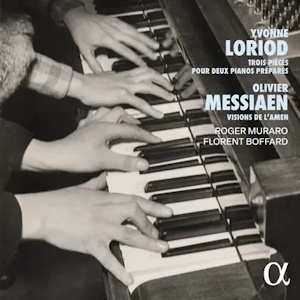
Yvonne Loriod (1924-2010)
Trois pièces pour deux pianos préparés (1951)
Olivier Messiaen (1908-1992)
Visions de l’Amen (1943)
Roger Muraro (piano); Florent Boffard (piano)
rec. December 2025, Conservatoire National Supérieur de Musique et de Danse, Paris
Reviewed from a WAV download: 44.1 kHz/16-bit
Alpha Classics ALPHA 1273 [72]
‘Toute une quincaillerie!’ In 2016 the Bibliothèque nationale de France was in the course of receiving materials from the Messiaen–Loriod archive. Curator Marie-Gabrielle Soret recalled finding at the back of a cupboard ‘small bags containing pieces of cardboard, screws, curlers, clothes-pegs… a whole hardware store!’ These items turned out not to be misplaced remnants of a domestic existence but rather essential accessories to scores by Loriod which were being transferred: materials to be used in ‘preparing pianos’ for the works which make up Trois pièces pour deux pianos préparés. Loriod had joined Messiaen’s harmony class at the Paris Conservatoire in 1941 and some ten compositions of hers survive from that decade. In 1949 she met John Cage at the Conservatoire, during the visit to Paris on which he performed his Sonatas and Interludes (1946–48) for prepared piano. This inspired the three further works which complete her compositional oeuvre, and which are recorded on this disc for the first time.
I don’t know that there is an instrument/timbre more confounding to the identification of an individual compositional voice than a prepared piano (except of course two prepared pianos), so it’s after some careful listening to Loriod and Cage that I feel confident in saying that Loriod’s prepared pieces sound nothing like Cage’s. A small part of this may be down to the fact that at the time Loriod was writing the Trois pièces, it seems Cage’s prepared-piano scores weren’t available to examine, so she had to devise her own preparation systems. But for the most part it was imagination and vision. In ‘La Murmurée’, Loriod transcribes the ‘whispering’ birdsong of the Parisian suburbs: blackbirds, an oriole and even a nightingale, anticipating Messiaen’s Réveil des oiseaux and Oiseaux exotiques. And although her immediate surroundings were urban her thoughts were more profound: ‘The Lovers are alone on Earth among the birds of their dreams’, she wrote in her programme note to the piece. And it sounds more celestial than earthly in performance: the colours which Roger Muraro and Florent Boffard, two Loriod pupils, are able to elicit in this first recording are astonishingly wide-ranging.
In ‘La Martelée’, the two pianos are assigned distinct genders and characters. The music is dramatic and uncompromising and Muraro and Boffard retain distinct lines throughout, timbres ranging from bell-like to buzzing, bone-dry chords against softer, trilling lines, until the work ends in what Loriod described as ‘extremes’: ‘primo: extreme in its sweetness, tenderness. secondo: extreme in its violence, passion, and madness’.
‘Gamelhang’ was written last of the three (and indeed was Loriod’s final composition) but is performed first here. It’s a striking invocation of the gamelan without ever trying to imitate it. There’s also a mini-narrative here, I think. The ceremonial bells and the conversational response suggest an increasingly urgent striving, the need for something to be resolved. As in the other two pieces, Loriod shows she has a unique voice which absolutely merits performance. One wonders what she might have gone on to do. It’s difficult to regret her choice of a career as a soloist, of course, given her achievements, but there’s enough here to suggest a more than plausible alternative history.
That soloistic career had already found its first major milestone when Loriod, at the age of 19, performed one of the two piano parts in Visions de l’Amen, Messiaen’s extraordinary seven-movement meditation on the words of the theologian Ernest Hello: ‘Amen, word of Genesis, which is the Apocalypse of the beginning; Amen, word of Apocalypse, which is the Genesis of consummation’. And Loriod’s central importance in the work’s creation is evident in Messiaen’s testimony: ‘I was able to allow myself the greatest eccentricities, because to [Loriod], anything is possible.’ If the choice of Visions to pair with the Loriod pieces seems obvious, then in a performance of this stature it’s no less welcome. Muraro and Boffard sound as if they have an absolutely innate understanding of this work and each other’s playing. I can’t remember ever hearing the ‘creation theme’ in the opening Amen emerge quite so organically and inexorably in the Piano II part against the shimmering of Piano I as it does here, for example. Or take ‘Amen des Anges…’ where there’s an impeccably judged conversation between Piano II’s rhythmic complexity and Piano I’s birdsong. And there is utter joy and grandeur in the last movement, the ‘Amen de la Consommation’, where musical and theological visions are as one as Muraro and Boffard’s brilliantly traverse Messiaen’s transformation of that creation theme into one of nobility, grace and unqualified joy.
Alpha has provided fine recorded sound for both works, an achievement especially notable in the Loriod pieces where Muraro and Boffard’s archaeological work with Loriod’s boxes of materials has resulted in a great many fascinating sonorities. Peter Asimov’s notes are very good on context, as one would expect from someone whose recent research has centred on Loriod’s unpublished works. The booklet doesn’t tell us who is playing which part in either the Messiaen or the Loriod. I suppose that’s a nice touch in some ways, but I would have quite liked to know. Finally, I should point out that the translation of Loriod’s notes for ‘La Murmurée’ is correct as ornithology but loses a joke: ‘mêmes oiseaux accompagnants, plus le Loriod’ is given as ‘same accompanying birds, plus the oriole’. Loriod had mischievously altered the French word ‘loriot’ to accommodate her name. I’ve no idea how that should have been conveyed in English, of course, but thought you might like to know.
Dominic Hartley
Previous review: Cristina Alejandra Estrella
Buying this recording via the link below generates revenue for MWI, which helps the site remain free













