
Frank Loesser (1910-1969)
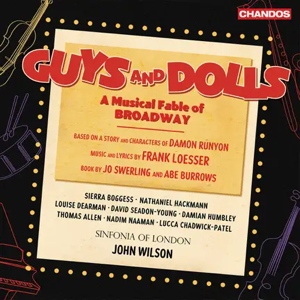
Guys and Dolls (1950)
A Musical Fable of Broadway
Based on a story and characters of Damon Runyon (1880-1946)
Music & lyrics by Frank Loesser. Book by Jo Swerling (1897-1964) and Abe Burrows (1910-1985)
Sarah Brown – Sierra Boggess; Sky Masterson – Nathaniel Hackmann; Miss Adelaide – Louise Dearman; Nathan Detroit – David Seadon Young
‘Guys and Dolls’ Ensemble
Sinfonia of London / John Wilson
rec. 2025, Susie Sainsbury Theatre, Royal Academy of Music, London, UK
Libretto included
Chandos CHSA5382(2) SACD [2 discs: 83]
For the latest in his series of Broadway musicals, John Wilson has turned to Frank Loesser’s Guys and Dolls, which, as we shall see, is a rather different proposition compared to the great Rogers and Hammersmith shows.
As is usual with this series, the booklet benefits from an extended and expert essay by David Benedict, from which I learned a great deal. I shall draw on what he has to say in this paragraph and the next two. As Benedict explains, the show was the brainchild of one of the two producers, Ernie Martin,. He pitched the idea to his fellow producer Cy Feuer after Mrs Martin read some of Damon Runyan’s short stories. Initially, they brought in Jo Swerling to write the book but Swerling’s efforts failed to hit the mark and Abe Burrows was brought on board instead. Though the book is largely Burrows’ work, Swerling managed not only to keep his name on the credits but also to secure a share of the royalties: nice work if you can get it! Initially, Frank Loesser was recruited as the lyricist, in which field he had built his reputation. However, Benedict points out that since the 1940s Loesser had been writing the music for an increasing number of his songs and so it was quite logical that in the end he also composed the score for Guys and Dolls. As Benedict explains, Loesser’s lyrics (and music) and Burrows’ book dovetailed ideally with Runyon’s original stories – Burrows used two for his book – and, crucially, with Runyan’s style of writing. Benedict also draws attention to the fact that because Loesser was responsible for both music and lyrics the show is seamless. This, I think, is where Guys and Dolls differs from a show like Oklahoma!. In all those traditional Broadway hits, when the time came for a set-piece number, the action effectively paused, whereas in Guys and Dolls the set-pieces often flow out of and back into the action. That point is not a criticism of the Rogers and Hammerstein genre; it’s just a different approach.
The show, which opened on 24 November 1950, was a huge hit. It ran for 1200 performances and, along the way, picked up a Tony Award for best musical. As is his wont, Wilson has gone back to the original sources and here he presents, for the first time in a recording, not only every note of Loesser’s score but also he uses the original orchestrations by George Bassman (1914-1997) and Ted Royal (1904-1981). I gather that the original orchestrations were lost – later productions used simplified, reduced scoring – but Larry Moore has reconstructed the original work of Bassman and Royal and I have to say the results are spectacular. Right at the very start, in the Overture, I love the sweet, vibrato-rich sound of the saxophones and that sets the tone for a terrifically vibrant, sassy orchestral sound for the next 80 minutes or so.
Runyon wrote his short stories in the 1920s and 1930s. In them, he brought to life a wide range of characters from the New York underworld. I confess that I’ve never read any of Runyon’s work but I was fascinated by a parallel which David Benedict drew in his essay with the writings of P G Wodehouse, whose stores I’ve loved for years and who himself wrote a few show lyrics (including those for that great song ‘Bill’ in Showboat). On the face of it, the two authors seem very far apart – we’re not talking of Jeeves comes to Broadway here – but Benedict says this: “Like that of the equally precise P G Wodehouse, Runyon’s zesty writing created a world and clearly delineated milieu unique unto itself, its own vocabulary peppered with invented words and terms that the reader somehow immediately understands. Wodehouse’s characters play with status, those of Runyon with the law – something which his characters hold in highly polished low regard”. When I look back at my listening notes, I’m struck by the number of times that I’ve described a number as “clever”; Loesser’s lyrics, presumably following the spirit, if not always the letter of Runyon’s original writing, are ingenious and witty.
To describe the plot of Guys and Dolls as busy would risk understatement. Characters come and go at a speed which is bewildering at times. Fortunately, Chandos print the full libretto so that you can see who’s entering stage right and leaving stage left. Also, there’s a comprehensive synopsis by David Benedict; the fact that this occupies more than four pages in the booklet speaks to the busy nature of the plot. Very sensibly, all the key track numbers are included in this synopsis. I’m not going to outline the plot in this review; it would take far too long and be self-defeating. Just buy the recording and be swept along by the action.
The recording is strongly cast, featuring several soloists who have starred in previous Wilson recordings. There is one significant newcomer. John Wilson persuaded Sir Thomas Allen to come out of retirement to take on the role of Arvide Abernathy, the grandfather of Sarah Brown. Abernathy only has one number in the show, ‘More I cannot wish you’ in Act II, scene 2. It’s true that this number is a sentimental old thing but Allen puts it across beautifully, genuinely sounding grandfatherly. I hope he won’t mind me saying that he was 80 when these sessions took place. I mention it only in order to emphasise that he’s still got it. It’s a delight to hear him and the invitation to take part was a masterstroke by Wilson. I scribbled down in my notes that I bet the number has never been delivered better in any production or recording.
The other cast members are all seasoned music theatre artists, and rightly so. Nathaniel Hackmann is ideally cast as Sky Masterson. He leads a terrific rendition of ‘Luck be a lady tonight’ and his duet with Sierra Boggess (Sarah Brown) in ‘I’ve never been in love before‘ is marvellous. For my money, that’s the best number in the show – the tune is memorable – and these two artists do it full justice. Much earlier in the show, they also share ‘I’ll know’ in which they also combine to great effect. Just a few minutes before ‘I’ve never been in love before’ Hackmann has Sky’s solo number ‘My time of day’. I’m not sure this is quite in the same class as a song but Hackmann’s account of it makes you feel that it is.
Sierra Boggess is equally well cast as Sarah Brown. I referred earlier to the sheer cleverness of Loesser’s lyrics. ‘If I were a bell’ is a choice example. Bogges puts it across really well. At this point in the action, Sarah is decidedly tipsy after indulging in rather too many cocktails. I think Boggess gets this just right; she doesn’t overdo the tipsiness but we certainly know that Sarah is under the influence.
I started off with slightly mixed feelings about Louise Dearman as Miss Adelaide. ‘A Bushel and a Peck’, which Adelaide sings with the chorus of Dolls, is wittily done but I’m not wholly convinced by the childish ‘doll voices’. I realise this is probably how it’s supposed to sound but, as a matter of personal taste, I found the effect overdone; maybe this is a number which works better on stage than in a studio recording. That said, I soon warmed to Dearman’s characterisation. ‘Adelaide’s Lament’, which follows almost immediately in Act I, scene 4, is another example of Loesser’s very clever marriage of lyrics and music. This is a most amusing number and Dearman’s vocal acting is excellent. Happily, we get a second bite at this particular cherry when the number is reprised, in a shortened form, in Act II. Adelaide also leads one of the show’s cleverest numbers’ Take back your mink’ in Act II. Once again, she’s joined by the chorus of Dolls and here the gals get it just right. It’s a hugely entertaining rendition of the song and the pay-off, ‘Well? Wouldn’t you?’ literally made me laugh out loud the first time I heard it.
Adelaide’s “love interest” is Nathan Detroit, a part very well taken by David Seadon Young. His musical highlight is the duet ‘Sue me’ with Adelaide. This comes off very well. As Nicely-Nicely Johnson, Damian Humbley gets to lead one of the palpable hits from the show, ‘Sit down, you’re rockin’ the boat’. This ensemble performance really fizzes; I bet it would have brought the house down in a theatre.
That number is just one – of many – in which the Sinfonia of London really delivers the goods. The verve and sheer pizzazz with which the players deliver the music is a major factor in the success of this enterprise. They set everything up with a bright and breezy rendition of the Overture, followed by the vibrantly colourful depiction of Runyonland as a wealth of characters pass across the stage, some never to feature again. The orchestra also more than plays its part in the ‘Fugue for Tinhorns’ which follows. I’ve referenced the cleverness of Loesser’s lyrics more than one. This Fugue is a terrific example of his musical ingenuity as three characters, crisply supported by the orchestra, strut their stuff together. The umber reminds me of ‘Cool’ in West Side Story; both are examples of music theatre numbers in which the compositional technique is highly sophisticated but the audience is largely unaware of the technical skill. The orchestra has an especially important role in scene 8 of Act I, ‘Havana, Cuba – a Dive’ Essentially, this is an extended orchestral number, lasting nine minutes; Sarah and Sky contribute just a few lines of dialogue. I’m sure that this is a number that works even better on stage, where you can see the action. However, the Sinfonia of London’s vibrant playing make it very easy for us to imagine the scene.
John Wilson knits all these performances together with his customary skill and verve. I mean no disrespect to his recordings of classical repertoire with the Sinfonia of London, many of which I’ve heard and enjoyed, but I think these Broadway show recordings display him at his very best. He shows great flair in directing these scores and I also admire very much the lengths to which he goes to ensure that we hear what the composers wanted us to hear in the first place.
Chandos continue to do Wilson’s Broadway recordings proud. The recorded sound created by producer/engineer Jonathan Allen, is ideal for this repertoire; it’s punchy and up front, but not in an aggressive way. The documentation is comprehensive.
These Guys and Dolls provide great entertainment.
John Quinn
Other cast
Nicely-Nicely Johnson – Damian Humbley; Benny Southstreet – Nadim Naaman; Rusty Charlie – Lucca Chadwick-Patel; Arvide Abernathy – Sir Thomas Allen
Buying this recording via the link below generates revenue for MWI, which helps the site remain free













