
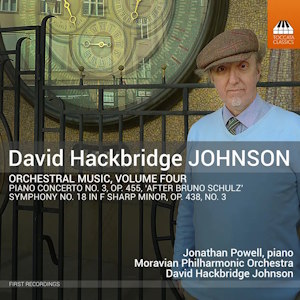
David Hackbridge Johnson (b. 1963)
Orchestral Music Volume 4
Piano Concerto No. 3, ‘After Bruno Schulz’, Op. 455 (2025)
Symphony No. 18 in F sharp minor, Op. 438/3 (2025)
Jonathan Powell (piano)
Moravian Philharmonic Orchestra/David Hackbridge Johnson
rec. 2025, Reduta Hall, Olomouc, Czech Republic
Toccata Classics TOCC0803 [69]
The home page on the Toccata Classics website carries the heading ‘Forgotten Music By Great Composers, Great Music By Forgotten Composers’. It is a good summary of this remarkable label, but only up to a point. ‘Forgotten’ composers do feature widely, but for others, such as David Hackbridge Johnson, ‘neglected’ would be a better word. The Toccata Music Group is made up of two record labels and a book publisher. The principal mission of all three is to bring before the public music which, for one reason or another, we would probably have missed. It is a salutary experience to peruse the list of composers in the Toccata catalogue and find that more than half of them are unfamiliar. The driving force behind all this is Martin Anderson. You have to search the website carefully to find him, but when you do you learn that in addition to running Toccata he writes ‘a bit about music in various publications in Britain and abroad.’ One of those publications is MusicWeb International, though he seems not to have contributed for quite some time. One of the most important series to be found in the catalogue is Music For My Love. Anderson invited composers to write a short work in memory of Yodit Tekle, his life partner, who died in 2015 at the age of 37. Composers responded positively, enough to fill three volumes, the third of which I reviewed in 2020.
Nestling among the enormous number of recordings of little-known composers can be found four volumes of music by David Hackbridge Johnson. He was born in 1963 – a slip of a kid, then – and the opus numbers above attest to his extraordinary productivity. We read in the booklet that when he learned of the possibility of making this record he was ‘faced with the question: what music do I have ready? Answer: none.’ Among more than 400 earlier works was there nothing that was both suitable and available? Apparently not. Johnson looked for Olomouc on the map and found that it was not too distant from the Polish border; and since his friend, the pianist Jonathan Powell, lived in Poland the answer was clear: Johnson must write a piano concerto for him. ‘Suddenly,’ he writes, ‘I had all the music I needed in my head.’
The concerto is subtitled ‘After Bruno Schulz’, a Polish artist and writer who, in 1942, was murdered by a Nazi officer in particularly sordid circumstances. Wikipedia has an article about Schulz that is well worth consulting if, like me, readers have never heard of him. The work is in three movements, with a duration of a little over half an hour. Johnson provides a step by step guide which I found very helpful when listening to the work for the first time. The musical language is advanced, and though the composer makes references to key centres tonality is an elusive element. That said, the music is approachable and makes its effect immediately. Much of it is violent but there are, nonetheless, many moments of quite radiant beauty. The soloist is rarely silent, and listening without a score one senses that the part is taxing, that the piano is very much the leader of the ensemble, and that there is no feeling at all of conflict between the piano and the orchestra. The short middle movement, entitled ‘Waltz-Phantom’ was a late addition to provide lightness and contrast to the two weighty outer movements. It is for most of its length a real waltz: Johnson refers to it as ‘a fairy-tale of shadowy dancers’ that evokes ‘the world of the salon and that of folksong’. It is delightful, though not without a lingering foreboding that is the essence of the work as a whole. There is a fair amount of martial music, quite mechanical in nature, but with many lighter moments. A passage in the finale evokes the Klezmer strain of Jewish folk music, a particular enthusiasm of the composer. Though the work is in no way a ‘biography’ of Schulz, the music nonetheless has a narrative feel to it, and Johnson allows us to imagine that the dramatic close might represent the event that ended Schulz’s life.
Johnson, unlike so many creative artists, is very lucid when writing about his own work. He is adept at finding unusual and engaging metaphors. A moment in the piano concerto, for instance, sounds ‘as if a page were being torn out of the score’; a theme ‘appears in full battle-dress’; and a moment in the symphony is ‘as if a hand were passing over the light and shade cast by a Venetian blind.’ Introducing his Symphony No. 18 Johnson explains that any inspiration or influences ‘would be more visual than musical’. He then launches into a short dissertation of how aspects of painting, such as light and colour, can find their home in a piece of music. I am usually rather allergic to this kind of thing, and in spite of his literary skills, I am happy to leave others to perceive how these influences might have ‘bled into the symphony’. The opening of the work, a melody given to the violins alone who are then interrupted by harsh brassy harmonies, is truly striking, and the remainder of the movement is equally compelling. The second movement is a kind of scherzo and trio, with the orchestra reduced to strings plus piano, harp and timpani. The trio section is a lovely long-breathed melody. The third movement, which Johnson refers to as a moto perpetuo, exploits the interval known as the tritone, in particular in a fugal passage. He evokes Vaughan Williams and Bax in referring to the finale as an epilogue. And in his note he has established a strong connection with his favoured painters and ‘departed loved ones [who] are sewn into the fabric of this symphony.’ This finale is highly complex, yet easy to follow, with many references to the melody that opened the work. Pivotal moments are characterised by particular instruments or instrumental combinations, and there are rather more references to tonality than in the earlier movements. The highly effective ending ‘sends the symphony into a dark space of memorial rather than a peace the certainty of which is in doubt.’ If I find the trajectory of the symphony marginally less convincing than that of the concerto, I feel sure any such feelings will dissipate as I get to know the work better.
The two works are conducted by the composer, leading us to presume a certain authenticity. The orchestral playing is good, the recorded sound also, though the strings seem underpowered compared to the rest of the ensemble. The booklet is excellent and, as I have indicated, mostly written by the composer. It includes a touching tribute to Jonathan Powell, who died suddenly in December 2025 and whose final recording this was.
William Hedley
Buying this recording via the link below generates revenue for MWI, which helps the site remain free













