
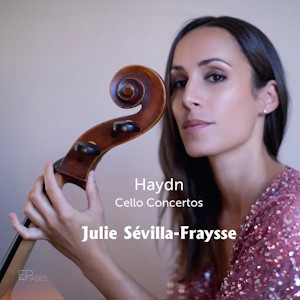
Joseph Haydn (1732-1809)
Cello Concerto in C Major Hob.VIIb/1 (early 1760s)
Cello Concerto in D Major Hob.VIIb/2 (ca 1783)
Julie Sévilla-Fraysse (cello)
Paris Virtuosi Orchestra/Éric Zorgniotti
rec. 2019, la Seine Musicale, Paris
En Phases ENP025 [47]
Julie Sévilla-Fraysse is a French cellist, teaching at a Parisian music school, and this would seem to be her first recording. You may have noted that it was made seven years ago; there is no indication why it has taken so long to be released. On her website, it states that one of her plans for 2027 is to make another recording of the Haydn concertos, this time with the French Republican Guard Orchestra. The Haydn concertos are staples of the repertoire; Presto lists well over 150 of each. To enter such a crowded field is obviously a challenge, let alone plan to do it twice.
In this recording, Sévilla-Fraysse has chosen to adopt a strict HIP approach; I somehow doubt that the same will apply to the Republican Guard version. The Paris Virtuosi is not a fixed ensemble, but rather takes players as required from the major Paris orchestras and elsewhere. They frequently perform chamber recitals in various historic Paris churches, and it is possible that I attended a performance of theirs last September. In its configuration for this recording, there are only thirteen strings, more or less the same size as the orchestra that Haydn would have had when he first began to work for Prince Nikolaus Esterházy in the early 1760s, which is when the C Major concerto was written.
From the opening notes, it is very clear that this is as austere as Haydn gets: no vibrato (is it possible to have negative vibrato?), lean textures, quickish tempos and restricted dynamics. You are certainly not going to mistake this for du Pré/Barenboim. Yet, it does work. Sévilla-Fraysse shapes her solo part with elegance, and the effect is that of chamber music. The approach suits the Adagio very well, and the closing Allegro molto is as exciting as it should be.
My favourite recording of the C Major is by Asier Polo on IBS Classical where the Orquesta Barroca de Sevilla had just one more string player than this Paris recording (review). It is actually faster than Sévilla-Fraysse’s, and is more dynamic and warmer. It’s also not Sévilla-Fraysse’s fault that her cello doesn’t sound as good as Polo’s magnificent Ruggieri. Polo, and another favourite of mine, that by Christian-Pierre La Marca with Le Concert De La Loge, use a harpsichord, which provides an extra dimension that really adds to the music; Sévilla-Fraysse does not, but she is certainly not alone in this.
By the time that the D Major was written, two decades later, Haydn would have had access to a significantly larger orchestra, but the Paris Virtuosi do lean more into their work, and sound larger. I did have some issues with the introduction, in that there seemed to be a conscious effort to deny the beauty of Haydn’s melody; no lingering on the notes, no softening of phrases. However, once the cello enters, this coldness begins to thaw. Again the Adagio is quite lovely – Sévilla-Fraysse is quite superb – but the finale could have been a little more playful.
Normally the pair of Haydn concertos will have a discmate, given their brevity, so it is a little disappointing that this is not so here. However, in her booklet notes, Sévilla-Fraysse explains that both concertos were recorded in a single day, so there would not have been time for anything to be added. Such a tight timeframe can give the sense of a live recording, as there would not have been time for lots of retakes. It also means that errors or misjudgements, such as that of the opening to the D Major, remain.
The booklet notes don’t tell us anything we didn’t already know about the concertos – hardly surprising – and Sévilla-Fraysse talks about their light, vitality and energy but also their melancholy. The English version also describes them oddly as “solar” (solaire in the original French), so I suspect this might be an AI mistranslation, which should have been “sunny”. The sound quality is not the best, rather dry, and the close miking picks up more than a few extraneous sounds.
There is no doubt that these performances will divide opinion, they are so pared back. I enjoyed them up to a point, and will certainly be keeping them, but I did feel that a little less austerity would have made quite a difference.
David Barker
Buying this recording via the link below generates revenue for MWI, which helps the site remain free













