
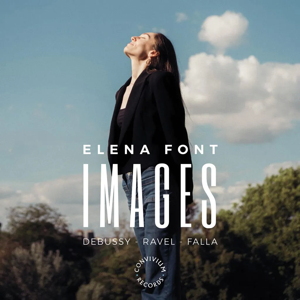
Images
Claude Debussy (1862-1918)
Images 1 and 2
Manuel de Falla (1876-1946)
El Amor Brujo
Maurice Ravel (1875-1937)
Le Tombeau de Couperin
Pavane pour une infante défunte
Elena Font (piano)
rec. 2026, L’église luthérienne Saint Pierre, Paris, France
Convivium Records CR132 [76]
Elena Font, born in 2000, is a Spanish pianist who has been praised for her elegance, clarity and refined sonority. Although Images is her first solo CD, she has performed widely across Europe, Asia and North and South America, with a special emphasis on her French heritage. Her studies took place both at the Escola Superior de Música de Catalunya (ESMUC), and later at the Ecole Normale de Musique in Paris with Denis Pascal. Her closest collaboration has been with her mentor, pianist Pascal Rogé, with whom she both regularly both performs and teaches internationally. She has also recorded a two-piano album of Poulenc’s music with him, as well as appearing as a guest on Decca Classics album of Gabriel Fauré.
Rather unusually, my immediate impressions on hearing this new album for the first time were that I was fairly certain where her strengths did and didn’t lie. On a second listening, this was confirmed, with the proviso that I might have been a little harsh about her Debussy playing, but that she certainly had the makings of a fine Ravel pianist. Having said that, she really comes alive with the de Falla piece, as if that music were really in her blood.
Images Book 1 doesn’t make a good start with Reflets dans l’eau. Reflections in the water! Am I just playing this too loud? It hardly starts delicately and only appears to be so in places, toward the end in particular, where you get the sense of some kind of magic. Otherwise, I found this a little heavy handed. Hommage à Rameau has a much more thoughtful and delicate beginning, lovely and wistful, as if drifting away to something, looking at it and then returning, much more fluid with effective ripples. There’s a point towards the end of the piece where it builds and drops to a beautiful quiet before resuming the flow. Font’s crescendos here are very telling and powerful, with her return to the main theme performed very subtly and beautifully. Hearing the subtlety in Mouvement makes me wonder where this pianist was at the beginning. Now there is a real lightness and delicacy, as if her hands are almost trailing the keyboard, rather than just playing.
The individual resonances of the different bells in Cloches à travers les feuilles are clear enough, but at times the playing is maybe a little hard. There is no doubt that Elena Font can build a mean climax, but at times she misses or over-emphasises the more delicate movements, (not that there are too many in this).
The eerie moon-world of Et la lune descend sur le temple qui fût is nicely evoked with the continuous runs overplaying each other. She can get a great deal out of the placement of a single note and the ripples which extend from it. The slowing into the minor second subject is beautifully judged, but again there can be a sameness about the dynamics. It can all occasionally be a little showy and lacking in delicacy, but not for long. In this, perhaps the most atonal of the images, the playing has the necessary, dreamlike and slightly ‘off’ quality, and the individual chord placement is beautifully executed and yes, judged with subtlety.
The world of Poissons d’or is far more upbeat and less mysterious, but it’s important to capture the nebulous and fleeting one minute, and the sudden darts the next. Font does this beautifully and captures the crescendo to the second theme powerfully; flashes of both fish and light are evoked.
It is probably not too surprising to find a Spanish pianist clearly more at home in de Falla than Debussy, but for me it is a pretty seismic change. In El Amor Brujo she displays all the limpid and languid qualities I missed in her first set of Images. Pantomima feels as if she is coming home, and the Romance des Pescador possesses all the sad and wistful qualities you would want. Maybe the ritual fire dance doesn’t quite have all the attack you might like, but it nevertheless a convincingly solid performance, which only reminds me of what a unique and powerful piece it can be in the right hands. It has a fine, crashing ending, too, and is, without doubt, the highlight of the disc.
The prelude of the Le Tombeau de Couperin seems to me to lack of both spring and spontaneity, and even at times a lack of care. In contrast, the fugue begins beautifully, capturing a wistful sadness that you don’t always feel with other renditions. It’s a simple piece, which doesn’t need over-emphasis or individuality, and Elena Font stays well the right side of this. Even though I have been wont to describe certain performances of forlane, the third movement, as ‘like a bear getting up’, we are pretty safe on the bear front here, with the rhythms played more jerkily and sprightlier than lumbering, meaning that it does at times lack a bit of character and sounds a little too ironed out in certain places. For all that, I enjoy the lightness of the playing, and it contrasts beautifully with the fugue that precedes it. It certainly sounds like the dance it is supposed to be, even if she occasionally finds herself with a bear as a dance partner.
The riguadon again illustrates one of my slight qualms about Font’s playing. She clearly possesses the technical skills to play this music, but the individuality such pieces need is sometimes lacking. Bearing in mind that this is a debut recital, I look forward to hearing something from her which is not quite so reigned in, although obviously the repertoire precludes some of this. The menuet has some of the most beautiful and controlled playing in the set and I get a sense of how beautiful and balanced the metronome in her head must be. The occasional ripple just before the second subject shows again just how beautiful her placement can be, with a rich and full half crescendo and diminuendo. Some of the finest placement on the whole disc is shown again with a perfect dying away in the last few bars. The final toccata is nicely choppy and rippling in equal measure with fine control of each. This final part of the suite is intended to show off the fleetness and further technical skills of the pianists and Font’s grasp of the two contrasting rhythms and the overall dynamic show this well. Her sudden stop before the final crescendo and climax is also nicely judged, building to a bold and bright conclusion.
Part of the problem with Pavane pour une infante défunte, one of Ravel’s most well-known pieces, is that it immediately evokes such a world of sadness, that it is difficult for a pianist to know where to go with it. Surely it is impossible not to think about the subject of the title, once you know it, so one of the big decisions is at what speed it should be played.
Elena Font plays it at the perfect speed for me, and, but it’s just a question whether the playing is at times too loud. It is a fine performance nevertheless, with just the right amount of pulling back of the melody without the music’s almost unbearable sadness being overdone.
Two questions immediately spring to mind when you’ve just heard an artist’s debut solo performance: the first is surely what her second and third releases will sound like, or even ten years down the line, the second is whether she is worthy of a debut in the first place. Once we are past the slight clunkiness and lack of finesse which I find in places in her first set of Images, there is a great deal to admire and encourage, especially in the de Falla.
Steven John Wray Gladwin
Availability: Convivium Records













