
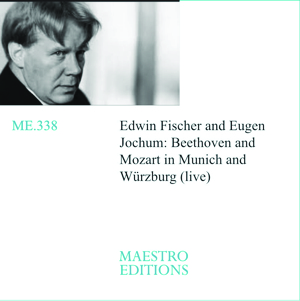
Ludwig van Beethoven (1770-1827)
Piano Concerto No.4 in G major, Op.58 (1806)
Wolfgang Amadeus Mozart (1756-1791)
Piano Concerto No.20 in D minor, KV 466 (1785)
Rondo for Piano and Orchestra in D major, KV 382 (1782)
Edwin Fischer (piano), Bavarian Radio Symphony Orchestra / Eugen Jochum
rec. 8 November 1951, Aula der Universität, Munich, Germany (Beethoven): 10 December 1954, Herkulessaal, Munich, Germany (Mozart Concerto); 26 June 1954, Kaisersaal, Würzburg, Germany (Mozart Rondo)
Maestro Editions ME338 [73]
Edwin Fischer’s musical collaborations with Wilhelm Furtwängler were amongst the most fruitful and enriching of experiences but Eugen Jochum, cut from something of the older conductor’s cloth, proved a thoroughly satisfying and mutually collegiate partner on those occasions when they made music together.
The first time, as Roger Smithson’s precisely pointed notes make clear, came in an unreleased recording session in Berlin in 1932 when they attempted Mozart’s Piano Concerto No.20 in D minor (review). This was one of the works that Fischer liked to direct from the keyboard and there is an example on Maestro Editions of him doing just that, though it’s preserved in only so-so sound. He left behind two commercial recordings of the concerto, one on 78s and the other on LP. With Jochum he proves an eloquent, dramatic performer, dispatching the first movement cadenza with flair and ensuring that the central movement is a Romanze, as marked, and not an Andante. His subtle rubati in the finale will be enjoyed by all who admire his committed, humane and occasionally fallible art.
Maestro Editions has also released a self-directed, live performance with the Vienna Philharmonic of Beethoven’s Fourth Piano Concerto in August 1949 (review), which Fischer famously recorded with the Philharmonia in 1954. Jochum sculpts the opening orchestral introduction with magisterial control – powerful and subtle – and the hall acoustic proves attractively open, not cramped. There is a slight brightness to the string tone but it doesn’t become serious, and the double basses are exceptionally sonorous – a real bass-up German sonority. Fischer plays his own ebullient, decidedly personal cadenza with real spirit. The central movement is significantly slower than the self-directed Philharmonia version and gains thereby in gravity. I’d be very surprised if they went straight into the finale, as here. One of my few complaints about this release is that the gaps between all the tracks are too brief. In the final Fischer plays d’Albert’s rather more appropriate cadenza and fills in adeptly for a horn miscounting, as Smithson reminds us.
Mozart’s Rondo in D major is the last of these Bavarian Radio performances and offers an agreeable, discursive and witty nine minutes of Fischer and Jochum. It ends a fine reclamation of their collaborations, all of which have been released before but probably never in such good sound as this.
Jonathan Woolf
Availability: Maestro Editions













