
Johann Sebastian Bach (1685-1750)
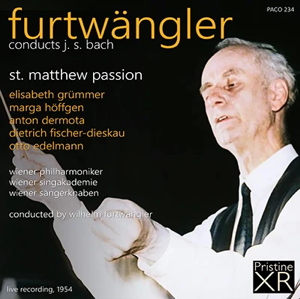
St. Matthew Passion, BWV 244
Elisabeth Grümmer (soprano); Marga Höffgen (contralto); Anton Dermota (tenor) – Evangelist; Dietrich Fischer-Dieskau (baritone) – Jesus; Otto Edelmann (bass) – arias, Peter, Pilate, Judas
Wiener Singakademie, Wiener Sängerknaben
Wiener Philharmoniker / Wilhelm Furtwängler
rec. live, 14-17 April 1954; Großer Konzerthaussaal, Vienna, Austria
Pristine Audio PACO 234 [3 CDs: 167]
Things have moved on tremendously in this repertoire since 1954, and this performance of Bach’s masterpiece will be considered beyond the pale by many music lovers today – indeed, Rob Cowan in July 2026’s Gramophone magazine felt exactly that, opining that “My ears hear a performance that is outside of the music’s zone”, and is only for “Furtwängler completists and dedicatees (though I appreciate that others may well feel differently)”. I almost always agree with Cowan’s opinions, but here I am one of those who “feels differently.” His main complaint concerns the very slow tempi (though he does mention that the opening chorus is considerably faster than both Mengelberg and Klemperer), and here, I think, is the nub of our disagreement. It is a matter of the changing Zeitgeist concerning the different ways in which we approach the sacred when compared to previous generations.
Before modern times, an approach of reverence, which usually meant slow tempi and a restrained approach, was standard for religious works, and in this country the work which exemplified this more than any other was Handel’s Messiah. The Victorian approach was that a performance of this work was only one step away from a religious service. Listening to any recording of an excerpt from Messiah made in the first quarter of the 20th century will show this clearly. Only with Beecham in the mid-1920s was a move made towards the present-day approach, and this was not universally adopted until well after the Second World War.
Today the emotional and intellectual approach to a performance of a religious work is, for the vast majority of the audience, no different from that to a symphony or serious opera. But I am very strongly in agreement with Richard Taruskin that we must absolutely not descend to what he terms “historical arrogance”, a comment he makes in the context of listening to early recordings. Unfortunately, I cannot lay my hands on the article, so I will have to summarise from memory, but his gist is that modern listeners, when listening to performances from the past, will often hear things which are different, sometimes radically so, from what is done in their own present time. They then automatically make the assumption that what the old performance did was wrong and that the stylistic decisions made in their contemporary performance are right. Who could disagree with Taruskin here? It really shouldn’t take more than thirty seconds of intelligent thought to be able to see how absurd the “arrogant” idea is – but very many people seem to be incapable of taking that thirty seconds’ intelligent thought. Without it, they are implicitly saying that the great musicians of the past were essentially simple-minded children who didn’t really know what they were doing, and only now do we know how things should be done. It never occurs to them, of course, that in a hundred years from now, similarly historically-arrogant people will hold those very performances which they admire so much in exactly the same disdain. After long years of listening and thinking, I have come to the absolute conclusion that in terms of performance style there is no such thing as progress; there are merely changes in fashion. No-one but a fool would say that Beethoven was better than Bach because music had developed to a more advanced state with the later composer – art is not like, say, medicine, where modern treatments are almost always simply better than those of a hundred years ago. The standard performance practice of any era is that which speaks most directly to its contemporary audiences; it is the style which excites and moves them, and is therefore (as Taruskin again says) the only truly “authentic” performance for that era.
Furtwängler’s approach is very clearly based in a 19th century approach to spirituality and was already becoming old fashioned in 1954. Although, as has been mentioned, the opening chorus is unexpectedly fast, all other tempi are markedly slower than would be expected today. To my ears, most of them work very well at these tempi, though the more dramatic choruses (particularly “Laß ihn kreuzigen”) are without the essential drama. The chorales are often taken in a highly reverential way that is far from modern expectations, but to me seems a perfectly reasonable approach – they are largely reflective in character, and Furtwängler understood that their function was fundamentally different in the context of a modern performance. Here, the chorales are not performed by the congregation, but are performed for the audience, so a sense of “performance” which was entirely irrelevant in Bach’s original context is essential. The solo arias can, however, not always avoid the charge of lugubriousness.
The singers in this performance are, with one minor and one major exception, excellent. Anton Dermota’s Evangelist is marvellous. He has true beauty of tone with a ringing top and a metal at the tonal centre when this is needed. His characterisation is varied and completely alive to the meaning of the text. He tends more to the reflective side than the overtly dramatic, but this all of a piece with the conductor’s approach. In the moments of emotion he can be deeply affecting, as in “Aber Jesus schweig stille” (But Jesus was silent) (disc 2 tr. 3). A particularly fine example of his range is shown in the short recitative beginning “Da hub er an” (disc 2 tr. 8) where he conveys Peter’s vehemence “verfluchen und schwören” (cursing and swearing) but within seconds is heartbreaking when he recounts that Peter “ging hinaus und weinete bitterlich” (went out and wept bitterly). His performances of the tenor arias are also excellent. Both the recitative and aria “Ich will bei meinem Jesu wachen” (disc 1 tr. 23 & 24) are exemplary. Elisabeth Grümmer is similarly fine. Her pure, silvery tone with its slight, narrow vibrato is ideal for this music, arguably more so than many of today’s baroque specialists. Her performance of “Blute nur” (disc 1 tr. 12) is beautifully vocalised, and her characterisation, with its hint of steel in the middle section concerning Christ’s betrayal, is very convincing, but this is one of the examples of Furtwängler’s tempi being too slow for anyone’s good. Marga Höffgen probably has the lion’s share of the solo work and is outstanding. “Buß und Reu” (disc 1 tr. 10) is a rather too stately, but is very well articulated, and “Ach nun ist mein Jesus hin” (disc 2 tr.1) is exquisitely shaded. But the gem is one of the greatest arias in the work, “Erbarme dich”. This is a glorious performance with a marvellous sense of momentum and wonderful dynamic variety, abetted by the superb violin obligato of Willi Boskovsky.
The male soloists are not able to match the quality of the female. Fischer-Dieskau has never been a favourite singer of mine (though I found him utterly compelling in the four or five live recitals I attended), and I have never been able to understand the claims made for his having a beautiful voice. His tone is grey and lacking depth in this performance, and his characterisation of Christ is surprisingly anonymous and unengaged. However, bottom of the pile is Otto Edelmann. German-school basses from at least the turn of the 20th century (when records allow us to begin to hear them) to the mid-1950s are almost all of Edelmann’s ilk. They are regularly lugubrious and flat-footed, often with a minimal vibrato which emphasises their approximate sense of tuning. Their style is also effortful with a lot of upward portamento which always reminds me of a fat man trying to haul himself out of a deep hole. Edelmann has many of these characteristics and his performance is distinctly ungainly. He does show some sensitivity at times and sings with an effective sense of “Innigkeit” in “Komm, sußes Kreuz” (disc 3 tr. 3) but it is rather a relief that “Gerne will ich”, “Gebt mir meinen Jesum” and “Mache dich” are cut.
The chorus is, of course, unimpressive by modern standards. The choral sound and technique of today’s semi-professional choirs have transformed our expectations over the last sixty years, and the Wiener Singakademie sound very sub fusc to our ears. The Wiener Philharmoniker, however, is a different matter. Their playing is superb in all departments, and all the obligato instruments play with great characterisation and beautiful sound.
The performance had been given three times, broadcast by the Rot-Weiß-Rot radio network, and also recorded by EMI. However, the planned release of this recording on disc never materialised. Furtwängler himself was reportedly unhappy with certain choral passages, and performance style was also already in the process of change, so the projected issue did not come to pass until it was issued by EMI in 1995 (though poor-quality recordings of the radio broadcast had been issued on “pirate” labels). An important piece of information to impart to those who might have that original EMI issue is that it was cut in order to be issued on two CDs. This Pristine issue reinstates those cuts, so there are approximately seven more minutes of music than on the EMI set. The sound quality is also noticeably better on Pristine. There is a remarkable depth and clarity, and the solo voices especially leap from the speakers with tremendous presence. The chorus numbers are the least successful, and can be rather congested with a fuzzy edge to the sound, but even this is comparatively slight and does not seriously impede enjoyment.
To use what has recently become something of a cliché, this is a Marmite performance – it will send the hip HIP adherents running screaming to the hills. But, at the very least, it is a fascinating historical document, and, if you approach it on its own terms, you may well find yourself being surprisingly moved by it.
Paul Steinson
Availability: Pristine Classical













